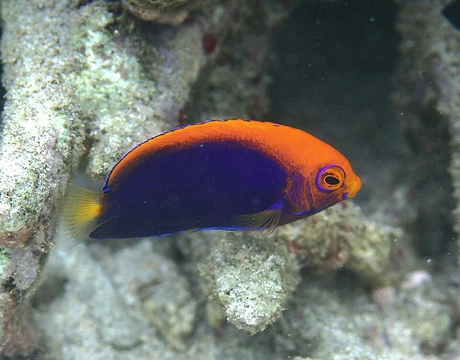
Orangeback angelfish (Centropyge acanthops)
Source-cited species reference: taxonomy from WoRMS, biology from FishBase, occurrence map from GBIF, conservation from IUCN Red List, description from Wikipedia.

Philippe Bourjon · CC BY-SA 3.0
The orangeback angelfish (Centropyge acanthops), also known as the flameback angelfish, African pygmy angelfish and in South Africa as the Jumping Bean or Bean, is a species of ray-finned fish, a marine angelfish belonging to the family Pomacanthidae. It is found in the western Indian Ocean.
- Scientific name
- Centropyge acanthops
- Authority
- (Norman, 1922)
- Family
- Pomacanthidae
- Order
- Acanthuriformes
- Maximum length
- 8 cm
- Depth range
- 6–40 m
- Habitat zone
- reef-associated
- Iucn red list
- Least Concern
- Gbif occurrence records
- 156
Physical Appearance & Taxonomic Identity
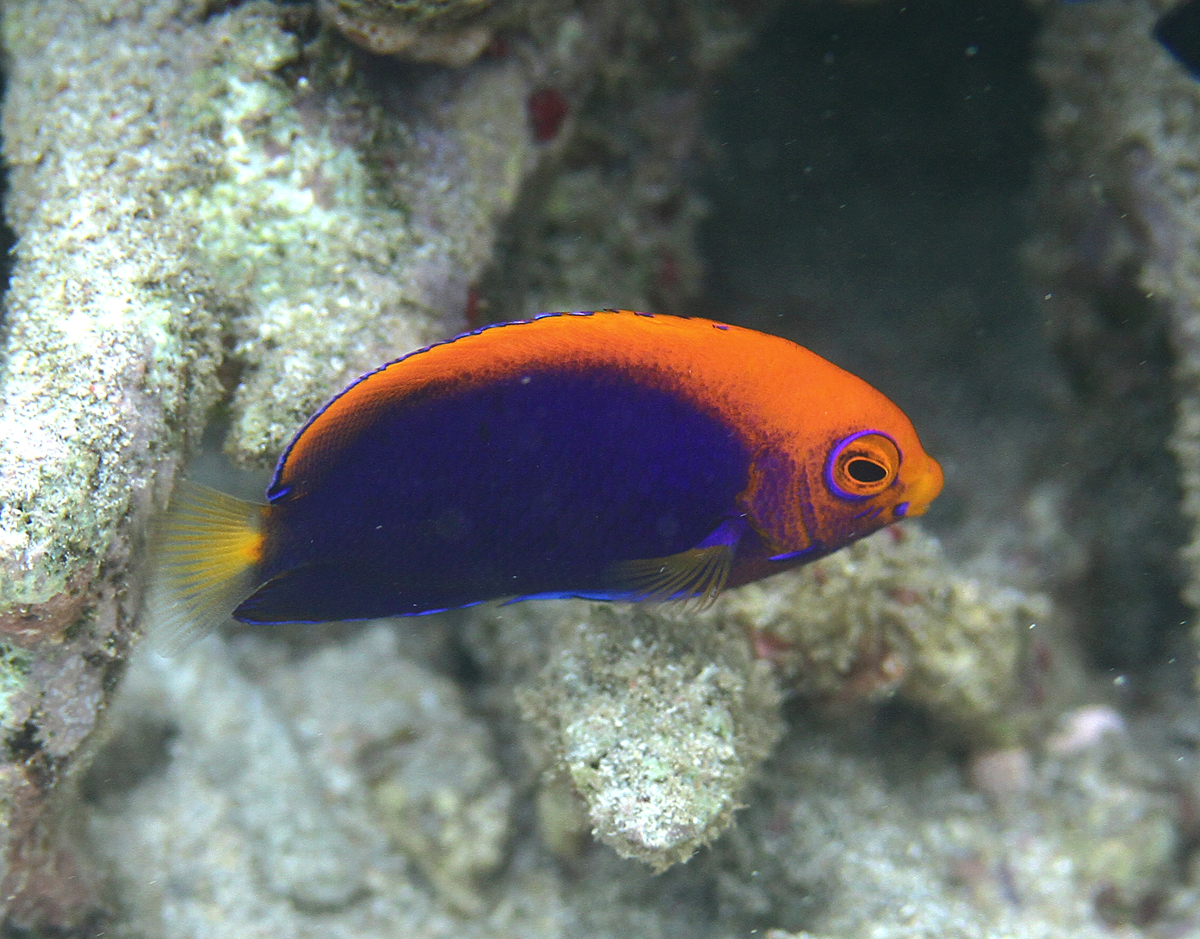
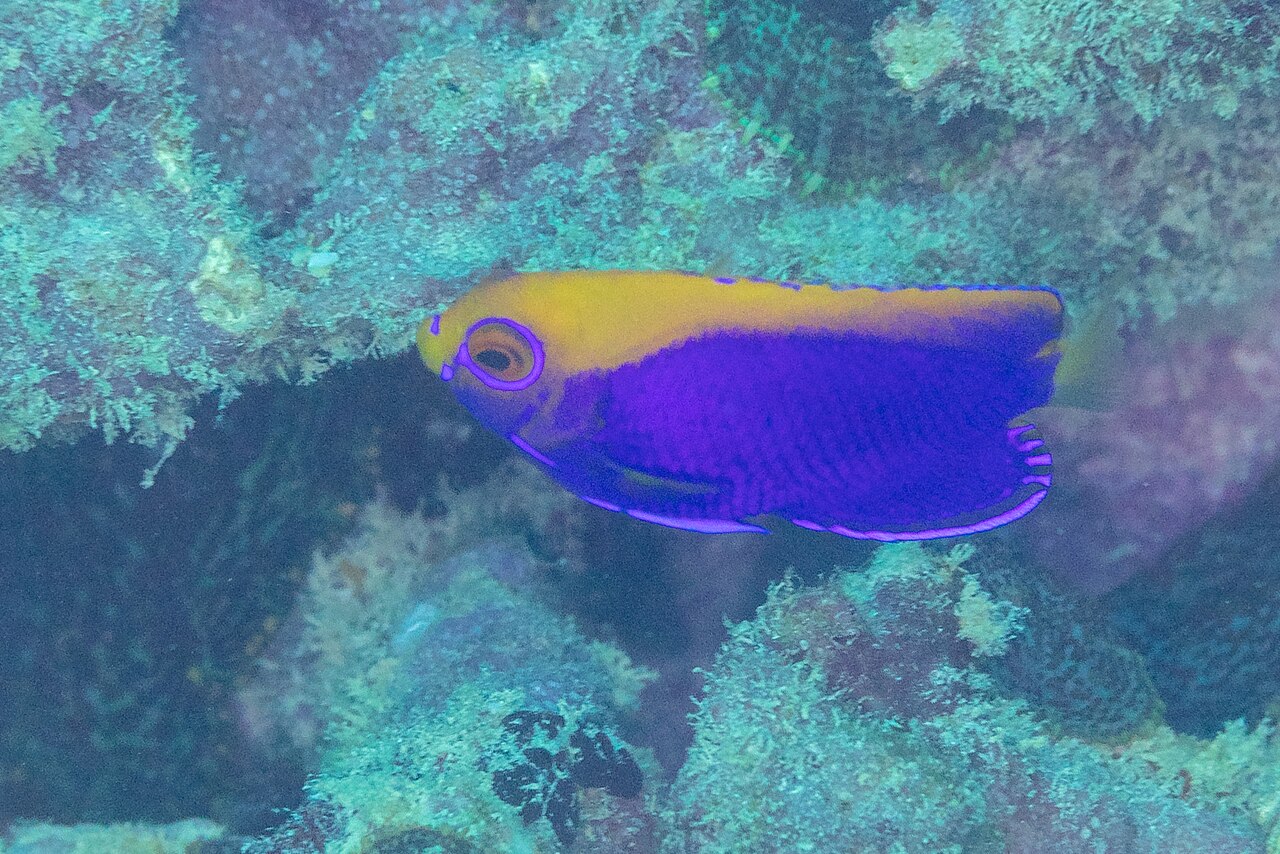
The orangeback angelfish is a small marine ray-finned fish within the family Pomacanthidae, reaching a maximum total length of just eight centimetres. Its coloration is striking and immediately recognizable: the head, upper flanks, dorsal fin, and caudal fin all glow in a rich golden yellow, while the lower flanks and anal fin are a deep black densely peppered with purple spots. A vivid blue ring encircles each eye, adding a final touch of contrast. In South African waters, locals have given it the playful nickname Jumping Bean or simply Bean, while other common names include flameback angelfish and African pygmy angelfish. The species was first formally described in 1922 by English ichthyologist John Roxborough Norman, who named it Holacanthus acanthops with Durban as the type locality. The specific epithet acanthops is a Greek compound—acanthus meaning spine and ops meaning eye—pointing to a small rearward-directed spine situated beneath the eye. In certain taxonomic schemes, the species is assigned to the subgenus Xiphipops within Centropyge.
Geographic Range & Habitat
The orangeback angelfish is a resident of the western Indian Ocean, with a range that stretches across a remarkable breadth of coastal and island waters. Along the East African mainland, it occurs from Somalia in the north all the way south to East London in South Africa's Eastern Cape Province. Its distribution also encompasses Madagascar, the Seychelles, the Comoros, the Chagos Islands, and the Mascarene Islands. Further afield, records exist from the Gulf of Aden, the Arabian Sea off Yemen including the island of Socotra, Oman, the Maldives, and even the Australian-administered Cocos (Keeling) Islands. In terms of vertical range, this species inhabits depths from just one metre down to seventy metres. It is most often associated with coral structures and has a particular fondness for areas of broken coral rubble, where it tucks itself into crevices to hide. Dense algal growth is a key feature of its preferred microhabitat, as the fish feeds primarily by grazing on algae supplemented with small invertebrates.
Social Structure & Reproductive Biology
One of the most fascinating aspects of the orangeback angelfish is its social and reproductive biology. Rather than living solitary lives, these fish are genuinely social, typically encountered in groups of up to ten individuals. They are protogynous hermaphrodites, meaning every member of the group begins life as a female. The social hierarchy within the group determines reproductive roles: the most dominant female transitions into a male. Remarkably, this transition is not permanent—if the individual loses its dominant position, it can revert back to a female. Spawning takes place at dusk. During the spawning event, the male bites the female on the abdomen, a stimulus that triggers her to release eggs. He then fertilises them, and the resulting eggs are simply released into the water column to drift on the current, with no parental tending. The combination of group living, sex reversal tied to social rank, and a spawning ritual performed at the close of the day makes this a species of considerable interest to anyone studying reef fish behavior.
Human Connection & Aquarium Trade
The orangeback angelfish has a notable relationship with human activity, particularly through the aquarium trade. It is described as both common and popular among hobbyists, and importantly, it has been successfully bred in captivity—a significant achievement for a marine species that reduces pressure on wild populations. In South Africa, where it was first formally described by John Roxborough Norman in 1922 with Durban as the type locality, the fish has earned the affectionate local name Jumping Bean or simply Bean. The species' modest maximum size of eight centimetres makes it well-suited to home aquaria, and its bold golden-and-black coloration with blue-ringed eyes gives it a visual impact that stands out in a reef tank. The fact that it can be bred in captivity suggests that aquarists can maintain stable populations without relying solely on wild-caught specimens, offering a more sustainable path for keeping this attractive western Indian Ocean species in artificial environments.
Gallery
Spotted an error? Know more?
Reader corrections go straight into our review queue. Suggest an edit · How this site is sourced