
Molpadia musculus
Source-cited species reference: taxonomy from WoRMS, biology from SeaLifeBase, occurrence map from GBIF, description from Wikipedia.

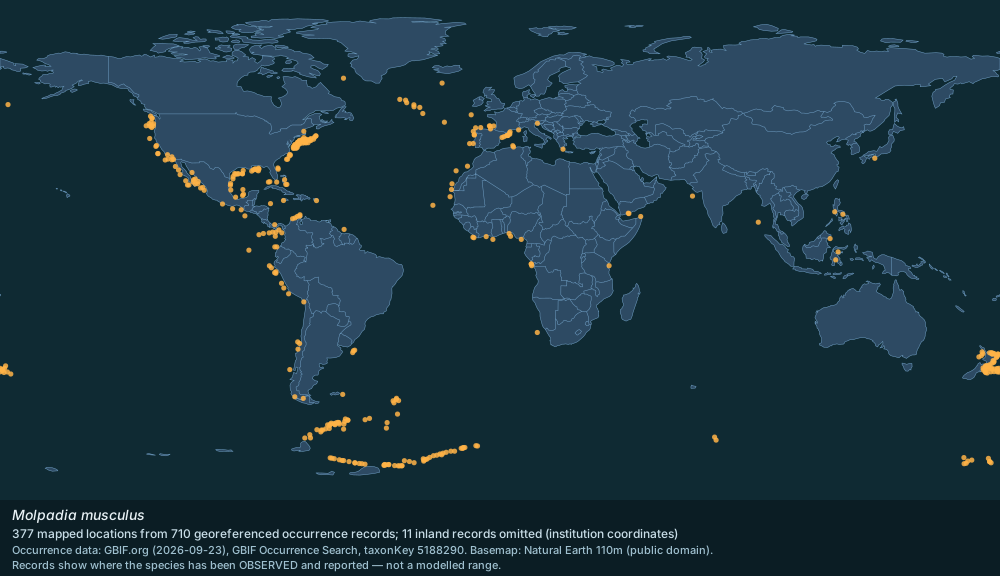
Distribution map plotted from GBIF.org occurrence records; basemap Natural Earth 110m · GBIF records CC0 / CC BY; Natural Earth public domain
Molpadia musculus is a species of sea cucumber in the family Molpadiidae. It is found in deep waters in the Atlantic Ocean, burrowing in the mud.
- Scientific name
- Molpadia musculus
- Authority
- Risso, 1826
- Family
- Molpadiidae
- Order
- Molpadida
- Depth range
- 25–5205 m
- Habitat zone
- benthic
- Gbif occurrence records
- 710
Classification (WoRMS)
Full classification as recorded by WoRMS: Kingdom: Animalia · Phylum: Echinodermata · Class: Holothuroidea · Order: Molpadida · Family: Molpadiidae · Genus: Molpadia.
Accepted name: Molpadia musculus · Authority: Risso, 1826 · Taxonomic status: accepted · AphiaID: 124801.
Synonyms and superseded combinations recorded for this taxon: Ankyroderma danielsseni Théel, 1886; Ankyroderma hispanicum Petit, 1883; Ankyroderma loricatum Perrier R., 1898; Ankyroderma musculus (Risso, 1826); Ankyroderma perrieri Petit, 1883; Eumolpadia asaphes Heding, 1935; Haplodactyla mediterranea Grube, 1840; Molpadia danielsseni Théel, 1886; Molpadia loricata (R. Perrier, 1898); Molpadia musculus f. spinosa Parker, 1964; Molpadia musculus f. violacea Parker, 1964; Trochostoma violaceum Théel, 1886.
Source: World Register of Marine Species (WoRMS) — https://www.marinespecies.org/aphia.php?p=taxdetails&id=124801 (CC BY 4.0). Accessed 2026-09-23.
Biology and life history (SeaLifeBase)
Measured values published by SeaLifeBase for Molpadia musculus. Only fields the database actually holds for this species are shown; these are database values, not aquarium guidance.
Depth range: 25–5205 m · Habitat zone: benthic.
SeaLifeBase notes: Maximum depth from Ref. 111335. Lives buried in sediment (Ref. 2545).
Source: SeaLifeBase species summary (SpecCode 50092) — https://www.sealifebase.se/summary/Molpadia-musculus.html (CC BY-NC 3.0 — non-commercial use only). Accessed 2026-09-23.
Distribution and occurrence records (GBIF)
710 georeferenced occurrence records for Molpadia musculus are published through GBIF from 49 countries or marine areas. The map above plots 377 distinct locations from a sample of 710 records, omitting 11 inland records that carry an institution's coordinates rather than a collection site; it shows where the species has been observed and reported, not a modelled range.
Most records by country or area: United States of America (188); New Zealand (136); Antarctica (124); Spain (50); Mexico (39); Chile (19); Bahamas (14); Portugal (11); Colombia (10); Italy (10); Panama (10); Peru (9); South Georgia and the South Sandwich Islands (6); France (5); Ecuador (4).
Marine regions with a valid WoRMS distribution record: European waters (ERMS scope); North East Atlantic; Canary Islands Exclusive Economic Zone; Mediterranean Sea; North West Atlantic; Portuguese Exclusive Economic Zone; Nice; Naples; Atlantic Europe; New Zealand Exclusive Economic Zone; Gulf of Mexico; Panamanian part of the North Pacific Ocean.
Source: GBIF Occurrence Search (taxonKey 5188290) — https://www.gbif.org/occurrence/search?taxon_key=5188290&has_coordinate=true (records CC0 / CC BY); WoRMS distribution records (MarineRegions) — https://www.marinespecies.org/aphia.php?p=taxdetails&id=124801 (CC BY 4.0); Natural Earth 110m basemap — https://www.naturalearthdata.com/ (public domain). Accessed 2026-09-23.
Description and natural history (Wikipedia)
Molpadia musculus is found in the northern Atlantic Ocean at depths of about 2000 to 5000 m. It lives buried in the mud on the seabed with its anterior (mouth end) directed downwards and its posterior (rear end) on the surface of the sediment. This sea cucumber can be very common on the deep seabed, with up to 220 per square metre having been recorded.
Molpadia musculus is a detritivore, ingesting the mud through which it burrows, extracting the nutritious fragments as the mud passes through the gut and voiding the rest onto the surface of the sediment. The mud has a high content of bacteria, archaea and other prokaryote organisms, especially the top centimetre. There is also a large diversity of micro-organisms present in the sea cucumber's gut; however, research has shown that the fauna of the gut are different from the fauna present in the sediment. To provide an explanation for this, the researchers hypothesized that the fauna in the gut were living there as commensals, to the mutual benefit of themselves and the sea cucumber. It seems that the sea cucumber does not need to build up a gut community of bacteria where the sediment is rich in organic matter, as in the Nazaré Canyon, but such a community is necessary where the sediment quality is poor as in the Cascais Canyon.
Like other sea cucumbers, Molpadia musculus is gonochoric, with separate sexes. Fertilisation is external, the larvae are planktonic and settle on the seabed when sufficiently developed, undergoing metamorphosis into juveniles.
Source: Wikipedia: Molpadia musculus — https://en.wikipedia.org/wiki/Molpadia_musculus (CC BY-SA 4.0). Accessed 2026-09-23.
Gallery
Spotted an error? Know more?
Reader corrections go straight into our review queue. Suggest an edit · How this site is sourced