Opossum pipefish (Microphis lineatus)
Source-cited species reference: taxonomy from WoRMS, biology from FishBase, occurrence map from GBIF, description from Wikipedia.
Last updated

Distribution map plotted from GBIF.org occurrence records; basemap Natural Earth 110m · GBIF records CC0 / CC BY; Natural Earth public domain
Microphis lineatus, the opossum pipefish, is a species of fish in the family Syngnathidae. It is found in fresh, brackish and marine waters in the West Atlantic region, ranging from New Jersey, United States, to São Paulo, Brazil, including the Caribbean and Gulf of Mexico. It is often found in rivers, among water hyacinth roots, in mangrove and in Sargassum.
Scientific classification
- KingdomAnimalia
- PhylumChordata
- ClassActinopterygii
- DivisionTeleostei
- OrderSyngnathiformes
- FamilySyngnathidae
- GenusMicrophis
- SpeciesMicrophis lineatus
Named by (Kaup, 1856)
Close relatives
Other species of Microphis with a Codexery entry.
- Ragged-tail pipefish Microphis retzii
Sources: Wikipedia taxobox: Microphis lineatus (CC BY-SA 4.0) · order, family and genus agree with WoRMS AphiaID 400978 (CC BY 4.0)
Conservation status
Data Deficient (DD)
Data Deficient: there is not enough information to place this species on the risk scale.
Source: IUCN Red List assessment
How big is it?
Largest length in the source, 0.19 m, next to a 1.8 m person.
Diagram: drawn by Codexery, schematic shapes to scale (not a likeness). Length: FishBase species summary
Where the opossum pipefish (microphis lineatus) has been recorded
Each dot is a place where the species has been observed and reported (443 records, half-degree grid) — not a modelled range. 97 inland records left out (institution coordinates).
Map: drawn by Codexery. Data: GBIF occurrence search (records CC0 / CC BY) · Natural Earth basemap (public domain) · place coordinates: Wikipedia (CC BY-SA 4.0)
Classification (WoRMS)
Full classification as recorded by WoRMS: Kingdom: Animalia · Phylum: Chordata · Class: Teleostei · Order: Syngnathiformes · Family: Syngnathidae · Genus: Microphis.
Accepted name: Microphis lineatus · Authority: (Kaup, 1856) · Taxonomic status: accepted · AphiaID: 400978.
Synonyms and superseded combinations recorded for this taxon: Doryichthys lineatus Kaup, 1856; Doryrhamphus sierra Nichols, 1915; Microphis brachyurus lineatus (Kaup, 1856); Oostethus brachyurus lineatus (Kaup, 1856); Oostethus lineatus (Kaup, 1856); Siphostoma brevicaudum Meek, 1904; Siphostoma eigenmanni Wilson, 1916; Siphostoma torrei Nichols, 1912; Syngnathus cayennensis Sauvage, 1882; Syngnathus torrei (Nichols, 1912).
Source: World Register of Marine Species (WoRMS) — https://www.marinespecies.org/aphia.php?p=taxdetails&id=400978 (CC BY 4.0). Accessed 2026-09-25.
Biology and life history (FishBase)
Measured values published by FishBase for Microphis lineatus. Only fields the database actually holds for this species are shown; these are database values, not aquarium guidance.
Maximum length: 19.399999618530273 cm · Habitat zone: pelagic-neritic · Body shape: eel-like · Vulnerability index: 13.7 of 100 · Fishery importance: of no interest · Aquarium trade: never/rarely.
FishBase notes: Found among floating Sargassum . Ovoviviparous (Ref. 205). The male carries the eggs in a brood pouch which is found under the tail (Ref. 205).
Source: FishBase species summary (SpecCode 26235) — https://www.fishbase.se/summary/Microphis-lineatus.html (CC BY-NC 3.0 — non-commercial use only). Accessed 2026-09-25.
Distribution and occurrence records (GBIF)
443 georeferenced occurrence records for Microphis lineatus are published through GBIF from 22 countries or marine areas. The map above plots 29 distinct locations from a sample of 443 records, omitting 97 inland records that carry an institution's coordinates rather than a collection site; it shows where the species has been observed and reported, not a modelled range.
Most records by country or area: Brazil (175); Mexico (105); Costa Rica (45); United States of America (28); Panama (18); Venezuela (Bolivarian Republic of) (10); Honduras (9); French Guiana (7); Trinidad and Tobago (7); Guatemala (6); Puerto Rico (6); Guyana (5); Martinique (4); Belize (3); Colombia (3).
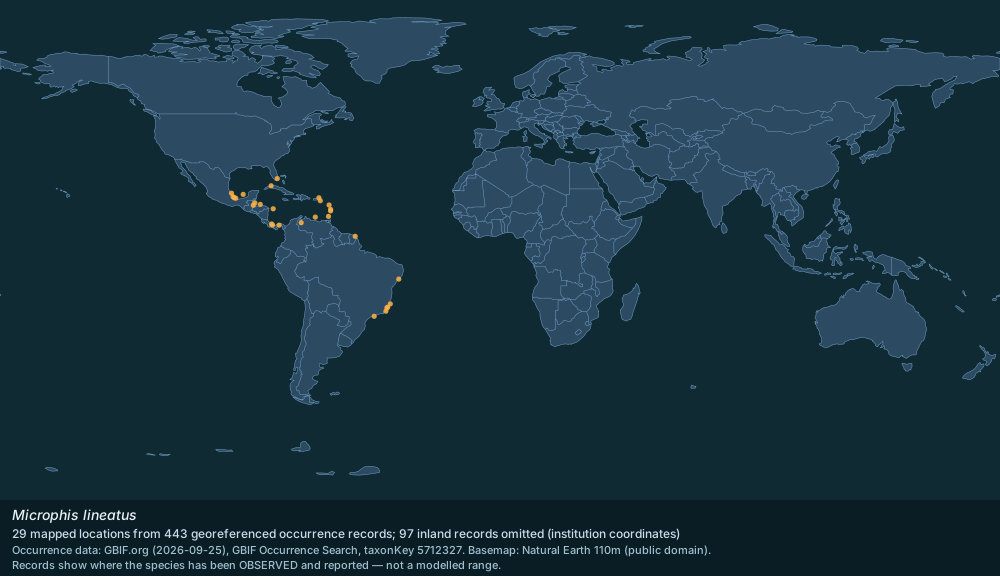
Source: GBIF Occurrence Search (taxonKey 5712327) — https://www.gbif.org/occurrence/search?taxon_key=5712327&has_coordinate=true (records CC0 / CC BY); WoRMS distribution records (MarineRegions) — https://www.marinespecies.org/aphia.php?p=taxdetails&id=400978 (CC BY 4.0); Natural Earth 110m basemap — https://www.naturalearthdata.com/ (public domain). Accessed 2026-09-25.
Description and natural history (Wikipedia)
The opossum pipefish was formerly regarded as a subspecies of Microphis brachyurus (native to Asia and Oceania), but is now recognized as a full species by both FishBase and Catalog of Fishes. Furthermore, it is possible that full-freshwater populations currently included in the opossum pipefish represent a separate species.
In the United States, the opossum pipefish is considered a species of concern by the National Marine Fisheries Service. Due to uncertainty about its taxonomy and vulnerability to habitat destruction, it is considered data deficient by the IUCN. It reaches up to 19.4 cm in standard length.
Opossum pipefish are a widespread species that spawn in low salinity areas of estuaries.
The color of the opossum pipefish is distinctive, especially in breeding adults: the upper snout and back half of the head and body is sienna brown with a series of dark red blotches on each lateral trunk ring forming a red stripe between the lateral and superior trunk ridges; there is a silver stripe on the mid-side between the lateral and inferior trunk ridges, a silver edge on the inferior trunk ridge; the lower half of the snout is bright red with a variable number of black vertical bars, and the caudal fin is also red with a central dark stripe.
Nothing is known about annual variation in population size, but the decline in habitat quality (described below) has likely led to a drastic decrease in population size.
The major threats to the opossum pipefish are habitat destruction, water control structures, declining water quality, and an increase in disease. These factors have been documented within the primary ecosystems occupied by opossum pipefish.
IUCN: Data deficient.
U.S. National Marine Fisheries Service: Species of Concern
Species of Greatest Conservation Need:FL, LA, and TX.
Source: Wikipedia: Microphis lineatus — https://en.wikipedia.org/wiki/Microphis_lineatus (CC BY-SA 4.0). Accessed 2026-09-25.
Test yourself
Three questions drawn from this entry’s sources. Pick an answer to check it.
Answers checked against the source article
Sources
Compiled from Wikipedia and the sources listed below. Text from Wikipedia is available under CC BY-SA 4.0; this entry is adapted from it.
- Wikipedia: Microphis lineatus (CC BY-SA 4.0).
- Classification: the source article's taxobox; order, family and genus checked against WoRMS, the World Register of Marine Species (CC BY 4.0).
- Conservation status: IUCN Red List assessment.
- Occurrence records: GBIF (CC0 / CC BY). Basemap: Natural Earth (public domain).
- Biology values: FishBase species summary (CC BY-NC 3.0, non-commercial).
- Word definitions: the , each quoted from its Wikipedia article.
Spotted an error? Know more?
Reader corrections go straight into our review queue. Suggest an edit · How this site is sourced