Sargassum
Brown macroalgae forming vast drifting mats in tropical oceans.

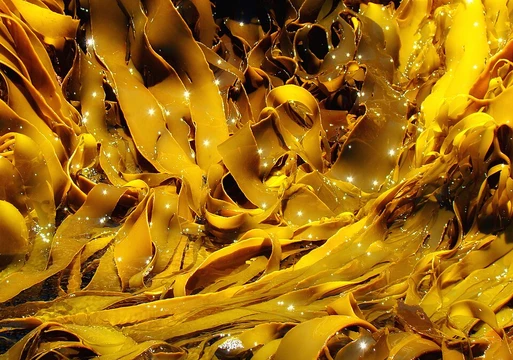
Sargassum is a genus of brown macroalgae (seaweed) in the order Fucales of the class Phaeophyceae, predominantly spread in tropical and subtropical areas. It is notable for forming golden brown drifting mats that can extend for kilometers across the ocean surface, moving with currents and wind, and for its recent large-scale arrivals throughout the Caribbean region, including the formation of the Great Atlantic Sargassum Belt (GASB) from western Africa into the Caribbean Sea.
Quick Facts
- Taxon
- Sargassum
Facts from the source article.
Lore & Background
Sargassum was named after sargaço, the Portuguese word for grape, after Portuguese sailors in the Sargasso Sea noticed the small air-filled bladders that keep the seaweed afloat. The earliest mention in history may be traced to the times of Cristobal Columbus in his maritime letters 'Relaciones y Cartas' of the first voyage, where he mentions encountering great masses of floating algae that made navigation difficult. Sargassum had acquired a legendary reputation as it expands through the entire Sargasso Sea and blocks ships movements, but it has since been discovered that it happens in drifts only.
Fossils of a floating brown algae reminiscent of modern Sargassum are common in certain layers of the Early Oligocene-aged Menilite Formation of Poland, in what was once the Paratethys Sea, suggesting that floating Sargassum mats have been a dominant feature of certain oceanic ecosystems for tens of millions of years. Associated with these fossil algae are fossils of shallow-water fishes and crabs, despite these fossil deposits otherwise preserving deepwater fish fossils, an assemblage nicknamed a 'quasi-Sargasso' assemblage.
Species of this genus may reach up to several metres in length, are brown or dark olive green, and consist of a holdfast, a stipe, and fronds. Most species have spherical, gaseous bladders called pneumatocysts that provide buoyancy. The fronds are frequently rough and slightly sticky, and their structure is loose yet strong to endure waves and currents. The morphological difference within the genus is significant and tends to change according to environmental factors including water flow, nutritional supply, and light intensity.
Reader's Guide
Sargassum plays a vital ecological role in the open ocean by providing habitat for a variety of marine species, including fish, crabs, sea turtles, migratory birds, and other organisms. The Sargasso Sea, named for hosting large amounts of Sargassum, is one of the few areas that can develop an ecosystem in the open-ocean region with no land boundaries. Drifting Sargassum patches act as a refuge for many species in different parts of their development and as permanent residence for endemic species that can only be found living on and within the Sargassum. These mats are home to more than 11 phyla and over 100 different species, including 81 fish species. The Sargasso Sea also plays a major role in the migration of catadromous eel species such as the European eel, American eel, and American conger eel, whose larvae hatch within the sea and later migrate to Europe or the East Coast of North America before returning to spawn.
However, when large amounts of Sargassum accumulate on shores and decompose, they form Sargassum brown tides (SBT), which alter water quality by reducing light penetration, decreasing dissolved oxygen, and changing pH. This affects seagrass meadows, corals, mangroves, and coastal communities dependent on tourism. Unprecedented inundation events cause biological and ecological impacts, including oxygen-depleted zones resulting in fish kills, and the creation of hydrogen sulfide gas (H2S) that causes health impacts in humans. During the 2018 inundation event, 11,000 Acute Sargassum Toxicity cases were reported in an 8-month span on the Caribbean islands of Guadeloupe and Martinique. Sargassum also serves as a trophic link between the ocean surface and the seabed, with isopods at depths of 5002–6288 m observed consuming it.
Did You Know?
- Sargassum was named after sargaço, the Portuguese word for grape, due to its air-filled bladders.
- The earliest mention of Sargassum is in Cristobal Columbus's maritime letters from his first voyage.
- Fossils of floating Sargassum-like algae have been found in the Early Oligocene-aged Menilite Formation of Poland.
- The Great Atlantic Sargassum Belt (GASB) is a new hotspot extending from western Africa into the Caribbean Sea.
More in Brown Macroalgae and Kelp 1-24
Spotted an error? Know more?
Reader corrections go straight into our review queue. Suggest an edit · How this site is sourced