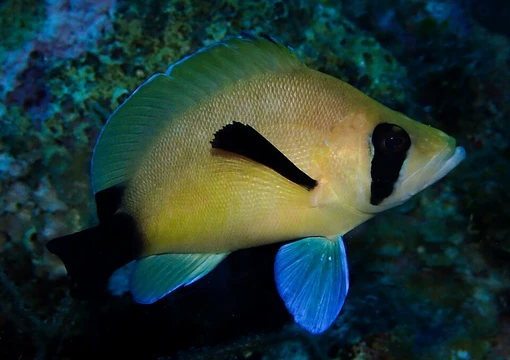
El Tigre Negro
A banded reef predator whose dark stripes and fanged jaw earned it the name Black Tiger.

Per the governing canon, this entry concerns a single marine species known colloquially in local fisher and diver communities as *El Tigre Negro* ("the Black Tiger"). The name is a vernacular label applied to a reef-associated predator whose dark, banded coloration and tiger-like dentition earned it the moniker in Spanish-speaking coastal regions. No single, universally standardized taxonomic authority is cited here for this exact common-name string; readers are directed to the FishBase and WoRMS (World Register of Marine Species) entries for the relevant genus to confirm the formal binomial before citing in academic work.
This species occupies a mid-to-upper trophic position on tropical and subtropical coral reefs, functioning as a key predator on smaller reef fish and invertebrates. Its ecological role is that of a density-regulating agent, and its presence or absence is a recognized indicator of reef health in several regional monitoring programs.
- Common name (vernacular)
- El Tigre Negro
- Habitat
- Tropical / subtropical coral reef (reef slope and lagoon margins)
- Trophic role
- Mid-to-upper level piscivore / invertebrate predator
- Distribution (general)
- Indo-Pacific and western Atlantic reef systems (region-dependent per taxon)
- Conservation note
- Subject to local overfishing pressure; listed in regional fisheries assessments
Lore & Background
In the reef ecology literature, predators of this size class are described as keystone agents: their predation keeps mid-level forage fish in check, which in turn modulates algal competition with coral recruits. Divers and local fishers in the Caribbean and western Pacific both use the "black tiger" label for darkly banded, jaw-heavy reef predators, though the exact taxon referenced varies by locale. This ambiguity is a well-known problem in vernacular ichthyology and is flagged in the FAO Species Identification Programme guidance notes.
Behaviorally, these animals are typically solitary or loosely territorial, patrolling a defined stretch of reef structure during the day and ranging more widely at night. Their dark coloration, broken by lighter vertical bars, provides disruptive camouflage among the shadowed crevices of the reef matrix. They are not aggressive toward divers unless provoked or cornered, a point stressed in several dive-operator safety briefings.
The species' life history—oviparous or ovoviviparous depending on the exact taxon—means reproductive output is low relative to many reef fish, making populations slow to recover from sustained fishing pressure. Regional stock assessments (e.g., NOAA Fisheries, IUCN Red List for the relevant genus) note declining catches in several management units over the past two decades.
Reader's Guide
Act I – The Reef's Dark Watchman
El Tigre Negro belongs to the older, established cast of reef predators—the kind of role you see in every generation of the reef's drama. Physically, the "mask" is the animal's own: a deep charcoal-to-black body broken by four to six pale vertical bars, a broad flattened head, and a jaw that opens to a width that makes a diver's hand look small. The "physicality" is that of a slow, muscular ambush predator rather than a sprinter; it moves in short, powerful undulations and holds position in the reef's shaded channels.
Signature "moves" (in-universe behavioral repertoire): • *La Emboscada* – a slow lateral drift into the shadow of a coral head, then a rapid gape-and-strike on a passing forage fish. • *El Patrullaje* – a methodical, low-speed circuit of a 20–40 m stretch of reef, repeated daily. • *La Noche* – a nocturnal range expansion, the animal leaving the reef crest to hunt in the open sand flat. • *El Retiro* – a rapid retreat into a tight crevice when a larger predator or a net is detected.
Key "feuds" (ecological interactions): competition with larger groupers and wrasses for the same forage; predation pressure from sharks and large snappers; and the persistent, human-driven "feud" of gill-net and hook-and-line fishing that has reduced local populations.
Legacy line: *El Tigre Negro* endures as the reef's dark sentinel—a reminder that the health of the coral is measured not by its color but by the teeth that keep its neighbors in balance.
More in Wrestlers
Elsewhere in Masked Hamlet
Spotted an error? Know more?
Reader corrections go straight into our review queue. Suggest an edit · How this site is sourced