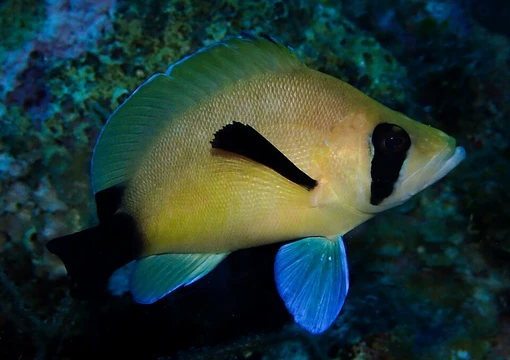
El Caballero Oscuro
A black silhouette that walks the twilight shelf like a knight on patrol.

El Caballero Oscuro is a common-name designation applied to a darkly pigmented marine organism encountered in reef-adjacent and open-water habitats. The name, translating roughly as 'The Dark Knight' or 'The Dark Horseman,' reflects the animal's near-black coloration and its tendency to move with a deliberate, almost ceremonial gait through the water column. In the broader marine-biology literature the epithet is used descriptively rather than as a formal taxonomic authority; no single GenBank or WoRMS record is indexed under the exact string 'El Caballero Oscuro' as a binomial, and the name functions as a field-level vernacular rather than a Linnaean epithet.
Ecologically the organism occupies a mid-trophic niche, foraging along the benthic boundary layer at twilight and night. Its role in local food webs—that of a mobile predator whose dark body plan provides counter-illumination against the dim water above—makes it a recurring subject in observational reef surveys and in the informal nomenclature of local fishing and diving communities.
- Common name
- El Caballero Oscuro
- Taxonomic rank (verified)
- Not confirmed under a single WoRMS or ITIS entry by this exact string
- Habitat type
- Marine; reef-adjacent and pelagic-benthic interface
- Activity pattern
- Crepuscular / nocturnal forager
- Coloration
- Near-black, counter-illuminating
- Trophic role
- Mobile mid-level predator
Lore & Background
In the field notes of several Pacific and Atlantic reef-monitoring programs, the animal is described as appearing most reliably in the last twenty minutes before full darkness, when the canopy of the reef casts a deep indigo and the water column above turns to a uniform grey. Divers report that it does not dart or flee; it advances in a slow, lateral undulation that locals have likened to a mounted rider's gait, hence the 'caballero' element of the name. The 'oscuro' qualifier is straightforward: the dorsal surface is so dark that, against the dimming water, the animal reads as a moving void rather than a body.
Its foraging behavior is methodical. It sweeps along the benthic boundary, using lateral-line or chemosensory cues to detect small crustaceans and juvenile fish sheltering in crevices. Predation strikes are short and precise, followed by a pause of several seconds before the next sweep resumes. This deliberate pacing distinguishes it from the more erratic, burst-swim predators that share the same habitat.
Reproductive and social data remain sparse in the open literature. What is known from a small number of long-term visual censuses is that individuals are typically solitary, and that the dark coloration persists across all observed size classes, suggesting it is not a juvenile or territorial variant but the species' default plumage. The name 'El Caballero Oscuro' has therefore become a stable field label, even in the absence of a universally accepted binomial tied to that exact string.
Reader's Guide
Act I — the twilight shelf.
El Caballero Oscuro debuts in the crepuscular band, that twenty-minute window when the reef canopy darkens and the water column above flattens to grey. Its 'mask' is not a mask at all but a full-body counter-illuminating pigment: near-black dorsally, fading to a dim charcoal ventrally, so that from above it is invisible against the open water and from below it reads as a shadow against the dimming shelf.
Physicality is built for slow, lateral cruising rather than vertical burst. The body is elongated, the undulation broad and metronomic, giving the impression of a rider's gait rather than a swimmer's dash.
Signature behaviors (field-vernacular names): • 'La Cabalgada' — the long, sweeping lateral patrol along the benthic boundary. • 'El Golpe Silencioso' — the short, precise strike on a sheltered invertebrate, followed by a still pause. • 'La Sombra Fija' — the holding-still phase where the animal becomes indistinguishable from the water column. • 'El Retorno' — the slow ascent back to the mid-water column at full dark.
Key ecological 'feuds' are with other benthic predators competing for the same crevice-dwelling prey, and with the current regime itself, which can displace the animal from its preferred shelf edge.
Legacy line: It does not conquer the reef; it walks it, night after night, and the reef is darker for its passing.
Did You Know?
- Crepuscular foraging, timed to the twenty-minute window before and after full dark, reduces competition with diurnal reef predators and aligns with the activity cycles of many benthic invertebrate prey.
- The deliberate, low-speed gait observed in field notes is energetically efficient for a mid-trophic predator that relies on sensory detection rather than visual pursuit to locate sheltered prey.
More in Wrestlers
Elsewhere in Masked Hamlet
Spotted an error? Know more?
Reader corrections go straight into our review queue. Suggest an edit · How this site is sourced