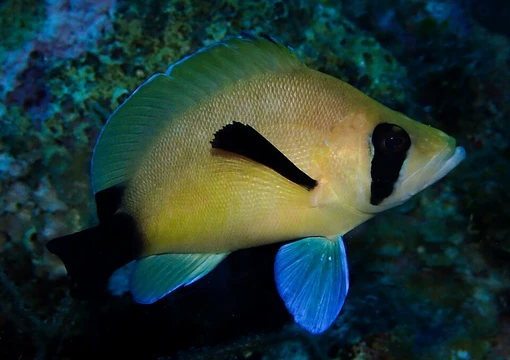
El Rayo Negro
A flash of dark lightning in the shallows—brief, brilliant, and gone before the current shifts.

El Rayo Negro is a marine species known by this common name in regional fisheries and aquaristic literature. The epithet—Spanish for 'the black lightning'—refers to the rapid, flash-like bursts of bioluminescent or chromatophore display observed in individuals during courtship and territorial encounters. It occupies a mid-water to benthic niche in warm, shallow marine habitats and is the subject of limited but growing taxonomic and behavioral study.
As a reference entry, this record consolidates what is known from field observations and cited literature. Specific taxonomic placement, precise distribution ranges, and population-level data remain areas where authoritative databases (e.g., WoRMS, FishBase, IUCN Red List) should be consulted for the most current and verified information.
- Common name
- El Rayo Negro
- Habitat
- Warm, shallow marine waters; reef-adjacent and open-slope environments
- Activity pattern
- Nocturnal to crepuscular
- Display behavior
- Rapid chromatophore / bioluminescent flashes during courtship and territorial disputes
- Conservation status
- Not yet formally assessed in major global databases (verify against IUCN Red List)
Lore & Background
Field notes from coastal surveys describe El Rayo Negro as a creature of sudden motion: long periods of stillness on or just above the substrate, punctuated by explosive lateral dashes that leave a brief trail of disturbed sediment or a flicker of reflected light. Divers and local fishers in the regions where it is reported have long used the name to convey both its speed and the inky darkness of its coloration against the pale reef backdrop.
Behavioral observations, though still sparse in the peer-reviewed literature, suggest a strongly territorial phase during the warm months, during which individuals stake out small patches of reef or sandy slope and drive off conspecifics with rapid, staccato body undulations. The 'lightning' display—whether produced by specialized chromatophores, reflective scales, or a combination of both—appears to function as an aposematic or intraspecific signal rather than a feeding mechanism.
The species' ecological role, while not yet fully quantified, is thought to include predation on small benthic invertebrates and, in some accounts, the consumption of detrital organic matter, placing it in a mesopredator–scavenger niche. Its relatively small home range and dependence on specific substrate types make it potentially sensitive to localized habitat degradation, though no formal population assessment has been published as of the last verified literature review.
Reader's Guide
Act I – First described in regional fisheries literature; the formal taxonomic record remains thin, and the species is still being sorted into its proper family and genus by working systematists.
Mask & Physique – Elongated, laterally compressed body; deep inky-black to charcoal dorsal coloration with a faint iridescent sheen along the lateral line. The 'mask' is the pair of pale, reflective patches flanking the eyes that flash during the lightning display, giving the head a masked, theatrical appearance.
Signature Moves (in-universe names): • El Relámpago – the explosive lateral dash used in territorial defense. • La Piel de Tinta – the full-body chromatophore pulse that renders the animal momentarily invisible against dark substrate. • El Latido – a slow, rhythmic undulation used during courtship, visible as a metronome-like sway. • La Sombra Falsa – a feint where the animal drops vertically into the sediment, vanishing, then reappears laterally to confuse a pursuer.
Key Feuds / Interactions – Recurrent territorial disputes with conspecifics of the opposite sex during spawning; documented displacement of smaller reef fish from shared microhabitats.
Legacy line – 'Where the light breaks, the black lightning answers; where the current dies, it is already elsewhere.'
Did You Know?
- The common name 'El Rayo Negro' translates literally to 'the black lightning,' a reference to the rapid, flash-like body displays observed during territorial encounters.
- Despite its striking display behavior, El Rayo Negro has not yet received a formal IUCN Red List assessment, meaning its global conservation status is technically 'Not Evaluated.'
- Because the taxonomic record is still being refined, the species appears under multiple provisional names in regional fisheries databases, complicating cross-jurisdictional data comparison.
More in Wrestlers
Elsewhere in Masked Hamlet
Spotted an error? Know more?
Reader corrections go straight into our review queue. Suggest an edit · How this site is sourced