
Rose coral (Manicina areolata)
Source-cited species reference: taxonomy from WoRMS, biology from SeaLifeBase, occurrence map from GBIF, conservation from IUCN Red List, description from Wikipedia.

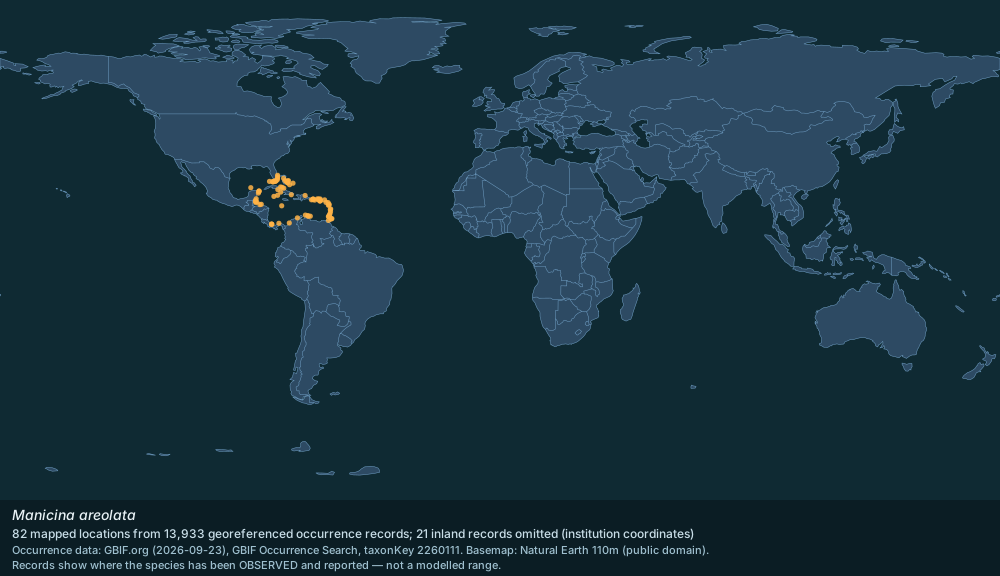
Distribution map plotted from GBIF.org occurrence records; basemap Natural Earth 110m · GBIF records CC0 / CC BY; Natural Earth public domain
Manicina areolata, commonly known as rose coral, is a colonial species of stony coral. It occurs in shallow water in the West Atlantic Ocean and Caribbean Sea, sometimes as small solid heads and sometimes as unattached cone-shaped forms.
- Scientific name
- Manicina areolata
- Authority
- (Linnaeus, 1758)
- Family
- Faviidae
- Order
- Scleractinia
- Depth range
- 0–65 m
- Habitat zone
- reef-associated
- Iucn red list
- Least Concern
- Gbif occurrence records
- 13,933
Classification (WoRMS)
Full classification as recorded by WoRMS: Kingdom: Animalia · Phylum: Cnidaria · Class: Hexacorallia · Order: Scleractinia · Family: Faviidae · Genus: Manicina.
Accepted name: Manicina areolata · Authority: (Linnaeus, 1758) · Taxonomic status: accepted · AphiaID: 290327.
Synonyms and superseded combinations recorded for this taxon: Madrepora areola Esper, 1791; Madrepora areolata Linnaeus, 1758; Maeandra (Manicina) areolata (Linnaeus, 1758); Maeandra areola (Esper, 1791); Maeandra areolata (Linnaeus, 1758); Maeandra areolata var. angusta (Dana, 1846); Maeandra areolata var. colummelaris Verrill, 1901; Maeandra areolata var. confertifolia Verrill, 1901; Maeandra areolata var. hispida (Ehrenberg, 1834); Maeandra areolata var. laxifolia Verrill, 1901; Maeandra dilatata (Dana, 1846); Manicina areolata f. areolata (Linnaeus, 1758); Manicina areolata f. mayori Wells, 1936; Manicina areolata var. angusta Dana, 1846; Manicina areolata var. gracilis Dana, 1846; Manicina areolata var. hispida (Verrill, 1901); Manicina areolata var. laxifolia (Verrill, 1901); Manicina crispata Milne Edwards & Haime, 1849; Manicina danai Haime & Milne Edwards, 1857; Manicina dilatata Dana, 1846; Manicina gyrosa (Ellis & Solander, 1786); Manicina hispida Ehrenberg, 1834; Manicina mayori Wells, 1936; Manicina praerupta Ehrenberg, 1834; Manicina sebacana Milne Edwards & Haime, 1849.
Source: World Register of Marine Species (WoRMS) — https://www.marinespecies.org/aphia.php?p=taxdetails&id=290327 (CC BY 4.0). Accessed 2026-09-23.
Biology and life history (SeaLifeBase)
Measured values published by SeaLifeBase for Manicina areolata. Only fields the database actually holds for this species are shown; these are database values, not aquarium guidance.
Depth range: 0–65 m · Habitat zone: reef-associated.
SeaLifeBase notes: Maximum depth from Ref. 83917. Zooxanthellate (Ref. 116012). Small and free-living colonies in subtidal seagrass beds; attached and hemispherical in shallow reef environments (Ref. 848). Also common in sand and coral rubble (Ref. 415)
Source: SeaLifeBase species summary (SpecCode 46771) — https://www.sealifebase.se/summary/Manicina-areolata.html (CC BY-NC 3.0 — non-commercial use only). Accessed 2026-09-23.
Distribution and occurrence records (GBIF)
13,933 georeferenced occurrence records for Manicina areolata are published through GBIF from 42 countries or marine areas. The map above plots 82 distinct locations from a sample of 3,000 records, omitting 21 inland records that carry an institution's coordinates rather than a collection site; it shows where the species has been observed and reported, not a modelled range.
Most records by country or area: Virgin Islands (U.S.) (5,734); United States of America (4,668); Puerto Rico (2,317); Cuba (229); Colombia (173).
The full country table, WoRMS marine regions and the sampling notes are on this species' Distribution page.
Source: GBIF Occurrence Search (taxonKey 2260111) — https://www.gbif.org/occurrence/search?taxon_key=2260111&has_coordinate=true (records CC0 / CC BY); WoRMS distribution records (MarineRegions) — https://www.marinespecies.org/aphia.php?p=taxdetails&id=290327 (CC BY 4.0); Natural Earth 110m basemap — https://www.naturalearthdata.com/ (public domain). Accessed 2026-09-23.
Conservation status (IUCN Red List)
The IUCN Red List assesses Manicina areolata (Linnaeus, 1758) as Least Concern (code LC). No trend, population estimate or threat analysis is given here, because none is available from this source without the Red List API; follow the source link for the full assessment, including its date.
Source: IUCN Red List of Threatened Species (taxon 132963) — https://www.iucnredlist.org/species/132963/0; GBIF IUCN Red List category endpoint (taxonKey 2260111) — https://api.gbif.org/v1/species/2260111/iucnRedListCategory. Accessed 2026-09-23.
Description and natural history (Wikipedia)
M. areolata is a colonial coral. Budding is intracalicular, occurring within the whorl of tentacles of the polyp. The corallites are arranged in a meandroid fashion, which means there are a series of linked centres in broad valleys, often 10 to 15 mm wide, giving the colony the appearance of the surface of a human brain. The polyps share an elongate oral disc with the tentacles round the rim.
Colonies are small, often less than 10 cm in diameter. Manicina areolata has two entirely different growth forms. Some individuals form small, solid hemispherical heads while others are small, cone-shaped structures that are not attached to the seabed. The surface of the coral consists of long meandering walls with wide intervening valleys. The polyps sit in corallites (stony cups) in the valleys from which fine septa (transverse ridges) extend in several series up to the summit of the walls on either side. Often the whole coral consists of one long, convoluted valley, sometimes with side valleys. Where there is more than one valley, the intervening walls have grooves running along the top. The colour of this coral is yellowish-brown, tan or dark brown, often with the valleys and walls being contrasting colours. The polyps are only extended at night and their oral surfaces are often green.
M. areolata is native to the tropical and subtropical West Atlantic Ocean. Its range includes the southern half of the Gulf of Mexico, the Caribbean Sea, southern Florida, the Bahamas and Bermuda. It is found on soft sediments, cobble or rubble, on fore-reef and back-reef slopes and in sea grass meadows. Usually occurring at depths of less than 10 m, its lower depth limit is around 60 m. The massive form is found on reefs attached to rocks but the unattached form is found on areas of broken coral fragments and on sandy or muddy substrates including lagoons and turtle grass (Thalassia testudinum) meadows.
The unattached cone-shaped form of Manicina areolata can right itself if overturned by a fish, current or wave action. The polyps have pleats and muscles in the mesentries which enable them to extend further from the corallite than can small-polyp corals. This gives them the facility to inflate the body cavity with water, enabling the polyps to swell up and dislodge sediment, and even turn the colony over if this proves necessary. It does this by inflating itself by filling its interior with water and then emitting jets of water on one side to make the whole structure topple over. It is a slow process and is more difficult to achieve as the coral grows larger. This may be the reason that this coral seldom exceeds a diameter of 10 cm. This coral can rid itself of sediment that threatens to engulf it by producing mucus and sloughing this and the sediment that adheres to it like a skin. The tissues of this coral contain symbiotic unicellular algae called zooxanthella.
Manicina areolata is a hermaphrodite, the gametes are produced around the time of the full moon in May and June. Fertilisation is internal and the larvae are brooded inside the colony for two weeks before being released simultaneously on the night of the new moon. The larvae may drift planktonically or settle immediately.
Other corals that occupy a similar habitat, and which often co-occur with rose coral, are the free-living corals Porites divaricata, Cladocora arbuscula and several species of Oculina.
Rose coral is tolerant of a wide range of salinities and temperature variations and some degree of sedimentation. It is a common species and the International Union for Conservation of Nature has rated it as being of "least concern".
Source: Wikipedia: Manicina areolata — https://en.wikipedia.org/wiki/Manicina_areolata (CC BY-SA 4.0). Accessed 2026-09-23.
Gallery
Related in Rose coral
Links follow this subject's own source article.
Elsewhere in Rose coral
Spotted an error? Know more?
Reader corrections go straight into our review queue. Suggest an edit · How this site is sourced