
Madracis auretenra
Source-cited species reference: taxonomy from WoRMS, biology from SeaLifeBase, occurrence map from GBIF, conservation from IUCN Red List, description from Wikipedia.
Madracis auretenra, commonly known as the yellow finger coral or yellow pencil coral, is a colonial species of stony coral in the family Pocilloporidae. It is a fairly common species and is found in the Caribbean Sea and western Atlantic Ocean. At one time this species was not recognised, but it was split from Madracis mirabilis on the grounds of morphology and depth range.
- Scientific name
- Madracis auretenra
- Authority
- Locke, Weil & Coates, 2007
- Family
- Pocilloporidae
- Order
- Scleractinia
- Habitat zone
- reef-associated
- Iucn red list
- Least Concern
- Gbif occurrence records
- 8,899
Classification (WoRMS)
Full classification as recorded by WoRMS: Kingdom: Animalia · Phylum: Cnidaria · Class: Hexacorallia · Order: Scleractinia · Family: Pocilloporidae · Genus: Madracis.
Accepted name: Madracis auretenra · Authority: Locke, Weil & Coates, 2007 · Taxonomic status: accepted · AphiaID: 430664.
Synonyms and superseded combinations recorded for this taxon: Madracis mirabilis (Duchassaing & Michelotti, 1860) sensu Wells, 1973; Madracis mirabilis f. martiniquensis Fenner, 1993.
Source: World Register of Marine Species (WoRMS) — https://www.marinespecies.org/aphia.php?p=taxdetails&id=430664 (CC BY 4.0). Accessed 2026-09-23.
Biology and life history (SeaLifeBase)
Measured values published by SeaLifeBase for Madracis auretenra. Only fields the database actually holds for this species are shown; these are database values, not aquarium guidance.
Habitat zone: reef-associated · Aquarium trade: never/rarely.
Source: SeaLifeBase species summary (SpecCode 131367) — https://www.sealifebase.se/summary/Madracis-auretenra.html (CC BY-NC 3.0 — non-commercial use only). Accessed 2026-09-23.
Distribution and occurrence records (GBIF)
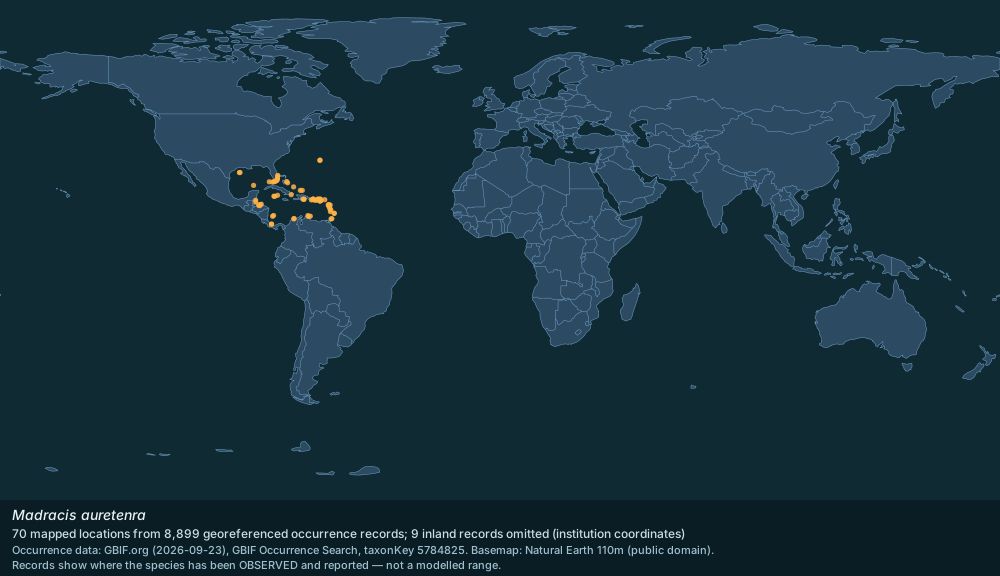
8,899 georeferenced occurrence records for Madracis auretenra are published through GBIF from 29 countries or marine areas. The map above plots 70 distinct locations from a sample of 3,000 records, omitting 9 inland records that carry an institution's coordinates rather than a collection site; it shows where the species has been observed and reported, not a modelled range.
Most records by country or area: United States of America (3,786); Puerto Rico (2,304); Virgin Islands (U.S.) (2,261); Bonaire, Sint Eustatius and Saba (143); Curaçao (77).
The full country table, WoRMS marine regions and the sampling notes are on this species' Distribution page.
Source: GBIF Occurrence Search (taxonKey 5784825) — https://www.gbif.org/occurrence/search?taxon_key=5784825&has_coordinate=true (records CC0 / CC BY); WoRMS distribution records (MarineRegions) — https://www.marinespecies.org/aphia.php?p=taxdetails&id=430664 (CC BY 4.0); Natural Earth 110m basemap — https://www.naturalearthdata.com/ (public domain). Accessed 2026-09-23.
Conservation status (IUCN Red List)
The IUCN Red List assesses Madracis auretenra Locke Weil & Coates, 2007 as Least Concern (code LC). No trend, population estimate or threat analysis is given here, because none is available from this source without the Red List API; follow the source link for the full assessment, including its date.
Source: IUCN Red List of Threatened Species (taxon 133618) — https://www.iucnredlist.org/species/133618/0; GBIF IUCN Red List category endpoint (taxonKey 5784825) — https://api.gbif.org/v1/species/5784825/iucnRedListCategory. Accessed 2026-09-23.
Description and natural history (Wikipedia)
In 2007, Locke, Weil & Coates erected a new species of Madracis coral from the Caribbean Sea and named it Madracis auretenra. They distinguished between this species and Madracis mirabilis (Duchassaing & Michelotti 1860), a deep-water species, on the grounds of the new species' thin-branched, dendritic structure, and its depth range (1 to 60 m). Other characteristics that distinguished the new species from others include the presence of base skeletal structures devoid of living tissue, a fairly smooth coenosteum, a distinct line of spines between the corallites, and the absence of secondary septa in the closely spaced corallites. In erecting this species they pointed out that "Authors of many recent studies on Madracis mirabilis sensu Wells will need to reconsider and reconfirm the identities of their study organisms".
Madracis auretenra forms hemispherical clumps that can be a metre or more across. Each colony is formed of densely packed, cylindrical branches with blunt, finger-like tips. In fore-reef habitats the branches are slender but in back-reef and lagoon habitats they are more robust and the clumps are larger. The hard skeletal material of which the colony is built is in most coral species covered by a thin layer of living tissue, the coenosarc. M. auretenra is unusual in this respect because, as the coral grows, the coenosarc progressively dies back on the lower parts of the branches leaving the skeleton bare, and only the tips of the branches are covered with living tissue. The corallites are from 1.1 to 1.6 mm in diameter and have at least ten septa. This coral is bright yellow.
Madracis auretenra is a zooxanthellate coral, housing symbiotic single-celled protists within its tissues. These provide the products of photosynthesis to the coral and use some of the coral's waste products. To supplement this food supply, the coral polyps spread their tentacles to catch zooplankton, feeding mostly on the larvae of crustaceans, polychaete worms and arrow worms.
M. auretenra is a hermaphrodite; individual colonies contain both male and female gonads. Liberation of gametes into the sea is linked to the phase of the moon and other factors. After fertilisation, the planula larvae form part of the plankton and eventually settle on the seabed and undergo metamorphosis into polyps. In some instances, M. auretenra has been observed to retain the gametes on its mesenteries and pseudo-brood the larvae briefly before liberating them into the sea.
M. auretenra also reproduces readily by fragmentation, a form of asexual reproduction. Even quite small fragments of the coral are able to survive and grow into new colonies; survival rates in trial studies varied between 29 and 81%, with the rates being highest in fore-reef environments and lowest in lagoons where there were higher levels of sedimentation.
M. auretenra has been used as a study organism to predict the effects of ocean acidification on corals. By manipulating the composition of modified sea water in which the corals were kept, it has been shown that the carbonate or aragonite concentration of the water, the factor usually considered as important predictors, was less relevant than the bicarbonate concentration.
Source: Wikipedia: Madracis auretenra — https://en.wikipedia.org/wiki/Madracis_auretenra (CC BY-SA 4.0). Accessed 2026-09-23.
Gallery
Related in Madracis auretenra
Links follow this subject's own source article.
Elsewhere in Madracis auretenra
Spotted an error? Know more?
Reader corrections go straight into our review queue. Suggest an edit · How this site is sourced