Indian snapper (Lutjanus madras)
Source-cited species reference: taxonomy from WoRMS, biology from FishBase, occurrence map from GBIF, conservation from IUCN Red List, description from Wikipedia.
Last updated

Distribution map plotted from GBIF.org occurrence records; basemap Natural Earth 110m · GBIF records CC0 / CC BY; Natural Earth public domain
Lutjanus madras, the Indian snapper, is a species of marine ray-finned fish, a snapper belonging to the family Lutjanidae. It is native to the western Pacific and Indian Oceans.
Scientific classification
- KingdomAnimalia
- PhylumChordata
- ClassActinopterygii
- DivisionTeleostei
- OrderAcanthuriformes
- FamilyLutjanidae
- GenusLutjanus
- SpeciesLutjanus madras
Named by (Valenciennes, 1831)
Close relatives
Other species of Lutjanus with a Codexery entry.
- African brown snapper Lutjanus dentatus
- Blackfin snapper Lutjanus buccanella
- Blue and gold snapper Lutjanus viridis
- Bluestriped snapper Lutjanus notatus
- Lutjanus alexandrei
- Lutjanus kasmira
- Lutjanus cyanopterus
- Lutjanus jocu
Sources: Wikipedia taxobox: Lutjanus madras (CC BY-SA 4.0) · differs from this box at order: WoRMS AphiaID 218478 (CC BY 4.0)
Conservation status
Least Concern (LC)
- LC▲ this species
- NT
- VU
- EN
- CR
- EW
- EX
Source: IUCN Red List assessment · GBIF copy of the Red List category
How big is it?
Largest length in the source, 0.33 m, next to a 1.8 m person.
Diagram: drawn by Codexery, schematic shapes to scale (not a likeness). Length: FishBase species summary
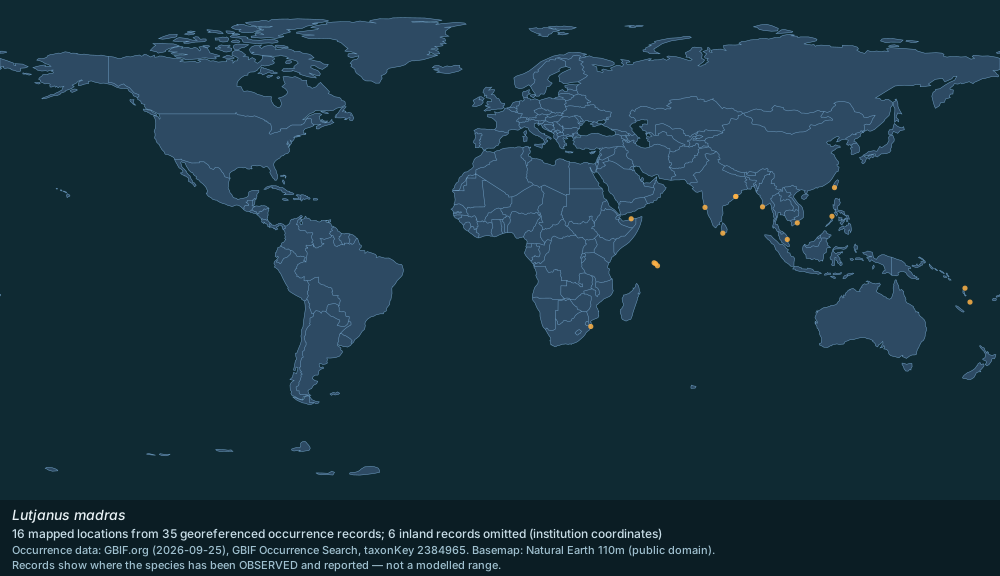
Where the indian snapper (lutjanus madras) has been recorded
Each dot is a place where the species has been observed and reported (35 records, half-degree grid) — not a modelled range. 6 inland records left out (institution coordinates).
Map: drawn by Codexery. Data: GBIF occurrence search (records CC0 / CC BY) · Natural Earth basemap (public domain) · place coordinates: Wikipedia (CC BY-SA 4.0)
Classification (WoRMS)
Full classification as recorded by WoRMS: Kingdom: Animalia · Phylum: Chordata · Class: Teleostei · Order: Eupercaria incertae sedis · Family: Lutjanidae · Genus: Lutjanus.
Accepted name: Lutjanus madras · Authority: (Valenciennes, 1831) · Taxonomic status: accepted · AphiaID: 218478.
Synonyms and superseded combinations recorded for this taxon: Mesoprion madras Valenciennes, 1831.
Source: World Register of Marine Species (WoRMS) — https://www.marinespecies.org/aphia.php?p=taxdetails&id=218478 (CC BY 4.0). Accessed 2026-09-25.
Biology and life history (FishBase)
Measured values published by FishBase for Lutjanus madras. Only fields the database actually holds for this species are shown; these are database values, not aquarium guidance.
Maximum length: 32.5 cm · Common length: 20 cm · Depth range: 5–80 m · Habitat zone: reef-associated · Body shape: fusiform / normal · Vulnerability index: 22.5 of 100 · Fishery importance: commercial · Aquarium trade: never/rarely.
FishBase notes: Adults inhabit coral and rocky reefs (Ref. 55) in coastal areas and outer slopes.
Source: FishBase species summary (SpecCode 160) — https://www.fishbase.se/summary/Lutjanus-madras.html (CC BY-NC 3.0 — non-commercial use only). Accessed 2026-09-25.
Distribution and occurrence records (GBIF)
35 georeferenced occurrence records for Lutjanus madras are published through GBIF from 14 countries or marine areas. The map above plots 16 distinct locations from a sample of 35 records, omitting 6 inland records that carry an institution's coordinates rather than a collection site; it shows where the species has been observed and reported, not a modelled range.
Most records by country or area: Seychelles (8); Thailand (5); India (4); Sri Lanka (3); Chinese Taipei (3); Malaysia (2); Oman (2); Vanuatu (2); Myanmar (1); Philippines (1); Singapore (1); Somalia (1); Viet Nam (1); South Africa (1).
Marine regions with a valid WoRMS distribution record: Seychellois Exclusive Economic Zone.
Source: GBIF Occurrence Search (taxonKey 2384965) — https://www.gbif.org/occurrence/search?taxon_key=2384965&has_coordinate=true (records CC0 / CC BY); WoRMS distribution records (MarineRegions) — https://www.marinespecies.org/aphia.php?p=taxdetails&id=218478 (CC BY 4.0); Natural Earth 110m basemap — https://www.naturalearthdata.com/ (public domain). Accessed 2026-09-25.
Conservation status (IUCN Red List)
The IUCN Red List assesses Lutjanus madras (Valenciennes, 1831) as Least Concern (code LC). No trend, population estimate or threat analysis is given here, because none is available from this source without the Red List API; follow the source link for the full assessment, including its date.
Source: IUCN Red List of Threatened Species (taxon 194369) — https://www.iucnredlist.org/species/194369/0; GBIF IUCN Red List category endpoint (taxonKey 2384965) — https://api.gbif.org/v1/species/2384965/iucnRedListCategory. Accessed 2026-09-25.
Description and natural history (Wikipedia)
Lutjanus madras was first formally described as Mesoprion madras in 1831 by the French zoologist Achille Valenciennes with the type locality given as Mahé in the Seychelles. The specific name madras is the local name for this fish on Mahé. The yellowfin snapper (Lutjanus xanthopinnis) which was described from Japan in 2013 was thought to account for the Pacific records of L. madras.
Description
Lutjanus madras has a fusiform, slender body which has a standard length that is 2.6 to 3.1 times as long as the body at its deepest point. It has a moderately to gently sloped forehead and the preopercular incision and knob are weakly developed. The vomerine teeth are arranged in a triangular patch with a central rearwards extension, or it is diamond shaped, and the tongue has a patch of grain-like teeth. The dorsal fin has 10-11 spines and 13-14 soft rays while the anal fin contains 3 spines and 8-9 soft rays.
The rear of the dorsal fin and the anal fin have an angular profile, the pectoral fins have 16-17 rays and the caudal fin is truncate or weakly emarginate. This fish attains a maximum total length of 30 cm, although 20 cm is more typical.
The colour of the upper back is brownish, the flanks are whitish marked with a series of very thin yellow longitudinal lines, one on each scale row on the lower half of the body. Above the lateral line there are fine brownish lines running diagonally. The fins, other than the pelvic fins which are whitish or very light yellow, are yellow.
Distribution and habitat
Lutjanus madras was thought to have a distribution restricted to the western Indian Ocean and had been recorded from Zanzibar, the Seychelles, Oman, southern India and Sri Lanka. It was thought that L. xanthopinnis replaced this species in the Pacific Ocean but there is a recent record of L. madras from the Philippines. This species occurs at depths between 5 and 90 m on coral and rocky reefs.
Biology
Lutjanus madras gathers in small to large aggregations around coral or rocky outcrops. This species is spawns pelagic eggs, forming aggregations for spawning. This is a predatory species which hunts during the day.
Fisheries
Lutjanus madras is a common item in the fish markets of the Andaman and Nicobar Islands where it is caught using handlines. In other areas subsistence fisheries may use gill nets and traps to catch this species.
Source: Wikipedia: Lutjanus madras — https://en.wikipedia.org/wiki/Lutjanus_madras (CC BY-SA 4.0). Accessed 2026-09-25.
Sources
Compiled from Wikipedia and the sources listed below. Text from Wikipedia is available under CC BY-SA 4.0; this entry is adapted from it.
- Wikipedia: Lutjanus madras (CC BY-SA 4.0).
- Classification: the source article's taxobox; compare WoRMS, the World Register of Marine Species (CC BY 4.0).
- Conservation status: IUCN Red List assessment.
- Occurrence records: GBIF (CC0 / CC BY). Basemap: Natural Earth (public domain).
- Biology values: FishBase species summary (CC BY-NC 3.0, non-commercial).
- Word definitions: the , each quoted from its Wikipedia article.
Spotted an error? Know more?
Reader corrections go straight into our review queue. Suggest an edit · How this site is sourced