
Dense-clumped kelp (Laminaria sinclairii)
Source-cited species reference: taxonomy from WoRMS, biology from SeaLifeBase, occurrence map from GBIF, description from Wikipedia.
Laminaria sinclairii is a species of brown algae (the class Phaeophyceae), in the family Laminariaceae, commonly referred to as "seaweed". It is native to the lower intertidal zone of the northeastern Pacific Ocean from British Columbia southwards to California.
- Scientific name
- Laminaria sinclairii
- Authority
- (Harvey ex J.D.Hooker & Harvey) Farlow, Anderson & Eaton, 1878
- Family
- Laminariaceae
- Order
- Laminariales
- Habitat zone
- sessile
- Gbif occurrence records
- 1,455
Classification (WoRMS)
Full classification as recorded by WoRMS: Kingdom: Chromista · Phylum: Ochrophyta · Class: Phaeophyceae · Order: Laminariales · Family: Laminariaceae · Genus: Laminaria.
Accepted name: Laminaria sinclairii · Authority: (Harvey ex J.D.Hooker & Harvey) Farlow, Anderson & Eaton, 1878 · Taxonomic status: accepted · AphiaID: 372507.
Synonyms and superseded combinations recorded for this taxon: Laminaria andersonii Eaton ex Hervey, 1881; Lessonia sinclairii Harvey ex J.D.Hooker & Harvey, 1847.
Source: World Register of Marine Species (WoRMS) — https://www.marinespecies.org/aphia.php?p=taxdetails&id=372507 (CC BY 4.0). Accessed 2026-09-23.
Biology and life history (SeaLifeBase)
Measured values published by SeaLifeBase for Laminaria sinclairii. Only fields the database actually holds for this species are shown; these are database values, not aquarium guidance.
Habitat zone: sessile.
Source: SeaLifeBase species summary (SpecCode 116847) — https://www.sealifebase.se/summary/Laminaria-sinclairii.html (CC BY-NC 3.0 — non-commercial use only). Accessed 2026-09-23.
Distribution and occurrence records (GBIF)
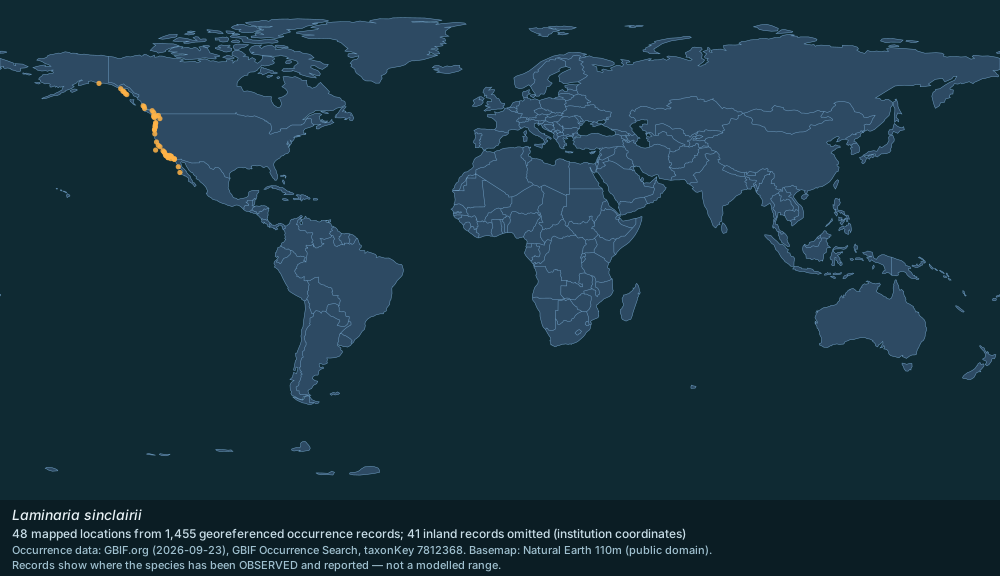
1,455 georeferenced occurrence records for Laminaria sinclairii are published through GBIF from 4 countries or marine areas. The map above plots 48 distinct locations from a sample of 1,455 records, omitting 41 inland records that carry an institution's coordinates rather than a collection site; it shows where the species has been observed and reported, not a modelled range.
Most records by country or area: United States of America (1,398); Canada (40); Mexico (16); South Africa (1).
The full country table, WoRMS marine regions and the sampling notes are on this species' Distribution page.
Source: GBIF Occurrence Search (taxonKey 7812368) — https://www.gbif.org/occurrence/search?taxon_key=7812368&has_coordinate=true (records CC0 / CC BY); WoRMS distribution records (MarineRegions) — https://www.marinespecies.org/aphia.php?p=taxdetails&id=372507 (CC BY 4.0); Natural Earth 110m basemap — https://www.naturalearthdata.com/ (public domain). Accessed 2026-09-23.
Description and natural history (Wikipedia)
This dark brown, perennial kelp grows from a creeping, branching rhizome which sends up thalli at intervals. The thalli are ribbon-like and grow to a length of about 1 m and width of 3 cm with a smooth surface and entire edges. They grow on short, cylindrical stipes some 10 cm long and 5 mm wide containing many mucilage ducts. It is very similar in appearance to Laminaria longipes but that species does not have mucilage glands in the stipes. In 1972, the American phycologist James W. Markham did some transplanting experiments to try to determine whether the presence of mucilage glands is a distinctive feature or the two species were identical. He found that they were indeed distinct and that there were some other differences between the two related to the width of blades, the shedding of the blades, the morphology of the reproductive structures, temperature tolerance and habitat preference.
Laminaria sinclairii is found in the northeastern Pacific Ocean, its range extending from Vancouver Island in British Columbia, southwards to Ventura County, California. It occurs on rocky substrates, sometimes partially covered in sand, in the lower part of the intertidal zone.
This is the dominant seaweed on rocks in the lower part of the intertidal zone in Oregon on beaches where sand levels fluctuate dramatically at different times of year. In March and April new thalli appear from the rhizomes but these blades are progressively buried by rising sand levels which results in the complete burial of the plants over the summer. With the arrival of storms in the fall, the sand is scoured away and the thalli reappear. Reproductive sori are produced on the old blades before they are shed in December and on the new blades that grow in the spring.
Source: Wikipedia: Laminaria sinclairii — https://en.wikipedia.org/wiki/Laminaria_sinclairii (CC BY-SA 4.0). Accessed 2026-09-23.
Gallery
Related in Dense-clumped kelp
Links follow this subject's own source article.
Elsewhere in Dense-clumped kelp
Spotted an error? Know more?
Reader corrections go straight into our review queue. Suggest an edit · How this site is sourced