Laminaria ochroleuca
Source-cited species reference: taxonomy from WoRMS, biology from SeaLifeBase, occurrence map from GBIF, description from Wikipedia.
Last updated

Distribution map plotted from GBIF.org occurrence records; basemap Natural Earth 110m · GBIF records CC0 / CC BY; Natural Earth public domain
Laminaria ochroleuca is a large kelp, an alga in the order Laminariales. They are commonly known as golden kelp, due to their blade colouration, distinguishing them from Laminaria hyperborea
Scientific classification
- CladeEukaryota
- CladeSar<!-- Do not change Sar to SAR. The consensus was to use Sar in the taxonomy template. -->
- CladeStramenopiles
- ClassPhaeophyceae
- OrderLaminariales
- FamilyLaminariaceae
- GenusLaminaria
- SpeciesLaminaria ochroleuca
Named by Bachelot de la Pylaie, 1824
Close relatives
Other species of Laminaria with a Codexery entry.
- Laminaria hyperborea Laminaria hyperborea
- Laminaria abyssalis
- Laminaria agardhii
- Laminaria digitata
- Laminaria nigripes
- Laminaria sinclairii
Sources: Wikipedia taxobox: Laminaria ochroleuca (CC BY-SA 4.0) · order, family and genus agree with WoRMS AphiaID 145728 (CC BY 4.0)
Where the laminaria ochroleuca has been recorded
Each dot is a place where the species has been observed and reported (2,477 records, half-degree grid) — not a modelled range. 40 inland records left out (institution coordinates).
Map: drawn by Codexery. Data: GBIF occurrence search (records CC0 / CC BY) · Natural Earth basemap (public domain)
Quick Facts
- Authority
- Bachelot de la Pylaie, 1824
- Family
- Laminariaceae
- Order
- Laminariales
- Habitat zone
- sessile
- Gbif occurrence records
- 2,477
Facts from the source article.
Classification (WoRMS)
Full classification as recorded by WoRMS: Kingdom: Chromista · Phylum: Ochrophyta · Class: Phaeophyceae · Order: Laminariales · Family: Laminariaceae · Genus: Laminaria.
Accepted name: Laminaria ochroleuca · Authority: Bachelot de la Pylaie, 1824 · Taxonomic status: accepted · AphiaID: 145728.
Synonyms and superseded combinations recorded for this taxon: Laminaria iberica (Hamel) Lami, 1934; Laminaria lejolisii Sauvageau, 1916; Laminaria pallida var. iberica Hamel, 1928.
Source: World Register of Marine Species (WoRMS) — https://www.marinespecies.org/aphia.php?p=taxdetails&id=145728 (CC BY 4.0). Accessed 2026-09-25.
Biology and life history (SeaLifeBase)
Measured values published by SeaLifeBase for Laminaria ochroleuca. Only fields the database actually holds for this species are shown; these are database values, not aquarium guidance.
Habitat zone: sessile.
Source: SeaLifeBase species summary (SpecCode 111071) — https://www.sealifebase.se/summary/Laminaria-ochroleuca.html (CC BY-NC 3.0 — non-commercial use only). Accessed 2026-09-25.
Distribution and occurrence records (GBIF)
2,477 georeferenced occurrence records for Laminaria ochroleuca are published through GBIF from 11 countries or marine areas. The map above plots 57 distinct locations from a sample of 2,477 records, omitting 54 inland records that carry an institution's coordinates rather than a collection site; it shows where the species has been observed and reported, not a modelled range.
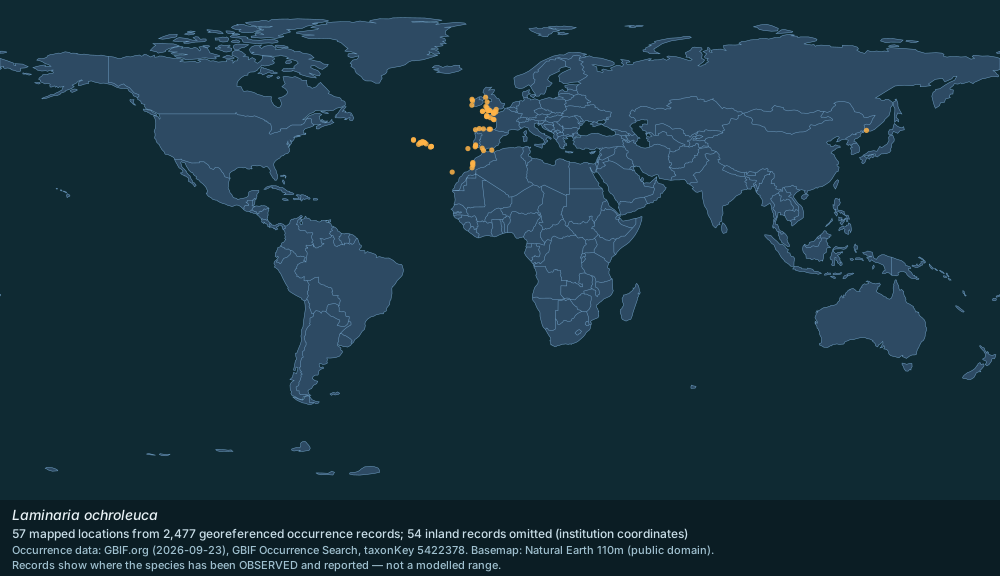
Most records by country or area: United Kingdom of Great Britain and Northern Ireland (935); Portugal (876); Spain (213); France (192); Guernsey (98).
The full country table, WoRMS marine regions and the sampling notes are on this species' Distribution page.
Source: GBIF Occurrence Search (taxonKey 5422378) — https://www.gbif.org/occurrence/search?taxon_key=5422378&has_coordinate=true (records CC0 / CC BY); WoRMS distribution records (MarineRegions) — https://www.marinespecies.org/aphia.php?p=taxdetails&id=145728 (CC BY 4.0); Natural Earth 110m basemap — https://www.naturalearthdata.com/ (public domain). Accessed 2026-09-25.
Description and natural history (Wikipedia)
This large brown alga can grow to a length of 2 m. It has large leathery blades or fronds which grow from a stipe.
The blade is without a midrib and divided into smooth linear sections. The stipe is stalk-like, stiff, smooth and attached to rocks by a claw-like holdfast. It is similar to Laminaria hyperborea but it is more yellow in colour and does not have the rough stipe of L. hyperborea.
Despite initial belief that the species was declining, investigations in 2022 and 2023 displayed recent growth and abundance of new individuals. It is suspected, however, that due to climate change, the range of Laminaria ochroleuca will shift north. The ideal temperature for the sporophyte phase is 12-22 °C, while the gametophyte has a narrower range of 15-18 °C.
The life-cycle is of the large diploid sporophyte alternating with the microscopic haploid stages producing female gametophytes which are fertilized by male gametophytes (sperm).
This species is found in the Northern Hemisphere, from Morocco to the south of England In the UK, it was first documented in Plymouth Sound in 1946 and its range expansion continues due to climate change. It was found on the northeast coast of England beyond the Humber estuary before 1965.
Laminaria ochroleuca has been shown to possess antimicrobial and antioxidant qualities, as well as a valuable source of nutrition. Actinobacteria strains isolated from Laminaria ochroleuca also revealed anticancer capabilities.
Source: Wikipedia: Laminaria ochroleuca — https://en.wikipedia.org/wiki/Laminaria_ochroleuca (CC BY-SA 4.0). Accessed 2026-09-25.
Related in Laminaria ochroleuca
Links follow this subject's own source article.
Elsewhere in Laminaria ochroleuca
Sources
Compiled from Wikipedia and the sources listed below. Text from Wikipedia is available under CC BY-SA 4.0; this entry is adapted from it.
- Wikipedia: Laminaria ochroleuca (CC BY-SA 4.0).
- Classification: the source article's taxobox; order, family and genus checked against WoRMS, the World Register of Marine Species (CC BY 4.0).
- Occurrence records: GBIF (CC0 / CC BY). Basemap: Natural Earth (public domain).
- Word definitions: the , each quoted from its Wikipedia article.
Spotted an error? Know more?
Reader corrections go straight into our review queue. Suggest an edit · How this site is sourced