
Tangle (Laminaria digitata)
Source-cited species reference: taxonomy from WoRMS, biology from SeaLifeBase, occurrence map from GBIF, description from Wikipedia.
Laminaria digitata is a large brown alga in the family Laminariaceae, also known by the common name oarweed. It is found in the sublittoral zone of the northern Atlantic Ocean.
- Scientific name
- Laminaria digitata
- Authority
- (Hudson) J.V.Lamouroux, 1813
- Family
- Laminariaceae
- Order
- Laminariales
- Habitat zone
- sessile
- Gbif occurrence records
- 23,478
Classification (WoRMS)
Full classification as recorded by WoRMS: Kingdom: Chromista · Phylum: Ochrophyta · Class: Phaeophyceae · Order: Laminariales · Family: Laminariaceae · Genus: Laminaria.
Accepted name: Laminaria digitata · Authority: (Hudson) J.V.Lamouroux, 1813 · Taxonomic status: accepted · AphiaID: 145724.
Synonyms and superseded combinations recorded for this taxon: Ceramium digitatum (Hudson) Stackhouse, 1797; Fucus bifurcatus Gunnerus, 1766; Fucus digitatus Hudson, 1762; Gigantea digitata (Hudson) Stackhouse, 1816; Hafgygia digitata (Hudson) Kützing, 1843; Laminaria bongardiana f. bifurcata (Gunnerus) Postels & Ruprecht, 1840; Laminaria bongardiana var. bifurcata (Gunnerus) Postels & Ruprecht, 1840; Laminaria conica Bory de Saint-Vincent, 1826; Laminaria cucullata (Le Jolis) Foslie, 1883; Laminaria cucullata f. longipes (Foslie) A.D.Zinova, 1950; Laminaria cucullata f. ovata (Le Jolis) Foslie, 1883; Laminaria digitata f. complanata Kjellman, 1877; Laminaria digitata f. cucullata (Le Jolis) Kjellman, 1883; Laminaria digitata f. cuneata Kjellman, 1890; Laminaria digitata f. debilipes Foslie, 1884; Laminaria digitata f. ensifolia (Le Jolis) Kjellman, 1883; Laminaria digitata f. grandifolia Foslie, 1884; Laminaria digitata f. latifolia (C.Agardh) Kjellman, 1877; Laminaria digitata f. latilaciniata (Foslie) Kjellman, 1883; Laminaria digitata f. longipes (Foslie) Kjellman, 1890; Laminaria digitata f. ovata (Le Jolis) Kjellman, 1883; Laminaria digitata f. stenophylla Harvey, 1851; Laminaria digitata f. valida (Foslie) Kjellman, 1883; Laminaria digitata var. debilipes (Foslie) Kjellman, 1890; Laminaria digitata var. ensifolia (Kützing) J.Agardh, 1868.
Source: World Register of Marine Species (WoRMS) — https://www.marinespecies.org/aphia.php?p=taxdetails&id=145724 (CC BY 4.0). Accessed 2026-09-23.
Biology and life history (SeaLifeBase)
Measured values published by SeaLifeBase for Laminaria digitata. Only fields the database actually holds for this species are shown; these are database values, not aquarium guidance.
Habitat zone: sessile.
Source: SeaLifeBase species summary (SpecCode 119587) — https://www.sealifebase.se/summary/Laminaria-digitata.html (CC BY-NC 3.0 — non-commercial use only). Accessed 2026-09-23.
Distribution and occurrence records (GBIF)
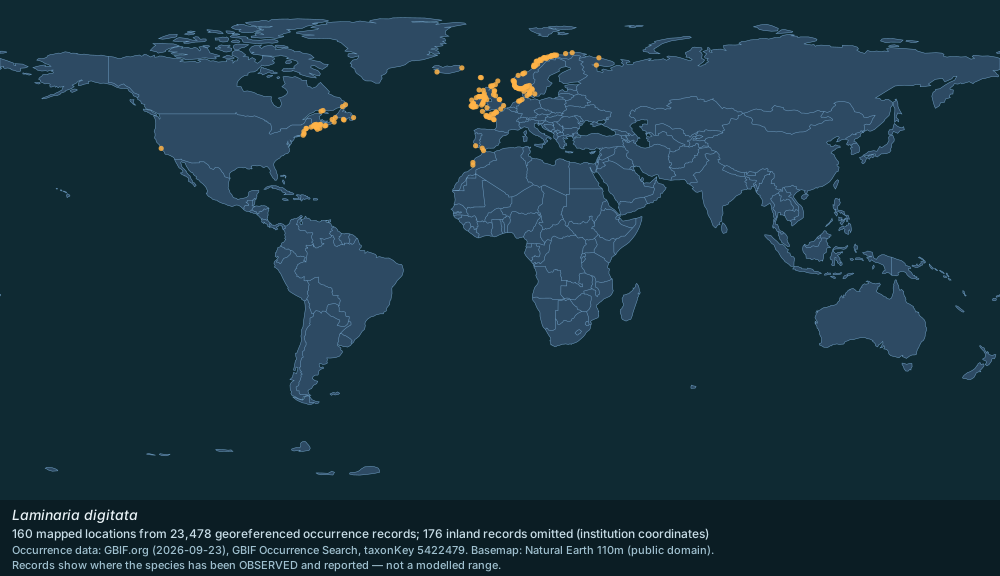
23,478 georeferenced occurrence records for Laminaria digitata are published through GBIF from 27 countries or marine areas. The map above plots 160 distinct locations from a sample of 3,000 records, omitting 176 inland records that carry an institution's coordinates rather than a collection site; it shows where the species has been observed and reported, not a modelled range.
Most records by country or area: United Kingdom of Great Britain and Northern Ireland (7,761); Sweden (4,285); France (2,469); Canada (2,180); Norway (1,975).
The full country table, WoRMS marine regions and the sampling notes are on this species' Distribution page.
Source: GBIF Occurrence Search (taxonKey 5422479) — https://www.gbif.org/occurrence/search?taxon_key=5422479&has_coordinate=true (records CC0 / CC BY); WoRMS distribution records (MarineRegions) — https://www.marinespecies.org/aphia.php?p=taxdetails&id=145724 (CC BY 4.0); Natural Earth 110m basemap — https://www.naturalearthdata.com/ (public domain). Accessed 2026-09-23.
Description and natural history (Wikipedia)
Laminaria digitata is a tough, leathery, dark brown seaweed that grows to 2 or 3 m long. The holdfast which anchors it to the rock is conical and has a number of spreading root-like protrusions called rhizoids. The stipe or stalk is flexible and oval in cross section and may be over 1 inch in diameter and grow to 5 ft in length. The blade is large and shaped like the palm of a hand with a number of more or less regular finger-like segments. This seaweed can be distinguished from the rather similar Laminaria hyperborea by being darker in colour and having a shorter stipe that does not easily snap when bent.
The life cycle is of the large diploid sporophytes and microscopic gametophytes. Spores develop in sori which occur over the central part of the blade.
Laminaria digitata occurs in the north west Atlantic from Greenland south to Cape Cod and in the north east Atlantic from northern Russia and Iceland south to France. It is common round the coasts of the British Isles except for much of the east coast of England.
Laminaria digitata is found mostly on exposed sites on shores in the lower littoral where it may form extensive meadows and can be the dominant algal species. It has a fairly high intrinsic growth rate compared to other algae, 5.5% per day, and a carrying capacity of about 40 kg wet weight per square meter. It may reach lengths of about. It overlaps to a small degree in distribution with Fucus serratus and Alaria esculenta. It is highly susceptible to grazing by sea urchins, among other species. It has low and high light limitation values of about 5 and 70 W per square meter respectively. Its distribution is also limited by salinity, wave exposure, temperature, desiccation and general stress. These and other attributes of the alga are summarized in the publications listed below.
It is a known host of the pathogenic fungus Phycomelaina laminariae.
Laminaria digitata is harvested offshore of France, Morocco and Ireland. Mostly it is used for manufacturing alginic acid. It is used as an ingredient in some cosmetics or (such as in Northern Ireland, Rathlin island) as an ingredient for food industry.
It was traditionally used as a fertiliser and spread on the land. In the 18th century it was burnt to extract the potash it contained for use in the glass industry. In the 19th century it was used for the extraction of iodine.
Historically, the dried stalks of L. digitata, called sea-tangle tents were used in traditional medicine as an abortifacient and for mechanically inducing labour.
Source: Wikipedia: Laminaria digitata — https://en.wikipedia.org/wiki/Laminaria_digitata (CC BY-SA 4.0). Accessed 2026-09-23.
Gallery
Elsewhere in Tangle
Spotted an error? Know more?
Reader corrections go straight into our review queue. Suggest an edit · How this site is sourced