
Sea belt (Saccharina latissima)
Source-cited species reference: taxonomy from WoRMS, biology from SeaLifeBase, occurrence map from GBIF, description from Wikipedia.
Laminaria agardhii is a species of brown kelp, noted by a strong holdfast and finger-like blades.
- Scientific name
- Saccharina latissima
- Authority
- (Linnaeus) C.E.Lane, C.Mayes, Druehl & G.W.Saunders, 2006
- Family
- Laminariaceae
- Order
- Laminariales
- Habitat zone
- sessile
- Gbif occurrence records
- 153,741
Classification (WoRMS)
Full classification as recorded by WoRMS: Kingdom: Chromista · Phylum: Ochrophyta · Class: Phaeophyceae · Order: Laminariales · Family: Laminariaceae · Genus: Saccharina.
Accepted name: Saccharina latissima · Authority: (Linnaeus) C.E.Lane, C.Mayes, Druehl & G.W.Saunders, 2006 · Taxonomic status: accepted · AphiaID: 234483.
Synonyms and superseded combinations recorded for this taxon: Arthrothamnus longipes (Bory) J.Agardh, 1868; Ceramium phyllitis (Stackhouse) Stackhouse, 1797; Ceramium saccharinum (Linnaeus) Stackhouse, 1797; Fucus phyllitis Stackhouse, 1796; Fucus saccharinus Linnaeus, 1753; Fucus saccharinus var. angusto-bullatus Wahlenberg, 1826; Fucus saccharinus var. bullatus Goodenough & Woodward, 1797; Fucus saccharinus var. latissimus Turner, 1811; Hafgygia longicruris (De la Pyl.) Aresch., 1883; Laminaria agardhii Kjellman, 1877; Laminaria bongardiana f. subsimplex (Setchell & N.L.Gardner) Petrov, 1972; Laminaria bullata f. subsimplex Setchell & N.L.Gardner, 1903; Laminaria caperata Bachelot Pylaie, 1824; Laminaria caperata var. eliptica J.Agardh, 1868; Laminaria caperata var. lanceolata J.Agardh, 1868; Laminaria caperata var. oblonga J.Agardh, 1868; Laminaria caperata var. obovata J.Agardh, 1868; Laminaria cuneifolia J.Agardh, 1868; Laminaria cuneifolia f. subsimplex (Setchell & N.L.Gardner) Setchell & N.L.Gardner, 1925; Laminaria faeroensis (Børgesen) Børgesen, 1902; Laminaria faeroensis f. sacchariniformis Børgesen, 1902; Laminaria groenlandica Rosenvinge, 1893; Laminaria hieroglyphica J.Agardh, 1868; Laminaria longicruris Bachelot Pylaie, 1824; Laminaria longicruris var. faeroensis Børgesen, 1896.
Source: World Register of Marine Species (WoRMS) — https://www.marinespecies.org/aphia.php?p=taxdetails&id=234483 (CC BY 4.0). Accessed 2026-09-23.
Biology and life history (SeaLifeBase)
Measured values published by SeaLifeBase for Saccharina latissima. Only fields the database actually holds for this species are shown; these are database values, not aquarium guidance.
Habitat zone: sessile · Aquarium trade: never/rarely.
SeaLifeBase notes: It is found on stony substrates (Ref. 95730).
Source: SeaLifeBase species summary (SpecCode 155096) — https://www.sealifebase.se/summary/Saccharina-latissima.html (CC BY-NC 3.0 — non-commercial use only). Accessed 2026-09-23.
Distribution and occurrence records (GBIF)
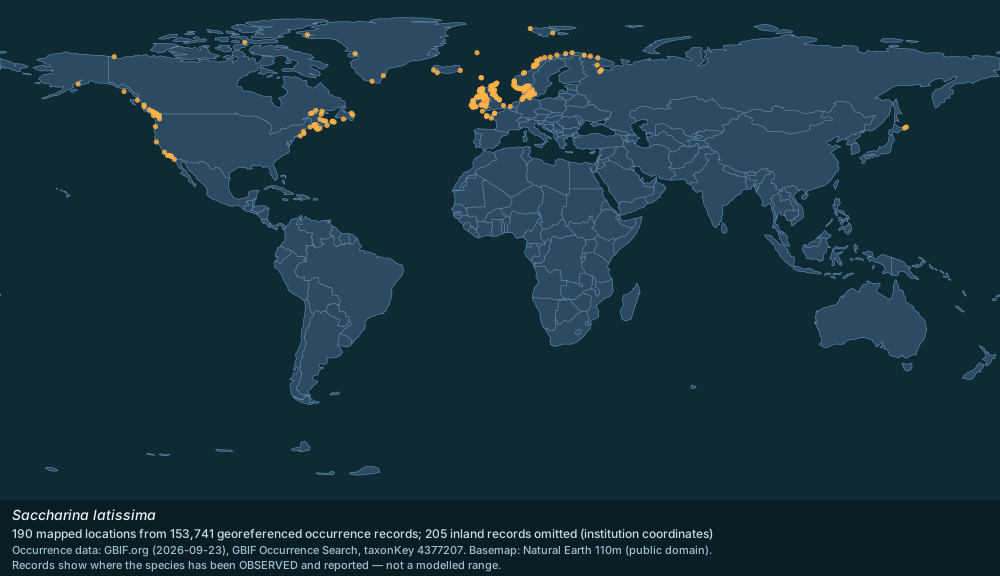
153,741 georeferenced occurrence records for Saccharina latissima are published through GBIF from 39 countries or marine areas. The map above plots 190 distinct locations from a sample of 3,000 records, omitting 205 inland records that carry an institution's coordinates rather than a collection site; it shows where the species has been observed and reported, not a modelled range.
Most records by country or area: United States of America (103,436); United Kingdom of Great Britain and Northern Ireland (27,388); Sweden (9,058); Canada (3,354); Norway (2,638).
The full country table, WoRMS marine regions and the sampling notes are on this species' Distribution page.
Source: GBIF Occurrence Search (taxonKey 4377207) — https://www.gbif.org/occurrence/search?taxon_key=4377207&has_coordinate=true (records CC0 / CC BY); WoRMS distribution records (MarineRegions) — https://www.marinespecies.org/aphia.php?p=taxdetails&id=234483 (CC BY 4.0); Natural Earth 110m basemap — https://www.naturalearthdata.com/ (public domain). Accessed 2026-09-23.
Description and natural history (Wikipedia)
This species of algae is most commonly found in the northeastern Atlantic Ocean, distribution is as southern as Massachusetts, United States, and northern as Baffin Bay of the Canadian Arctic. This kelp exists in the sublittoral zone, adapted to grow among tidal rocks of depths between 0.5 and 3 meters.
A strong stem secures the plant among sublittoral rocks, the stem can reach 0.5 meters in length, attached to a strong, fibrous holdfast. The blade of the plant is narrow and long, substantially so more than the stem. The blade of the Laminaria agardhii grows to be approximately 30 cm in width, and 3 meters in length.
Laminaria agardhii typically reproduces between September and April, peaking in January. This species of kelp reproduces via sporangia that grow on the surface of blades. The sporangia release zoospores with flagella, allowing for a greater area of dispersal. Gametophytes of Laminaria consist of a chain-like series of cells that grow into a new organism.
Laminaria agardhii has many uses, ranging from traditional medicine to nutritional intake.
Laminaria is high in iodine, a nutrient crucial for proper thyroid function. In addition to promoting thyroid health, members of the family Laminariaceae can be used to induce and aid in labor. Pieces of laminaria can be put in the cervix and water added. The laminaria absorbs the water and enlarges, making the opening of the cervix larger.
Source: Wikipedia: Laminaria agardhii — https://en.wikipedia.org/wiki/Laminaria_agardhii (CC BY-SA 4.0). Accessed 2026-09-23.
Gallery
Elsewhere in Sea belt
Spotted an error? Know more?
Reader corrections go straight into our review queue. Suggest an edit · How this site is sourced