Isis hippuris
Source-cited species reference: taxonomy from WoRMS, biology from SeaLifeBase, occurrence map from GBIF, description from Wikipedia.
Last updated

Paul Asman · via Wikipedia: Isis hippuris · CC BY 4.0
Isis hippuris, also known as sea bamboo (though this common name is ambiguous), is a species of bamboo coral found in the Western Pacific Ocean, commonly near the coasts of Indonesia. I. hippuris reproduce asexually, and is abundant throughout its habitats in Indonesia. For centuries, I. hippuris has been identified by its bamboo or bony-looking structure.
Additionally, it is notable for producing Hippuristanol, a molecule that could potentially have anti-cancer applications. While no actual conclusion regarding Hippuristanol in I. hippuris has been published, scientists and marine biologists continue to study how the molecule could be used in cancer research and recovery. Although only found in the Western Pacific Ocean, I. hippuris is highly sought after across the globe, and is seen as a symbol of beauty.
Scientific classification
- KingdomAnimalia
- PhylumCnidaria
- SubphylumAnthozoa
- ClassOctocorallia
- OrderMalacalcyonacea
- FamilyIsididae
- GenusIsis
- SpeciesIsis hippuris
Named by Linnaeus, 1758
Sources: Wikipedia taxobox: Isis hippuris (CC BY-SA 4.0) · order, family and genus agree with WoRMS AphiaID 290211 (CC BY 4.0)
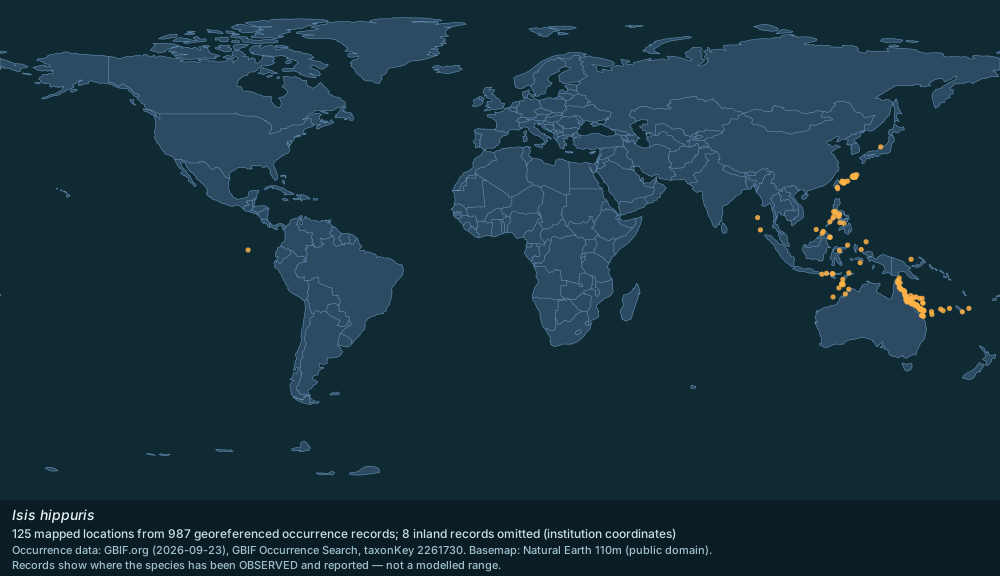
Where the isis hippuris has been recorded
Each dot is a place where the species has been observed and reported (987 records, half-degree grid) — not a modelled range. 8 inland records left out (institution coordinates). 1 isolated far-off record not drawn.
Map: drawn by Codexery. Data: GBIF occurrence search (records CC0 / CC BY) · Natural Earth basemap (public domain) · place coordinates: Wikipedia (CC BY-SA 4.0)
Quick Facts
- Authority
- Linnaeus, 1758
- Family
- Isididae
- Order
- Malacalcyonacea
- Habitat zone
- sessile
- Gbif occurrence records
- 987
Facts from the source article.
Classification (WoRMS)
Full classification as recorded by WoRMS: Kingdom: Animalia · Phylum: Cnidaria · Class: Octocorallia · Order: Malacalcyonacea · Family: Isididae · Genus: Isis.
Accepted name: Isis hippuris · Authority: Linnaeus, 1758 · Taxonomic status: accepted · AphiaID: 290211.
Source: World Register of Marine Species (WoRMS) — https://www.marinespecies.org/aphia.php?p=taxdetails&id=290211 (CC BY 4.0). Accessed 2026-09-25.
Biology and life history (SeaLifeBase)
Measured values published by SeaLifeBase for Isis hippuris. Only fields the database actually holds for this species are shown; these are database values, not aquarium guidance.
Habitat zone: sessile · Aquarium trade: never/rarely.
Source: SeaLifeBase species summary (SpecCode 163374) — https://www.sealifebase.se/summary/Isis-hippuris.html (CC BY-NC 3.0 — non-commercial use only). Accessed 2026-09-25.
Distribution and occurrence records (GBIF)
987 georeferenced occurrence records for Isis hippuris are published through GBIF from 12 countries or marine areas. The map above plots 125 distinct locations from a sample of 987 records, omitting 8 inland records that carry an institution's coordinates rather than a collection site; it shows where the species has been observed and reported, not a modelled range.
Most records by country or area: Australia (855); Philippines (42); Japan (34); Indonesia (19); New Caledonia (10); Malaysia (6); Papua New Guinea (6); Chinese Taipei (5); Palau (4); Timor-Leste (3); India (2); Ecuador (1).
Marine regions with a valid WoRMS distribution record: Indo-West Pacific.
Source: GBIF Occurrence Search (taxonKey 2261730) — https://www.gbif.org/occurrence/search?taxon_key=2261730&has_coordinate=true (records CC0 / CC BY); WoRMS distribution records (MarineRegions) — https://www.marinespecies.org/aphia.php?p=taxdetails&id=290211 (CC BY 4.0); Natural Earth 110m basemap — https://www.naturalearthdata.com/ (public domain). Accessed 2026-09-25.
Description and natural history (Wikipedia)
I. hippurisis a soft coral identified by its yellow-green coloration and thick stalks with a fuzzy appearance. Colonies of I. hippuris commonly grow to a height of 30–40 cm and a width of 10–20 cm, but colonies have been recorded growing to 100 cm in either dimension.
The physical structure of I. hippuris is composed of nodes and inter nodes, essentially "stacked" on top of each other, giving it the nickname sea bamboo. Together, the nodes and inter nodes can create either a skinny or thick structure, and oftentimes look similar to many organism's spine. With this, the I. hippuris coral have also been referred to as "the stony horse-tail", as their structure is their main distinguished identifying characteristic.
A 2015 study on the nodes and inter nodes in I. hippuris showed that it may display multiple phenotypes depending on its environment. The study compared groups of I. hippuris located at two different ridges with Wakatobi Marine National Park (WMNP), Indonesia.
The ridges differed in sediment thickness, height, and color. One phenotype displayed shorter, stockier branches, while the other had longer, thinner branches. It is not entirely clear if these differences indicate differing phenotypes, or if the two ridges contain distinct species.
Habitat and Distribution
I. hippuris is found in tropical coral reefs within the Indo-Pacific region of the Pacific Ocean, particularly off the coasts of Indonesia and India. I. hippuris may be adaptable to its environment, as factors such as sediment thickness, turbidity, and light availability may be linked to phenotypic differences. It has been found that specimens of I. hippuris with longer stalks and more vertical profiles are commonly found at the flats of reefs, while specimens with shorter stalks and more horizontal profiles are found at the crests.
I. hippuris is one of many Gorgonian corals found throughout Indo-Pacific coral reefs. Gorgonian corals are oftentimes dominant members of the benthic communities they're found in, acting almost as centerpieces for the reefs.
Like most Gorgonians, I. hippuris prefers areas with loose substrates and strong water flow. It seems that areas with differing underwater elevations are ideal for diverse groups of Gorgonians, both in regards to overall species richness and differing phenotypes of I. hippuris. Areas with high turbidity and sedimentation are not suitable for Gorgonians.
Feeding
Isis hippuris is a suspension feeder, using their stalks to catch food from the water flow. The differing appearances of I. hippuris stalks can possibly be attributed to this, as longer stalks are more efficient at lower elevations with more competition close to the ground, and shorter, more lateral specimens would excel at the peak of the ridges.
Reproduction
Like other members of the class Anthozoa, I. hippuris is able to reproduce asexually, spawning small larva which go through metamorphosis quickly and take root in sediment to grow into an adult.
Relation to humans
The molecule Hippuristanol present in I. hippuris continues to be studied as a hypothetical approach to leukemia treatment. Hippuristanol is polyoxygenated, and is able to target and diminish the spread and presence of T-cell leukemia in organisms. Researchers have broken down the chemical makeup and studied the functions of Isis hippuris in order to truly determine if there is a correlation between the steroid hippuristanol, and the reduced number of leukemia cells in an organism exposed to hippuristanol. Continuing to research the rate at which hippuristanol is able to eliminate leukemia, and the effectiveness, may ultimately result in a major medical breakthrough.
As I. hippuris is found primarily in coral reefs, it has been affected by the overall destruction of coral reefs by man. The Wakatobi Marine National Park, I. hippuris'''s main habitat, is in theory protected by local government from destructive actions, but in practice the protection is not properly enforced. Additionally, there is a lack of education provided to the local community about the importance of these coral reefs for the worldwide ecosystem, which also contributes to its destruction.
In addition to the typical endangerment that a coral would receive from mankind, I. hippuris has also been sought after and collected for its medicinal purposes. The Indonesian government has placed a protective ban on the collection of I. hippuris'', in attempts to let the species re-flourish.
Source: Wikipedia: Isis hippuris — https://en.wikipedia.org/wiki/Isis_hippuris (CC BY-SA 4.0). Accessed 2026-09-25.
Sources
Compiled from Wikipedia and the sources listed below. Text from Wikipedia is available under CC BY-SA 4.0; this entry is adapted from it.
- Wikipedia: Isis hippuris (CC BY-SA 4.0).
- Classification: the source article's taxobox; order, family and genus checked against WoRMS, the World Register of Marine Species (CC BY 4.0).
- Occurrence records: GBIF (CC0 / CC BY). Basemap: Natural Earth (public domain).
- Biology values: SeaLifeBase species summary (CC BY-NC 3.0, non-commercial).
- Word definitions: the Codexery glossary, each quoted from its Wikipedia article.
Spotted an error? Know more?
Reader corrections go straight into our review queue. Suggest an edit · How this site is sourced