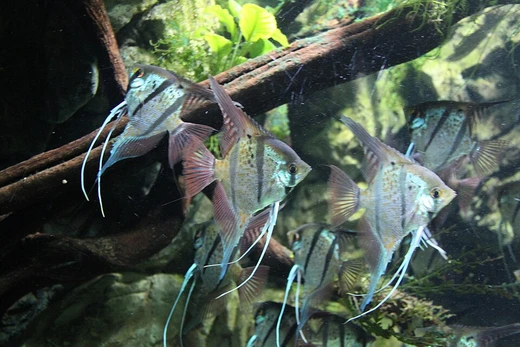
Angelfish (Holacanthus bermudensis)
Source-cited species reference: taxonomy from WoRMS, biology from FishBase, occurrence map from GBIF, conservation from IUCN Red List, description from Wikipedia.

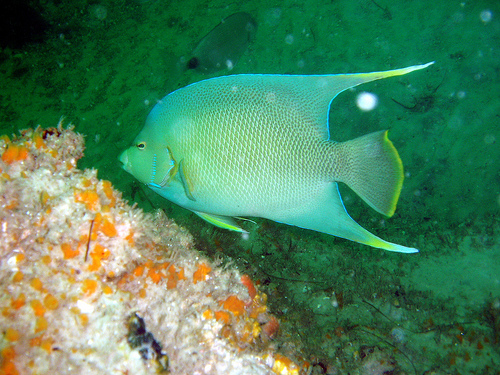
Cliff from Arlington, Virginia, USA · CC BY 2.0
Holacanthus bermudensis, also known as the blue angelfish or Bermuda blue angelfish, is a species of ray-finned fish, a marine angelfish belonging to the family Pomacanthidae. It occurs in the western Atlantic Ocean.
- Scientific name
- Holacanthus bermudensis
- Authority
- Goode, 1876
- Family
- Pomacanthidae
- Order
- Acanthuriformes
- Maximum length
- 45 cm
- Depth range
- 2–92 m
- Habitat zone
- reef-associated
- Iucn red list
- Least Concern
- Gbif occurrence records
- 27,949
Taxonomy & Evolutionary Lineage
The queen angelfish carries a long taxonomic pedigree. Carl Linnaeus first catalogued it in 1758 as Chaetodon ciliaris in the tenth edition of his Systema Naturae, assigning a type locality in the Western Atlantic and Caribbean. Three decades later, French naturalist Bernard Germain de Lacépède shifted it into the genus Holacanthus, a name built from Ancient Greek roots meaning "full" and "spine." The species epithet ciliaris, translating to "fringed," references the fish's ciliate scales. Molecular evidence places the origin of the Holacanthus genus between 10.2 and 7.6 million years ago. The Guinean angelfish, found off West Africa, sits as the sister lineage to every other member, suggesting the group first colonized the Atlantic from the Indian Ocean. The later closure of the Isthmus of Panama, roughly 3.5 to 3.1 million years ago, isolated the Tropical Eastern Pacific species. The queen angelfish's nearest living relative is the Bermuda blue angelfish, from which it diverged about 1.5 million years ago. The two can still interbreed, producing the fertile Townsend angelfish, a hybrid blending traits of both parents that can itself reproduce with either parent species or with other hybrids.
Appearance & Color Variation
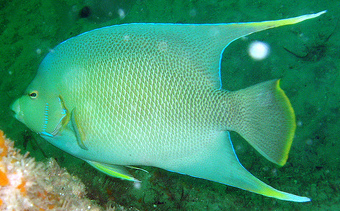
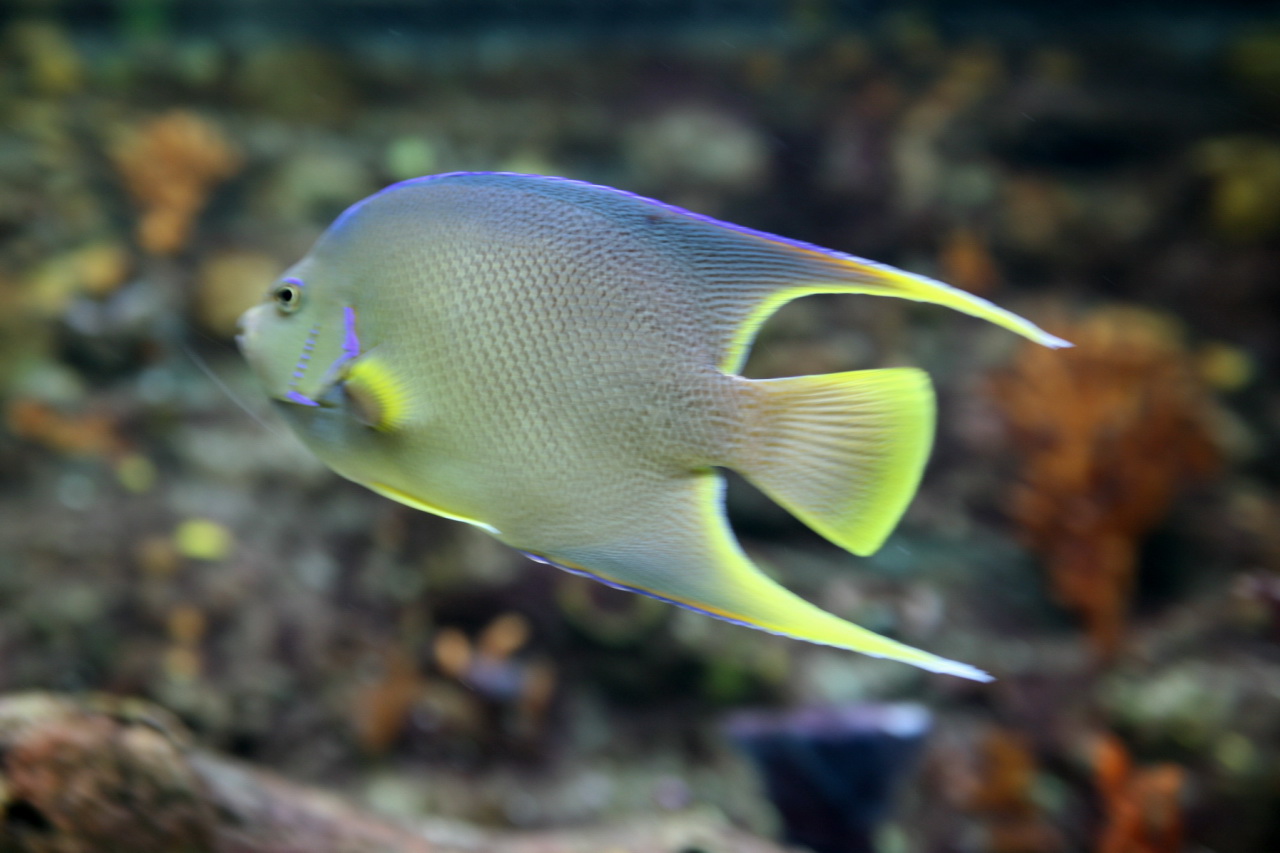
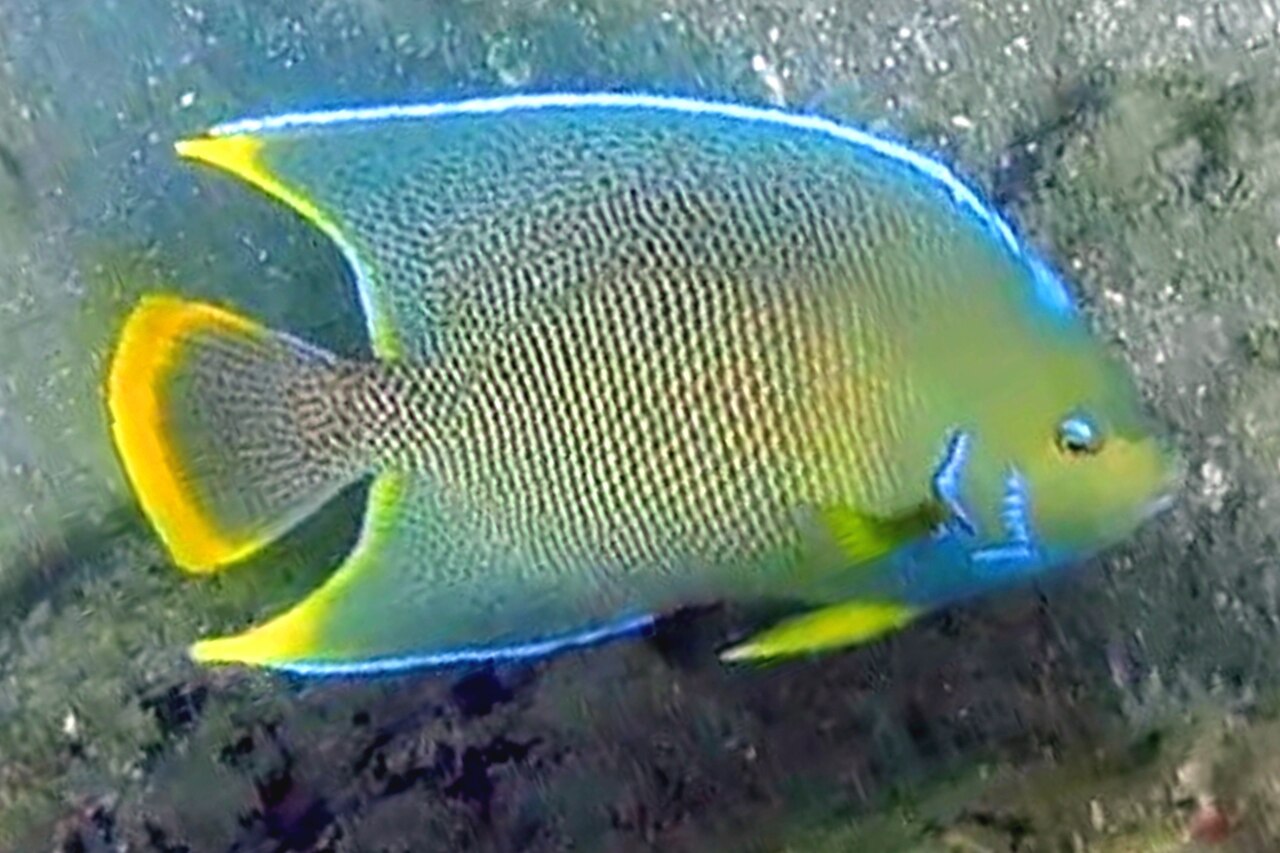
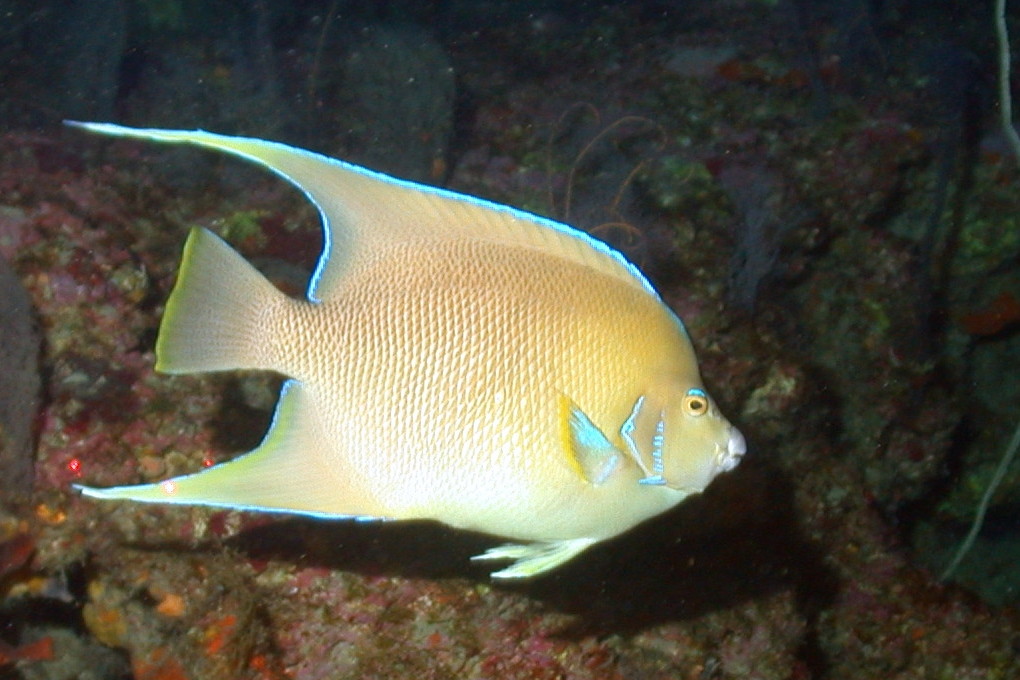
The queen angelfish has a broad, flattened oval body with a triangular tail, a short blunt snout, and a small mouth of bristle-like teeth. Its dorsal fin carries fourteen spines and nineteen to twenty-one soft rays; the anal fin has three spines and twenty to twenty-one soft rays, both trailing behind the body. Adults reach up to forty-five centimeters and sixteen hundred grams, with males generally larger. The fish is covered in blue-green scales with yellow tips, a bright yellow tail and paired fins, and orange-yellow edges on the dorsal and anal fins. Most distinctive is the forehead crown: a cobalt-blue spot ringed in electric blue and dotted with tiny blue marks, the single feature separating it from the closely resembling Bermuda blue angelfish. Juveniles look entirely different—dark blue with vivid vertical stripes and a yellow pectoral area. Seven extra color morphs have been logged around the Saint Peter and Saint Paul Archipelago, including mostly gold, bright orange, and all-white individuals. A cobalt-blue form with white and yellow-orange patches turned up off Dry Tortugas, Florida, in 2009. Two wild fish at the archipelago also showed a pughead deformity, a squashed upper jaw with a protruding lower jaw, a condition more typical of captivity.
Social Structure & Reproduction
Queen angelfish organize their lives around a harem system: one dominant male holds a large territory and mates with two to four females. The species is believed to be protogynous, meaning individuals likely begin life as females; if the territorial male dies or departs, the largest female in the group may transition into a male role. Daily life within the harem centers on midday foraging. Each female leaves to feed independently at a different location, while the male shuttles between them, rushing toward each one, circling, and swimming alongside her as she feeds. This constant male attention appears central to the social bond. Spawning occurs year-round but clusters around the full moon. Courtship involves the male displaying his flank to the female and flicking his pectoral fins. The resulting eggs are transparent and drift freely in the water column until they hatch. Juveniles occupy a completely different ecological niche. Rather than foraging for sponges like adults, young queen angelfish serve as cleaner fish, establishing stations where they remove ectoparasites from larger species. Their dark blue, vertically striped appearance is distinct from the adults' blue-and-yellow palette.
Range, Diet & Conservation
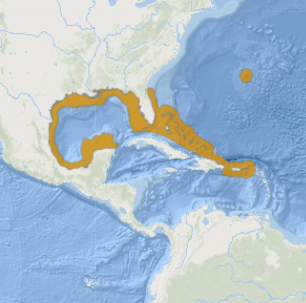
Queen angelfish inhabit tropical and subtropical waters of the Western Atlantic, stretching from Florida's coasts through the Gulf of Mexico and Caribbean Sea down to Brazil. Their range extends eastward to Bermuda and the remote Saint Peter and Saint Paul Archipelago. As benthic species, they favor coral reefs, particularly soft corals, and can be found from shallow inshore waters down to seventy meters. Diet is notably selective. Adults primarily consume sponges, though tunicates, jellyfish, corals, plankton, and algae also appear on the menu. Off St. Thomas and Salvador, Bahia, sponges make up roughly ninety percent of adult intake. At the Saint Peter and Saint Paul Archipelago, more than thirty prey species have been identified, with sponges at sixty-eight percent, algae at twenty-five, and bryozoans at five. The fish specifically target rarer sponge species such as Geodia neptuni and Erylus latens, suggesting preference rather than mere availability drives their feeding. In the aquarium trade, the queen angelfish is a popular and commonly exported species, with Brazil being a particularly significant source. Despite this commercial pressure, the International Union for Conservation of Nature assessed the species as Least Concern in 2010, noting that wild populations appeared stable.
Gallery
Related in Angelfish
Links follow this subject's own source article.
Elsewhere in Angelfish
Spotted an error? Know more?
Reader corrections go straight into our review queue. Suggest an edit · How this site is sourced