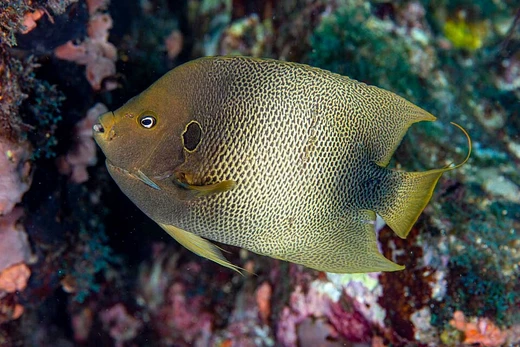
Holacanthus_africanus (Holacanthus africanus)
Source-cited species reference: taxonomy from WoRMS, biology from FishBase, occurrence map from GBIF, conservation from IUCN Red List, description from Wikipedia.

Reeffish · CC BY-SA 4.0
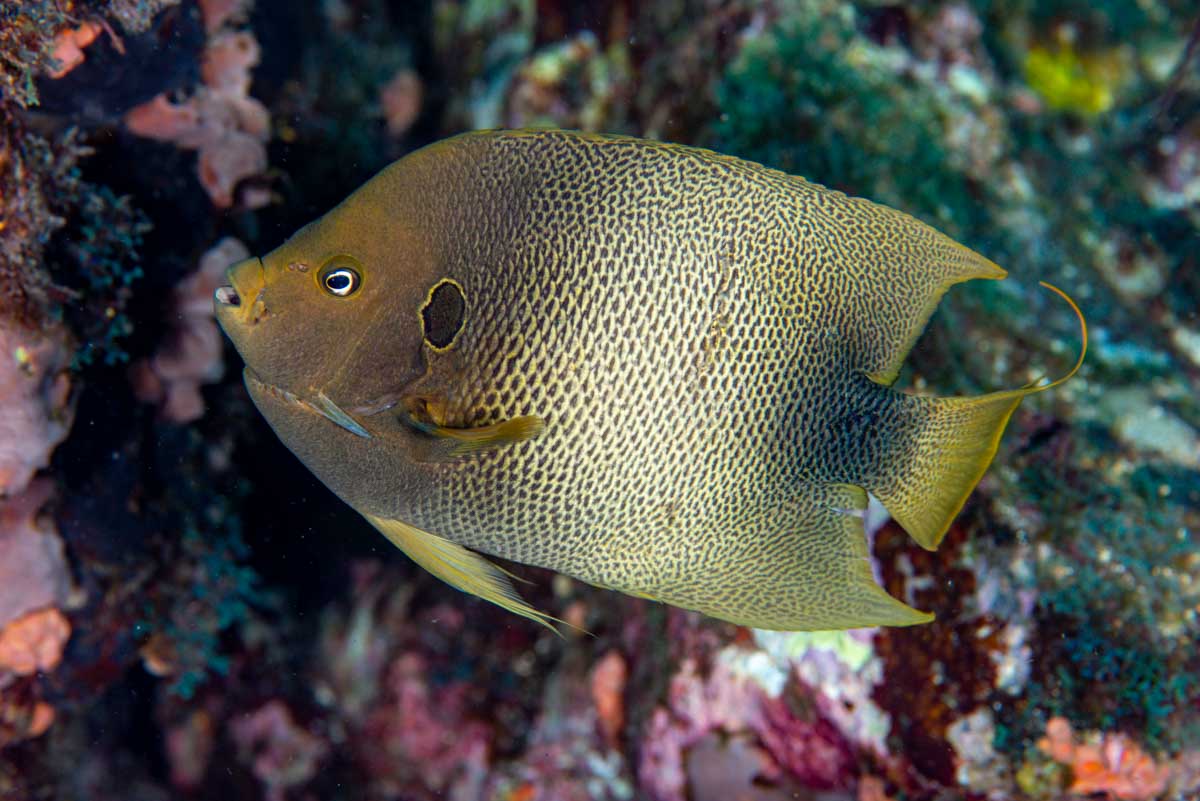
Holacanthus africanus, the Guinean angelfish or West African angelfish, is species of marine ray-finned fish, a marine angelfish belonging to the family Pomacanthidae. It is found in the warmer sections of the eastern Atlantic Ocean off the coast of West Africa.
- Scientific name
- Holacanthus africanus
- Authority
- Cadenat, 1951
- Family
- Pomacanthidae
- Order
- Acanthuriformes
- Maximum length
- 45 cm
- Depth range
- 1–40 m
- Habitat zone
- reef-associated
- Iucn red list
- Least Concern
- Gbif occurrence records
- 671
Taxonomic Identity and the Meaning Behind the Name
The genus Holacanthus belongs to the family Pomacanthidae, the group of marine angelfishes. Its scientific name is a direct translation drawn from Ancient Greek, combining two roots: 'hólos,' which carries the sense of 'full' or 'complete,' and 'ákantha,' referring to a 'spine.' Together, the name essentially evokes the image of a fish bearing a full complement of spines, a fitting descriptor for a member of the angelfish family. Within this genus, Holacanthus africanus holds its place as one of eight recognized species, each contributing to the diversity of what is a relatively compact but visually striking group of reef-associated fish. The family Pomacanthidae is well known among marine biologists and hobbyists alike for producing some of the most visually arresting fish in coral-rich waters, and the Holacanthus lineage sits squarely within that tradition of bold coloration and distinctive body shape that defines the group.
Habitat and the Volcanic Reef Connection
Members of the genus Holacanthus, including the African species, show a marked preference for particular reef environments. They are described as being particularly abundant in the waters surrounding volcanic rocks and coral islands, suggesting a strong ecological tie to geologically active or recently formed substrates. This habitat association is notable because volcanic formations often create complex three-dimensional structures, such as crevices, overhangs, and rugged outcrops, that provide shelter and foraging grounds for reef fish. Coral islands, meanwhile, offer the living framework of polyps and branching structures that many angelfishes rely on for both food and protection. The fact that these fish thrive in such settings indicates an adaptation to environments where hard, rocky surfaces dominate the seafloor landscape. For Holacanthus africanus, this means its natural range is tied to the volcanic and coral island settings where the genus as a whole is most commonly encountered.
Culinary Value and the Aquarium Trade
The eight species within the genus Holacanthus occupy a dual role in human economies. Some members are considered highly valued as a source of food, reflecting their presence in coastal communities where reef fish form an important part of the local diet. However, the genus has found perhaps even greater commercial significance in the ornamental aquarium trade. The driving factor behind this demand is straightforward: every species in the group displays vivid, bright coloration that makes them visually compelling to hobbyists and aquarists. This universal trait of intense coloring sets the genus apart and explains why, even where a species might be caught for the table, the aquarium market often places a higher premium on live specimens. For Holacanthus africanus, this means its striking appearance, shared across all eight congeners, likely makes it a candidate for the same dual exploitation, serving both as a potential food source and as a prized addition to marine display tanks.
A Compact Genus of Eight
The genus Holacanthus is a relatively small group, comprising exactly eight recognized species of marine angelfish. Despite this modest number, the genus represents a distinct lineage within the family Pomacanthidae, each species contributing its own variation on the theme of bright coloration and reef association. The African species, Holacanthus africanus, is one thread in this eight-part tapestry, sharing the genus's hallmark traits: vivid hues, a preference for volcanic and coral island habitats, and the spiny body plan that gives the group its evocative Greek-derived name. The compactness of the genus makes it a manageable unit for taxonomists to study, yet the ecological and economic roles its members play, from food fish to aquarium centerpiece, ensure that even a group of just eight species carries considerable weight in both marine biology and human commerce. The shared characteristics across all eight, particularly the universal bright coloration, underscore a coherent evolutionary identity that unites the genus despite the diversity of its individual members.
Gallery
Spotted an error? Know more?
Reader corrections go straight into our review queue. Suggest an edit · How this site is sourced