
Common sea fan (Gorgonia ventalina)
Source-cited species reference: taxonomy from WoRMS, biology from SeaLifeBase, occurrence map from GBIF, description from Wikipedia.
Gorgonia ventalina, the common sea fan and purple sea fan, is a species of sea fan, an octocoral in the family Gorgoniidae. It is found in the western Atlantic Ocean and the Caribbean Sea.
- Scientific name
- Gorgonia ventalina
- Authority
- Linnaeus, 1758
- Family
- Gorgoniidae
- Order
- Malacalcyonacea
- Depth range
- 0–4 m
- Habitat zone
- sessile
- Gbif occurrence records
- 8,702
Classification (WoRMS)
Full classification as recorded by WoRMS: Kingdom: Animalia · Phylum: Cnidaria · Class: Octocorallia · Order: Malacalcyonacea · Family: Gorgoniidae · Genus: Gorgonia.
Accepted name: Gorgonia ventalina · Authority: Linnaeus, 1758 · Taxonomic status: accepted · AphiaID: 290045.
Synonyms and superseded combinations recorded for this taxon: Rhipidigorgia ventalina (Linnaeus, 1758).
Source: World Register of Marine Species (WoRMS) — https://www.marinespecies.org/aphia.php?p=taxdetails&id=290045 (CC BY 4.0). Accessed 2026-09-23.
Biology and life history (SeaLifeBase)
Measured values published by SeaLifeBase for Gorgonia ventalina. Only fields the database actually holds for this species are shown; these are database values, not aquarium guidance.
Depth range: 0–4 m · Habitat zone: sessile.
SeaLifeBase notes: Minimum depth from Ref. 109199. Intertidal (Ref. 109199).
Source: SeaLifeBase species summary (SpecCode 44144) — https://www.sealifebase.se/summary/Gorgonia-ventalina.html (CC BY-NC 3.0 — non-commercial use only). Accessed 2026-09-23.
Distribution and occurrence records (GBIF)
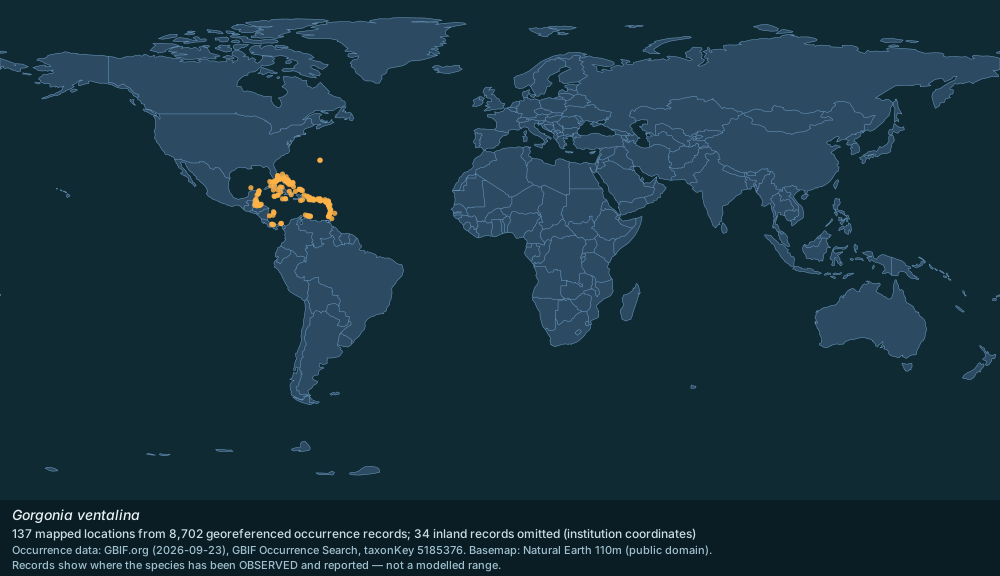
8,702 georeferenced occurrence records for Gorgonia ventalina are published through GBIF from 45 countries or marine areas. The map above plots 137 distinct locations from a sample of 3,000 records, omitting 34 inland records that carry an institution's coordinates rather than a collection site; it shows where the species has been observed and reported, not a modelled range.
Most records by country or area: United States of America (3,364); Puerto Rico (1,421); Mexico (751); Guadeloupe (455); Bonaire, Sint Eustatius and Saba (281).
The full country table, WoRMS marine regions and the sampling notes are on this species' Distribution page.
Source: GBIF Occurrence Search (taxonKey 5185376) — https://www.gbif.org/occurrence/search?taxon_key=5185376&has_coordinate=true (records CC0 / CC BY); WoRMS distribution records (MarineRegions) — https://www.marinespecies.org/aphia.php?p=taxdetails&id=290045 (CC BY 4.0); Natural Earth 110m basemap — https://www.naturalearthdata.com/ (public domain). Accessed 2026-09-23.
Description and natural history (Wikipedia)
G. ventalina is a fan-shaped colonial coral with several main branches and a latticework of linking smaller branches. The skeleton is composed of calcite and gorgonin, a collagen-like compound. The calyces in which the polyps are embedded are in two rows along the branches. Many of the smaller branches are compressed in the plane of the fan, which distinguishes this species from the Venus sea fan (Gorgonia flabellum). It often has small accessory fans growing out sideways from the main fan. It grows to 1.5 m (5 ft) tall and is variable in colour, being whitish, yellow, or pale purple. The main branches are often purple and the fan is orientated at right angles to the current.
The purple sea fan is found in the western Atlantic and Caribbean, with a range extending from Bermuda and Florida and the Gulf of Mexico to Curaçao. It grows near the shore in shallow water in areas with strong wave action and on deeper outer reefs with strong currents down to a depth of about 15 m.
G. ventalina is a filter feeder. Each polyp extends its eight tentacles to catch plankton drifting past on the current. Its tissues contain symbiotic dinoflagellate Symbiodinium spp., which are photosynthetic and use sunlight to create organic carbon compounds which are then available to the host coral.
The skeleton of G. ventalina contains hard structures known as sclerites which are unpalatable to predators. It also contains certain secondary metabolites in its tissues which are distasteful. The nudibranch Tritonia hamnerorum seems undeterred by these defences and is often found associated with the coral. While feeding on the coral, it concentrates the metabolites in its tissues which render it unpleasant to potential predators. This is because T.hamnerorum sequesters the chemical compound julieannfuran from G.ventalina to use as a chemical deterrent to predators.
This coral is sometimes attacked by the fungus Aspergillus sydowii which causes aspergillosis. This results in damaged patches, galls, purpling of the tissues, and even coral death. Several epizootics have occurred in the Caribbean on corals growing in stressful conditions such as in low-salinity water in estuaries which seem especially susceptible. A parasite of the class Labyrinthulomycetes in the family Thraustochytriidae has been found to have similar effects of damaged purple patches on the fan called multifocal purple spots.
A study done in the U.S. Virgin Islands has shown that G. ventalina has a high ecological resilience with populations maintaining their densities after two hurricanes in 2017.
Source: Wikipedia: Gorgonia ventalina — https://en.wikipedia.org/wiki/Gorgonia_ventalina (CC BY-SA 4.0). Accessed 2026-09-23.
Gallery
Related in Common sea fan
Links follow this subject's own source article.
Elsewhere in Common sea fan
Spotted an error? Know more?
Reader corrections go straight into our review queue. Suggest an edit · How this site is sourced