Goniastrea retiformis
Source-cited species reference: taxonomy from WoRMS, biology from SeaLifeBase, occurrence map from GBIF, conservation from IUCN Red List, description from Wikipedia.
Last updated

Hectonichus · via Wikipedia: Goniastrea retiformis · CC BY-SA 3.0
Goniastrea retiformis is a species of stony corals in the family Merulinidae. It is native to shallow water in the Indo-Pacific region.
Scientific classification
- KingdomAnimalia
- PhylumCnidaria
- SubphylumAnthozoa
- ClassHexacorallia
- OrderScleractinia
- FamilyMerulinidae
- GenusGoniastrea
- SpeciesGoniastrea retiformis
Named by (Lamarck, 1816)
Close relatives
Other species of Goniastrea with a Codexery entry.
- Goniastrea favulus Goniastrea favulus
Sources: Wikipedia taxobox: Goniastrea retiformis (CC BY-SA 4.0) · order, family and genus agree with WoRMS AphiaID 207461 (CC BY 4.0)
Conservation status
Least Concern (LC)
- LC▲ this species
- NT
- VU
- EN
- CR
- EW
- EX
Source: IUCN Red List assessment · GBIF copy of the Red List category
Where the goniastrea retiformis has been recorded
Each dot is a place where the species has been observed and reported (1,379 records, half-degree grid) — not a modelled range. 40 inland records left out (institution coordinates).
Map: drawn by Codexery. Data: GBIF occurrence search (records CC0 / CC BY) · Natural Earth basemap (public domain)
Classification (WoRMS)
Full classification as recorded by WoRMS: Kingdom: Animalia · Phylum: Cnidaria · Class: Hexacorallia · Order: Scleractinia · Family: Merulinidae · Genus: Goniastrea.
Accepted name: Goniastrea retiformis · Authority: (Lamarck, 1816) · Taxonomic status: accepted · AphiaID: 207461.
Synonyms and superseded combinations recorded for this taxon: Astraea (Fissicella) eximia Dana, 1846; Astraea eximia Dana, 1846; Astraea retiformis Lamarck, 1816; Astraea spongia Hemprich & Ehrenberg, 1834; Astrea eximia (Dana, 1846); Astrea retiformis Lamarck, 1816; Astrea spongia (Hemprich & Ehrenberg, 1834); Goniastraea retiformis (Lamarck, 1816); Goniastraea retiformis var. bournoni (Milne Edwards & Haime, 1849); Goniastrea bournoni Milne Edwards & Haime, 1849; Goniastrea bournonii Milne Edwards & Haime, 1849; Goniastrea eximia (Dana, 1846).
Source: World Register of Marine Species (WoRMS) — https://www.marinespecies.org/aphia.php?p=taxdetails&id=207461 (CC BY 4.0). Accessed 2026-09-25.
Biology and life history (SeaLifeBase)
Measured values published by SeaLifeBase for Goniastrea retiformis. Only fields the database actually holds for this species are shown; these are database values, not aquarium guidance.
Depth range: 0–30 m · Habitat zone: reef-associated.
SeaLifeBase notes: Sometimes a dominant species of intertidal habitats (Ref. 848).
Source: SeaLifeBase species summary (SpecCode 46759) — https://www.sealifebase.se/summary/Goniastrea-retiformis.html (CC BY-NC 3.0 — non-commercial use only). Accessed 2026-09-25.
Distribution and occurrence records (GBIF)
1,379 georeferenced occurrence records for Goniastrea retiformis are published through GBIF from 46 countries or marine areas. The map above plots 198 distinct locations from a sample of 1,379 records, omitting 40 inland records that carry an institution's coordinates rather than a collection site; it shows where the species has been observed and reported, not a modelled range.
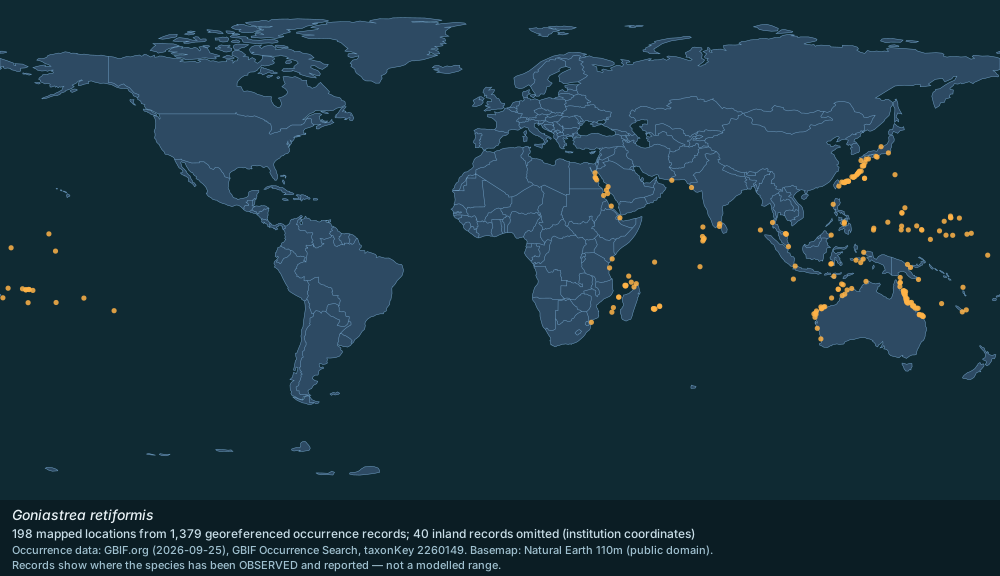
Most records by country or area: Australia (741); Japan (272); American Samoa (44); Mayotte (37); Indonesia (33).
The full country table, WoRMS marine regions and the sampling notes are on this species' Distribution page.
Source: GBIF Occurrence Search (taxonKey 2260149) — https://www.gbif.org/occurrence/search?taxon_key=2260149&has_coordinate=true (records CC0 / CC BY); WoRMS distribution records (MarineRegions) — https://www.marinespecies.org/aphia.php?p=taxdetails&id=207461 (CC BY 4.0); Natural Earth 110m basemap — https://www.naturalearthdata.com/ (public domain). Accessed 2026-09-25.
Conservation status (IUCN Red List)
The IUCN Red List assesses Goniastrea retiformis (Lamarck, 1816) as Least Concern (code LC). No trend, population estimate or threat analysis is given here, because none is available from this source without the Red List API; follow the source link for the full assessment, including its date.
Source: IUCN Red List of Threatened Species (taxon 133634) — https://www.iucnredlist.org/species/133634/0; GBIF IUCN Red List category endpoint (taxonKey 2260149) — https://api.gbif.org/v1/species/2260149/iucnRedListCategory. Accessed 2026-09-25.
Description and natural history (Wikipedia)
This species forms massive colonies, domed, flat or columnar, reaching a maximum diameter of 50 cm and a height of 1 m. It has small deep calices, usually with a diameter of 3 - 4 mm. Corallites are recessed, four to six sided. The basic color of these corals is cream or pale brown, but it may also be brown, pink or green.
This quite common species can be found in the Indo-West Pacific, the Red Sea, the Indian Ocean and the Australian coast. It occurs on reef slopes, especially in shallow waters.
Goniastrea retiformis is a zooxanthellate species of coral. It obtains most of its nutritional needs from the symbiotic dinoflagellates that live inside its soft tissues. These photosynthetic organisms provide the coral with organic carbon and nitrogen, sometimes providing up to 90% of their host's energy needs for metabolism and growth. Its remaining needs are met by the planktonic organisms caught by the tentacles of the polyps.
This coral is a common species with a wide range and large total population size which makes it more resilient than some coral species. The main threats faced by corals are related to the mechanical destruction of their coral reef habitats and climate change; these include increasing damage from extreme weather events, rising sea water temperatures and ocean acidification. The International Union for Conservation of Nature has assessed the conservation status of this species as being of "least concern". All corals receive protection by being listed on CITES Appendix II.
Source: Wikipedia: Goniastrea retiformis — https://en.wikipedia.org/wiki/Goniastrea_retiformis (CC BY-SA 4.0). Accessed 2026-09-25.
Related in Goniastrea retiformis
Links follow this subject's own source article.
Elsewhere in Goniastrea retiformis
Sources
Compiled from Wikipedia and the sources listed below. Text from Wikipedia is available under CC BY-SA 4.0; this entry is adapted from it.
- Wikipedia: Goniastrea retiformis (CC BY-SA 4.0).
- Classification: the source article's taxobox; order, family and genus checked against WoRMS, the World Register of Marine Species (CC BY 4.0).
- Conservation status: IUCN Red List assessment.
- Occurrence records: GBIF (CC0 / CC BY). Basemap: Natural Earth (public domain).
- Biology values: SeaLifeBase species summary (CC BY-NC 3.0, non-commercial).
- Word definitions: the , each quoted from its Wikipedia article.
Spotted an error? Know more?
Reader corrections go straight into our review queue. Suggest an edit · How this site is sourced