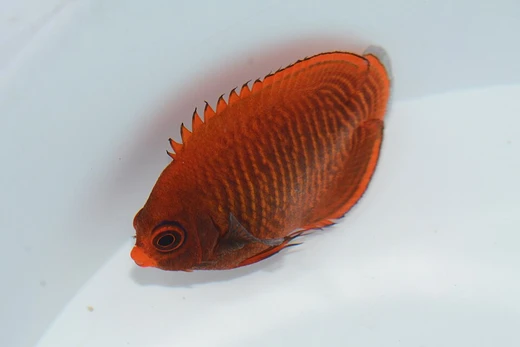
Golden angelfish (Centropyge aurantia)
Source-cited species reference: taxonomy from WoRMS, biology from FishBase, occurrence map from GBIF, conservation from IUCN Red List, description from Wikipedia.

Jokuyken15 · CC BY-SA 4.0
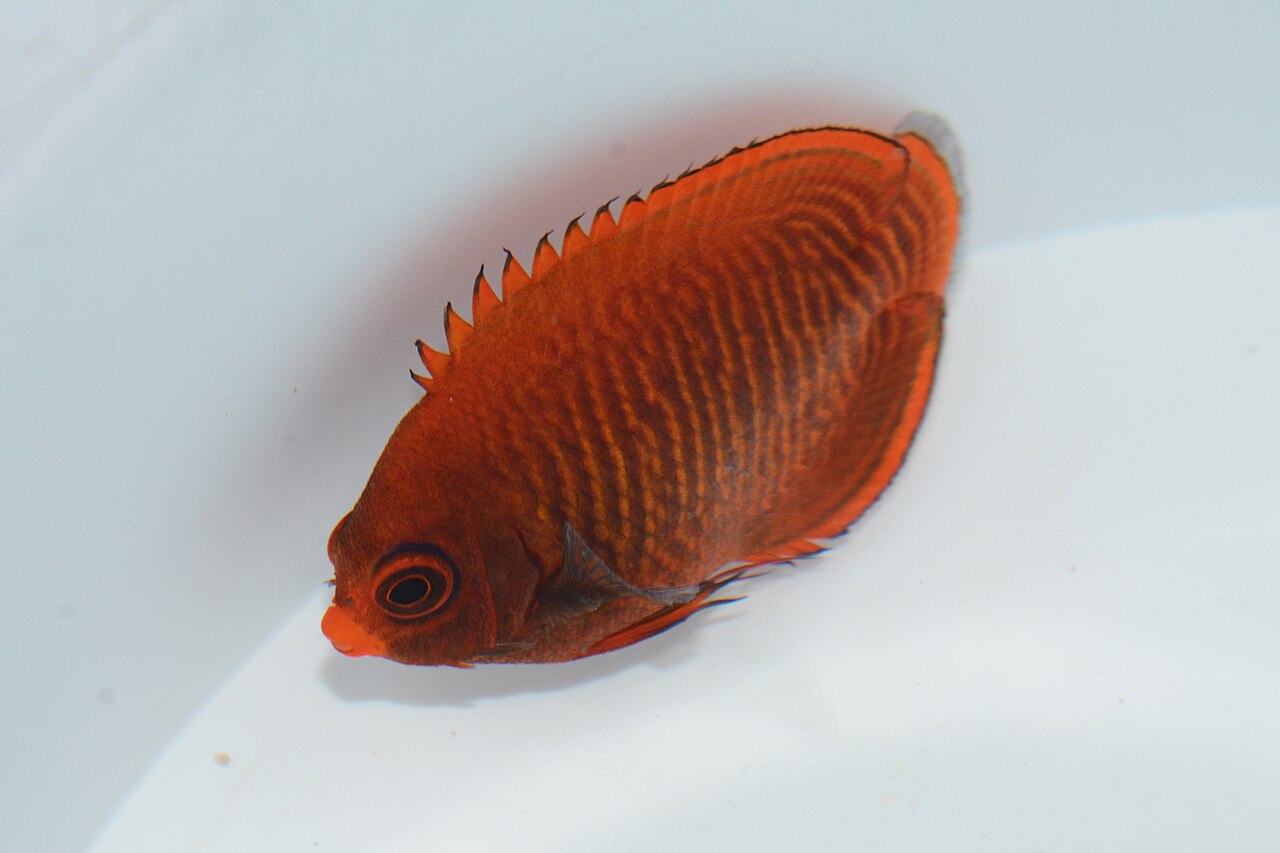
Golden angelfish (Centropyge aurantia), also known as golden pygmy angelfish or velvet dwarf angel, is a small marine ray-finned fish, a marine angelfish belonging to the family Pomacanthidae. It inhabits shallow reefs in the western Pacific Ocean.
- Scientific name
- Centropyge aurantia
- Authority
- Randall & Wass, 1974
- Family
- Pomacanthidae
- Order
- Acanthuriformes
- Maximum length
- 10 cm
- Depth range
- 3–60 m
- Habitat zone
- reef-associated
- Iucn red list
- Least Concern
- Gbif occurrence records
- 27
Striking Form and Colour
The flameback angelfish presents a compact, oval silhouette that is notably deep and compressed from side to side, giving it a disc-like profile typical of its family. Its face is characterized by a short, blunt snout and a correspondingly small mouth, while the preopercular region bears a long, robust spine at its angle with a vertically serrated margin. Behind the bony structure beneath the eye sit two large, rearward-pointing spines, accompanied by a series of smaller spines distributed across both the preopercle and opercle. The colour scheme is immediately arresting: the body is predominantly blue, yet the head and dorsal region blaze in a bright golden-yellow. A distinct blue ring encircles each eye, adding to the facial contrast. The caudal and anal fins are a darker blue densely marked with black spots. Fin architecture includes fourteen to fifteen spines and fifteen to sixteen soft rays in the dorsal fin, while the anal fin carries three spines and seventeen soft rays. The species reaches a maximum total length of just 7.5 centimetres, or roughly three inches.
Geographic Range and Reef Associations
Native to the tropical waters of the Western Atlantic, the flameback angelfish ranges from the Lesser Antilles and Curaçao in the Netherlands Antilles, continuing along the northern South American coastline from Venezuela all the way down to southern Brazil. A single record also places this species in the eastern Atlantic, at São Tomé in the Gulf of Guinea, suggesting a possible trans-oceanic presence. In terms of vertical habitat, the fish occupies a remarkably broad depth window, from as shallow as 15 metres to as deep as 300 metres, spanning roughly 49 to 984 feet. Within that range it favours reef structures and areas of rock rubble, and it may be particularly common in the vicinity of isolated patches of staghorn coral, Acropora cervicornis. Its diet consists of algae and sponges, placing it as a small-scale grazer within these reef communities. The combination of a wide latitudinal spread, deep depth tolerance, and a preference for structured hard-substrate habitats makes the flameback angelfish a notably versatile resident of tropical Atlantic reef ecosystems.
Taxonomic History and the Meaning Behind the Name
The flameback angelfish was first formally described in the scientific literature in 1974 by ichthyologist Warren E. Burgess. The type locality he designated for the species was off Oistins, a coastal area in Barbados, anchoring the original description to a specific Caribbean location. In certain taxonomic frameworks the species is assigned to the subgenus Xiphipops within the genus Centropyge, though its placement has not been universally fixed. The specific epithet aurantonotus is a deliberate compound: aurantia, meaning orange, joined with notus, meaning back. Together they directly reference the species' most visually distinctive feature, the golden-orange coloration covering the head and dorsal region. Beyond its scientific name, the fish accumulates a rich set of common names in English, including flameback pygmy angelfish, Brazilian flameback angelfish, Caribbean flameback angelfish, and fireball angelfish, each reflecting a different regional or visual emphasis. All of these names point to the same small, vividly coloured member of the angelfish family Pomacanthidae.
Reproductive Strategy and the Aquarium Trade
Like other members of the angelfish family, the flameback angelfish reproduces by releasing pelagic eggs, meaning its offspring begin life as free-floating larvae in the water column rather than remaining attached to a substrate. This reproductive strategy is typical of many reef-dwelling marine fishes and allows larval dispersal across open water before juveniles eventually settle onto suitable reef or rubble habitats. In terms of human interaction, the species has long been a favourite of the ornamental aquarium trade. Its compact size, reaching only about 7.5 centimetres, combined with its striking blue-and-gold coloration, makes it an attractive addition to display tanks. During the twentieth century, thousands of individuals were exported from Brazil specifically for this purpose, indicating a substantial commercial fishery operating along the South American coast. The combination of a small adult size, vivid colouration, and a pelagic larval phase that can be harvested from the water column made the flameback angelfish both biologically suited to and commercially valuable within the global aquarium market.
Gallery

Spotted an error? Know more?
Reader corrections go straight into our review queue. Suggest an edit · How this site is sourced