
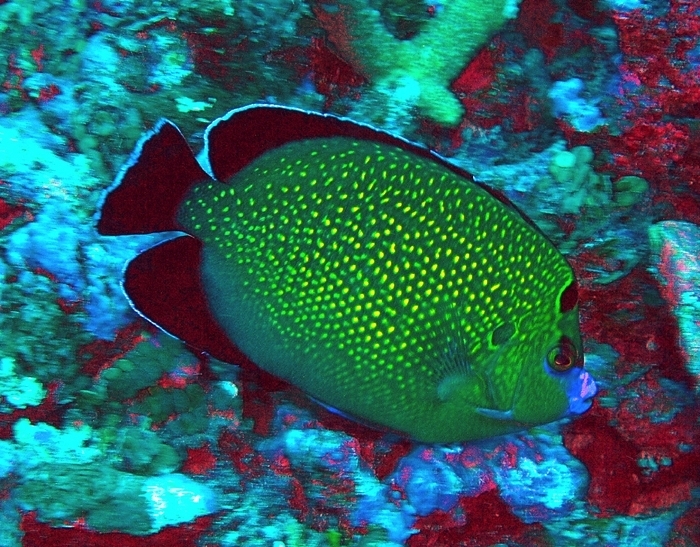
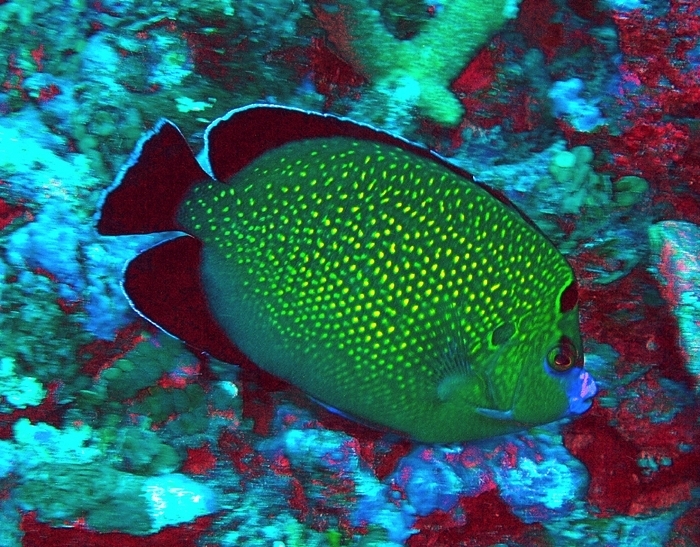
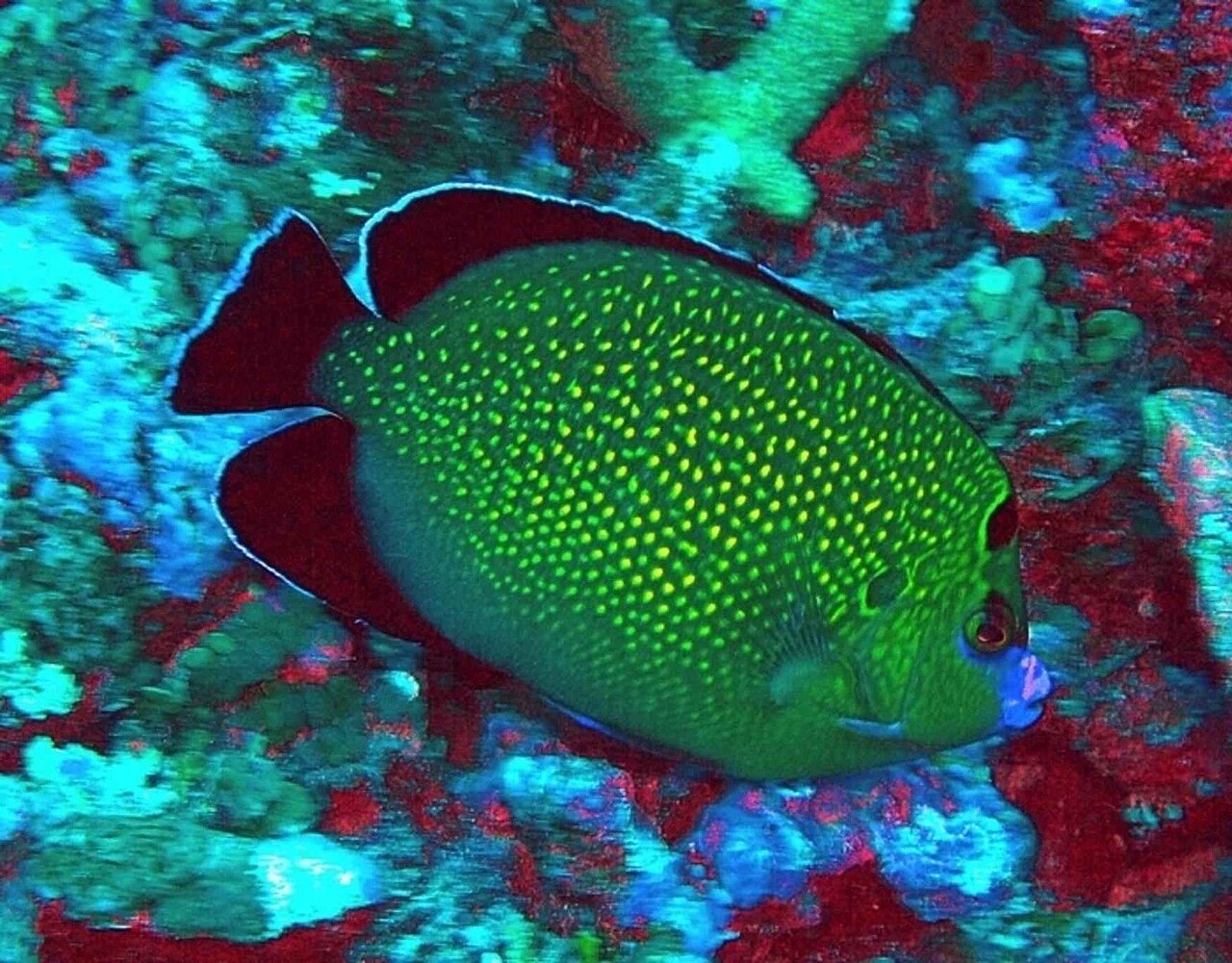
Spotted angelfish (Genicanthus takeuchii)
Source-cited species reference: taxonomy from WoRMS, biology from FishBase, conservation from IUCN Red List, description from Wikipedia.

Jim E Maragos, U.S. Fish and Wildlife Service · Public domain
Genicanthus takeuchii, the spotted angelfish or Takeuchi's angelfish, is a species of marine ray-finned fish, a marine angelfish belonging to the family Pomacanthidae.
- Scientific name
- Genicanthus takeuchii
- Authority
- Pyle, 1997
- Family
- Pomacanthidae
- Order
- Acanthuriformes
- Maximum length
- 25 cm
- Habitat zone
- reef-associated
- Iucn red list
- Least Concern
Discovery & Taxonomic Journey
The spotted angelfish entered the formal scientific record in 1997, when American ichthyologist Richard L. Pyle described the species under the name Holocanthus semifasciatus. The type locality he recorded was Ani-jima, Mansakunohama, located among the Ogasawara Islands off Japan's southeastern coast. The species was subsequently reclassified into the genus Genicanthus, where it now sits alongside other marine angelfishes of the family Pomacanthidae. The specific epithet takeuchii was assigned to honour Hiroshi Takeuchi, a Japanese diver who first brought this fish to the attention of the scientific community. This naming practice reflects a long-standing convention in ichthyology of crediting the individual who first collected or identified a previously unrecognised organism. That a species of this kind remained undescribed until the late twentieth century underscores how little was understood about the deep-water fish assemblages of these remote island chains prior to the 1990s.
Colour, Pattern & Sexual Dimorphism
Like other members of the genus Genicanthus, the spotted angelfish displays pronounced sexual dichromatism, with males and females presenting clearly different colour schemes and markings. Males show a greyish-white upper body crossed by six to eight horizontal stripes, while the lower portion of the body fades to a pale white. Their dorsal fin and caudal fin are each marked with prominent large black spots. Females, by contrast, carry a more uniform greyish-white base overlaid with a dense scattering of black spots concentrated on the upper body and tail. Juveniles of both sexes sport a distinctive honeycomb pattern across the upper body, a trait that presumably transitions into the adult colouration as they mature. Structurally, the species possesses a dorsal fin armed with fifteen spines followed by sixteen soft rays, and an anal fin bearing three spines alongside seventeen or eighteen soft rays. The maximum total length recorded for this angelfish is twenty-five centimetres, or roughly ten inches.
Geographic Range & Deep-Reef Habitat
The spotted angelfish occupies a remarkably limited slice of the northwestern Pacific Ocean. Its confirmed range is centred on Marcus Island and the Ogasawara Islands, a chain lying to the southeast of mainland Japan, with additional records from the Marianas Islands. This restricted distribution makes it one of the more geographically isolated marine angelfishes known to science. In terms of habitat, the species inhabits deep coral reef environments, typically encountered at depths ranging from twenty-five to sixty metres, roughly eighty-two to one hundred and ninety-seven feet. This places it well below the shallow reef zones where most familiar reef fish are observed, in a dimmer, higher-pressure environment where coral communities differ markedly from those at the surface. The species is consistently described as little known, a reflection of both its remote location and the technical difficulty of studying fish at such depths. Very little is documented about its daily behaviour, feeding preferences, or reproductive biology beyond what can be inferred from its physical adaptations and the structure of its reef habitat.
Hybridisation & Absence from the Aquarium Trade
One of the more ecologically interesting aspects of Genicanthus takeuchii is its documented capacity to hybridise with the Japanese swallow, Genicanthus semifasciatus, a closely related congener. This interspecific gene flow adds a layer of taxonomic complexity to an already geographically restricted species, and it is consistent with patterns seen among reef-dwelling angelfishes that share overlapping ranges. On the human-interaction front, the spotted angelfish is notably absent from the ornamental aquarium trade. Unlike many of its reef-dwelling relatives that are collected and sold to hobbyists worldwide, this species has not entered the commercial fish market. Its deep-water habitat, confined to depths of twenty-five to sixty metres, likely makes collection technically demanding, while its restricted range limits available populations. The combination of these factors means the spotted angelfish remains a species known almost exclusively to scientists and experienced deep-water divers, preserving its wild populations from the pressures of commercial exploitation.
Gallery
Spotted an error? Know more?
Reader corrections go straight into our review queue. Suggest an edit · How this site is sourced