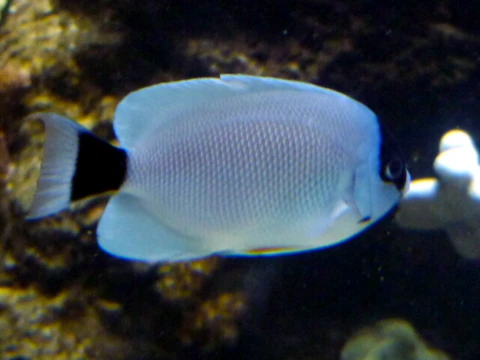
Masked angelfish (Genicanthus personatus)
Source-cited species reference: taxonomy from WoRMS, biology from FishBase, occurrence map from GBIF, conservation from IUCN Red List, description from Wikipedia.

George Berninger Jr. · CC BY-SA 3.0
Genicanthus personatus the masked angelfish, is a species of marine ray-finned fish, a marine angelfish belonging to the family Pomacanthidae. It is endemic to Hawaii.
- Scientific name
- Genicanthus personatus
- Authority
- Randall, 1975
- Family
- Pomacanthidae
- Order
- Acanthuriformes
- Maximum length
- 21 cm
- Depth range
- 20–174 m
- Habitat zone
- reef-associated
- Iucn red list
- Least Concern
- Gbif occurrence records
- 313
The Living Mask: A Life of Dramatic Transformation
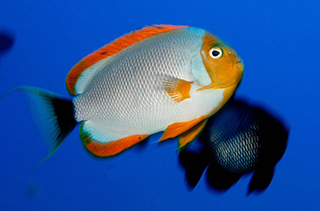
The masked angelfish earns its common name from a striking feature that evolves dramatically across its lifespan. At every stage, the body remains predominantly brilliant white, but the head tells a shifting story. Juveniles wear an almost solid black covering across most of their head, giving them the appearance of a dark mask. As they mature, this mask gradually fragments: the lips lighten to a bluish white, and the caudal fins deepen toward black. In younger sexually mature adults, all of which are female, the black retreats further until it clings only around the eyes, the chin, and the edges of the operculum and its spine, while the pelvic fins take on a yellow hue. The most spectacular transformation arrives when a fish reaches roughly fifteen to eighteen centimetres. At that threshold, dominant individuals may shift sex to become males. The change is vivid: an intense orange-yellow floods the pectoral fins, the entire face, and the margins of the dorsal, anal, and pelvic fins, while the caudal fin lobes sprout long, flowing filamentous extensions. No individual exceeds twenty-one centimetres in total length, yet even at that modest size, the shift from masked juvenile to flamboyant adult is one of the most visually arresting in the marine angelfish family.
A Hawaiian Exclusive: Range and Ecology
Unlike many reef species that roam across broad oceanic regions, the masked angelfish is found nowhere in the world except the Hawaiian Islands, making it a true endemic. Within that archipelago, populations are noticeably more abundant around the northwestern islands, suggesting local environmental conditions there favour the species. In terms of vertical range, the fish occupies a remarkably wide band of depth, from just ten metres down to as much as one hundred and fifty metres. Within that range it favours rocky reef structures and the outer slopes of reefs, environments that likely provide both the structural complexity it needs and the food sources it depends on. Its diet is varied: it feeds on green algae belonging to the genus Codium, on small planktonic organisms drifting through the water column, and even on the eggs of other fish. This mixed foraging strategy allows it to exploit several ecological niches simultaneously, from grazing on benthic algae to picking up suspended particles and scavenging reproductive remnants left by neighbouring species.
Naming and Discovery
For decades the masked angelfish went unnamed in the scientific literature, existing only as an unclassified curiosity among Hawaiian reef collections. That changed in 1975, when the American ichthyologist John Ernest Randall, a figure whose career spanned the mid-twentieth century and who passed away in 2020, formally described the species and gave it the binomial Genicanthus personatus. The type locality he recorded was Honolulu on the island of Oahu, anchoring the species to a specific, well-known point in the Hawaiian archipelago. The specific epithet personatus is drawn from Latin and simply means masked, a direct reference to the dark head pattern that juveniles and younger females display. Taxonomically, the fish sits within the family Pomacanthidae, the marine angelfishes, and is classified as a ray-finned fish. Randall's description placed this small, endemic Hawaiian species firmly within the broader angelfish lineage, linking its protogynous hermaphroditism and reef lifestyle to a well-understood group of marine fishes while preserving the unique identity that its restricted range and distinctive colouration provide.
Rarity and the Aquarium World
In the global aquarium trade, the masked angelfish occupies a peculiar and coveted position. Because its entire wild range is confined to the Hawaiian Islands and even there it is not a common sight, specimens reaching the commercial market are exceedingly scarce. That extreme rarity translates directly into price: when a live individual does appear for sale, it commands a premium that far exceeds most other marine angelfishes, reflecting both the difficulty of sourcing and the visual appeal of its dramatic colour phases. Collectors and public aquaria that manage to acquire one do so with considerable effort, and the fish's sequential protogynous hermaphroditism adds an extra layer of interest, since a single specimen may one day display the bold orange-yellow male livery after initially presenting as a masked female. Encouragingly, the species has been successfully bred in captivity, a milestone that offers a more sustainable path for keeping and studying the fish without placing additional pressure on its small, geographically restricted wild populations in Hawaiian waters.
Gallery
Spotted an error? Know more?
Reader corrections go straight into our review queue. Suggest an edit · How this site is sourced