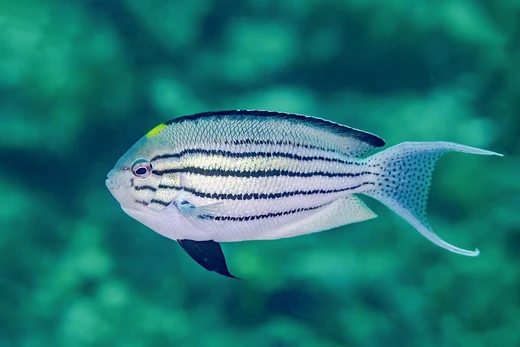
Blackstriped angelfish (Genicanthus lamarck)
Source-cited species reference: taxonomy from WoRMS, biology from FishBase, occurrence map from GBIF, conservation from IUCN Red List, description from Wikipedia.

Rickard Zerpe · CC BY 2.0
Genicanthus lamarck, the blackstriped angelfish or Lamarck's angelfish, is a species of marine ray-finned fish, a marine angelfish belonging to the family Pomacanthidae. It occurs in the Indo-West Pacific region.
- Scientific name
- Genicanthus lamarck
- Authority
- (Lacepède, 1802)
- Family
- Pomacanthidae
- Order
- Acanthuriformes
- Maximum length
- 25 cm
- Depth range
- 10–50 m
- Habitat zone
- reef-associated
- Iucn red list
- Least Concern
- Gbif occurrence records
- 469
Physical Appearance and Sexual Dimorphism
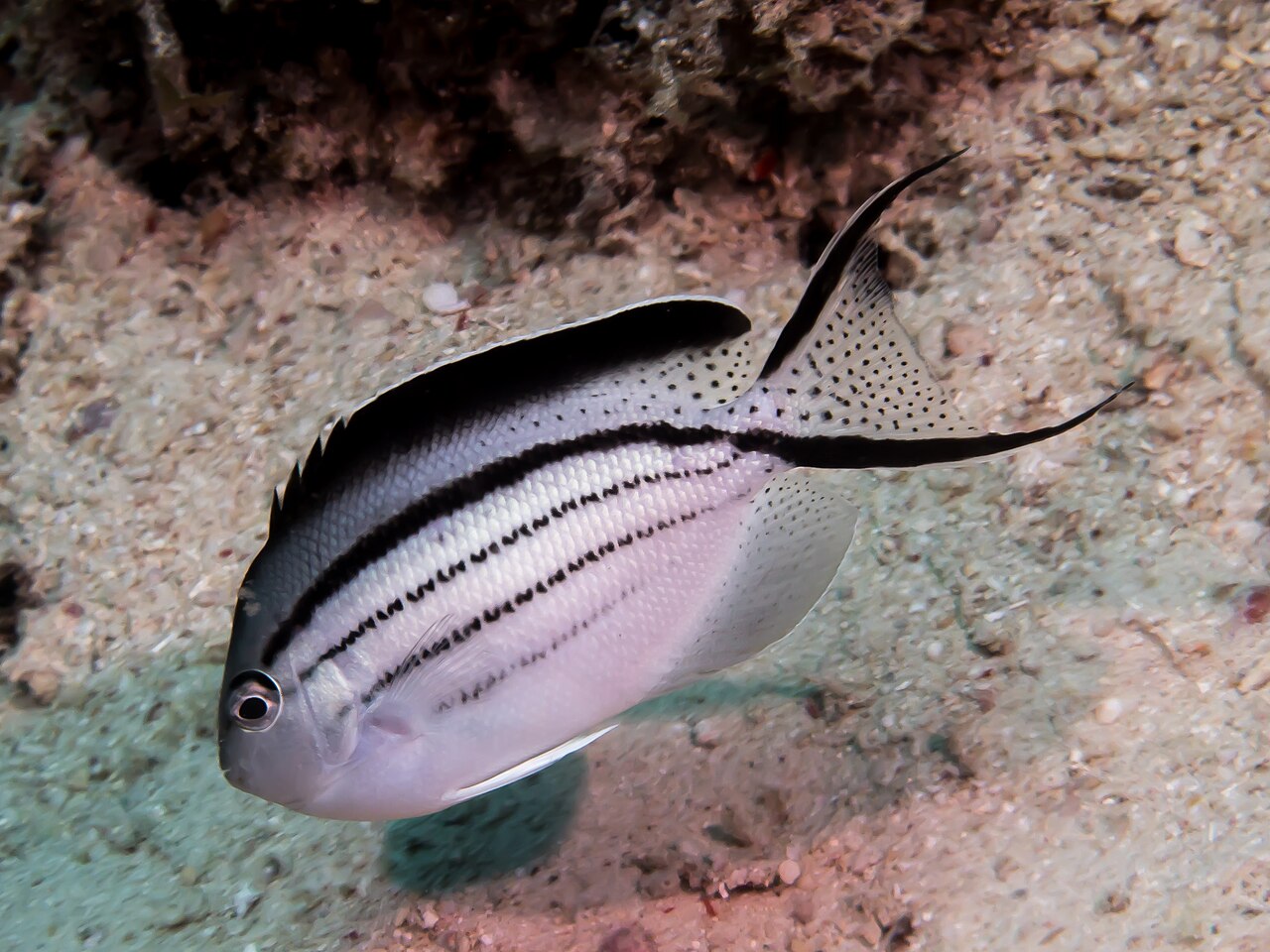
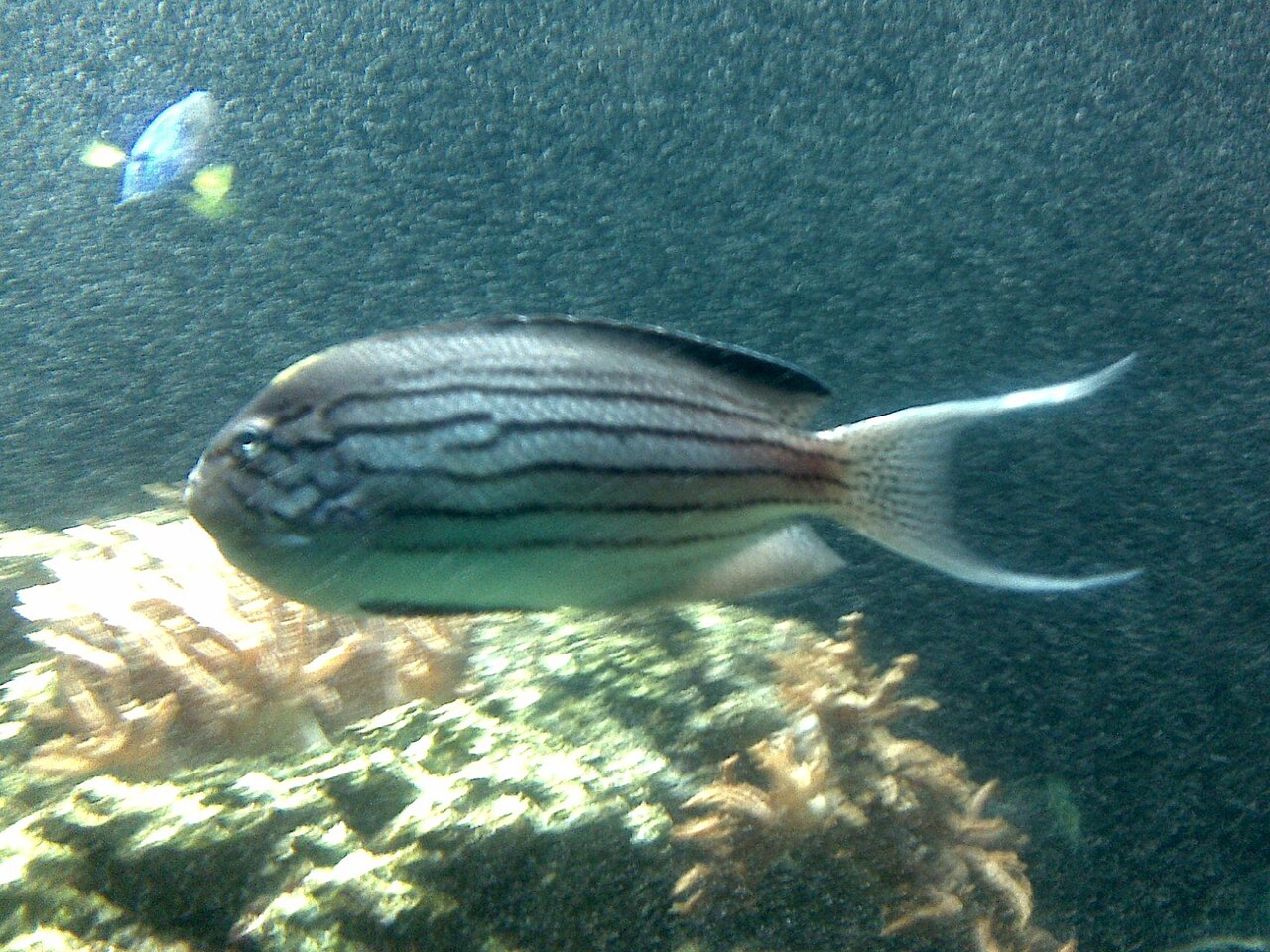
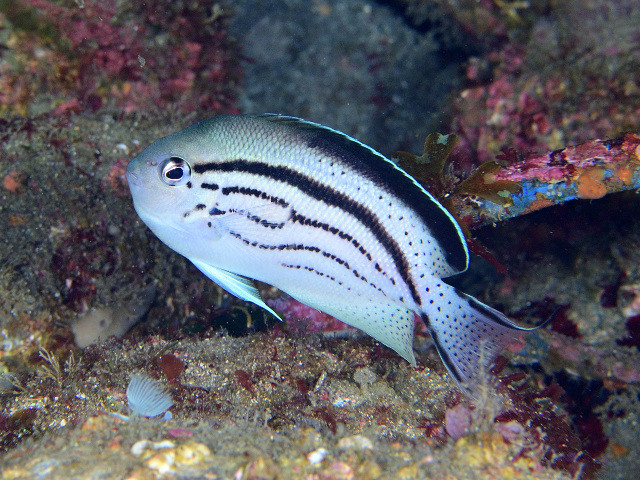
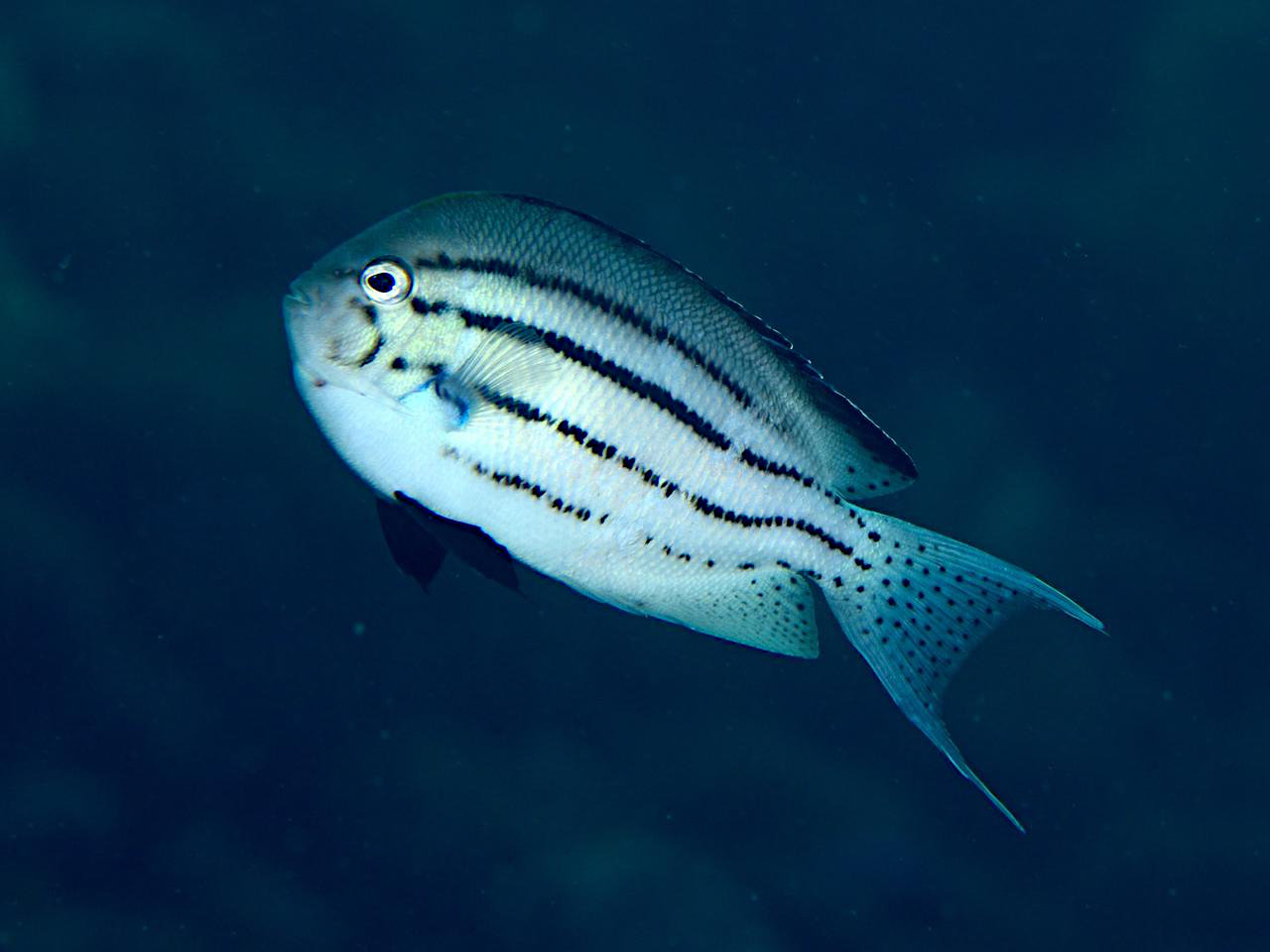
The blackstriped angelfish presents a striking visual profile against the pale backdrop of reef waters. Adults display a base coloration ranging from pale greyish to whitish, overlaid with four to five irregular, undulating black stripes that fan outward from the eye and trace horizontal paths along the body's flanks. A broad black band sits just below the edge of the dorsal fin, while the tail fin carries a fine pattern of spots. Sexual differences are immediately apparent: males sport a yellow patch atop the crown, black pelvic fins, and dramatically elongated lobes on the caudal fin tipped in white. Females, by contrast, show white pectoral fins and black caudal fin lobes. Juveniles and females share a notably wider topmost stripe compared to adult males. The dorsal fin is built from fifteen spines and fifteen to sixteen soft rays, while the anal fin carries three spines alongside sixteen to seventeen soft rays. At its largest, this species reaches a total length of twenty-five centimetres, roughly ten inches.
Geographic Range and Preferred Habitat
The blackstriped angelfish inhabits a broad swath of the Indo-West Pacific. Its range stretches eastward from the Gulf of Thailand, threading through the Malayan Archipelago all the way to the Solomon Islands. To the north, populations extend as far as southern Japan, while to the south the species is documented along the Great Barrier Reef. Within Australian waters, its presence also encompasses Ashmore Reef and Cartier Island in the Timor Sea. In terms of vertical positioning, this angelfish occupies a depth window of roughly ten to fifty metres. It favours areas of dense coral growth, particularly along the seaward-facing slopes of reefs and at steep drop-offs where the reef structure plunges into deeper water. These habitats provide the structural complexity and proximity to open water that suit a species whose normal diet consists of zooplankton.
Social Structure and Reproductive Biology
In the wild, the blackstriped angelfish is most often encountered hovering over the reef bottom in small social groups. These groups take the form of harems, typically comprising one dominant male accompanied by two to six females. The species is a sequential protogynous hermaphrodite, a reproductive strategy that proves critical to the harem's continuity. Should the dominant male die or simply go missing, the most dominant female in the group changes sex and assumes the male role, ensuring the social unit persists without disruption. This built-in succession mechanism means the harem rarely needs to reform from scratch. The species feeds on zooplankton as its normal diet, a foraging strategy well suited to its position along dense coral slopes and steep reef drop-offs. The combination of a stable harem structure, a reliable succession pathway, and a consistent food source makes this a remarkably cohesive social arrangement in the Indo-Pacific reef environment.
Taxonomic History and Human Interaction
The blackstriped angelfish was first formally described in 1860 under the name Holocanthus caudovittatus by the French naturalist Bernard Germain de Lacépède, who lived from 1756 to 1825. Notably, Lacépède provided no type locality with the original description. The species' current specific epithet honours another French naturalist, Jean-Baptiste Pierre Antoine de Monet, Chevalier de Lamarck (1744–1829). Within its genus, Genicanthus lamarck is known to hybridise with the ornate angelfish, Genicanthus bellus, a relationship that underscores the close ties between these two reef species. Beyond its scientific and taxonomic significance, the blackstriped angelfish occupies two distinct niches in human activity. It is frequently found in the aquarium trade, a testament to the appeal of its striking coloration and the visible differences between males and females. In the Moluccas, however, the same species is regarded as a delicacy, a culinary use that highlights how a single reef fish can serve both ornamental and food-related purposes across different cultures.
Gallery
Spotted an error? Know more?
Reader corrections go straight into our review queue. Suggest an edit · How this site is sourced