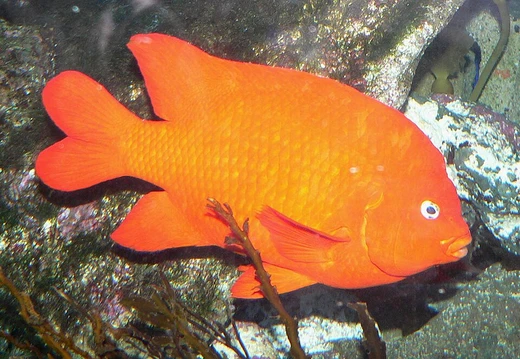
Garibaldi (fish) (Hypsypops rubicundus)
Source-cited species reference: taxonomy from WoRMS, biology from FishBase, occurrence map from GBIF, conservation from IUCN Red List, description from Wikipedia.

M.O. Stevens · CC BY 3.0
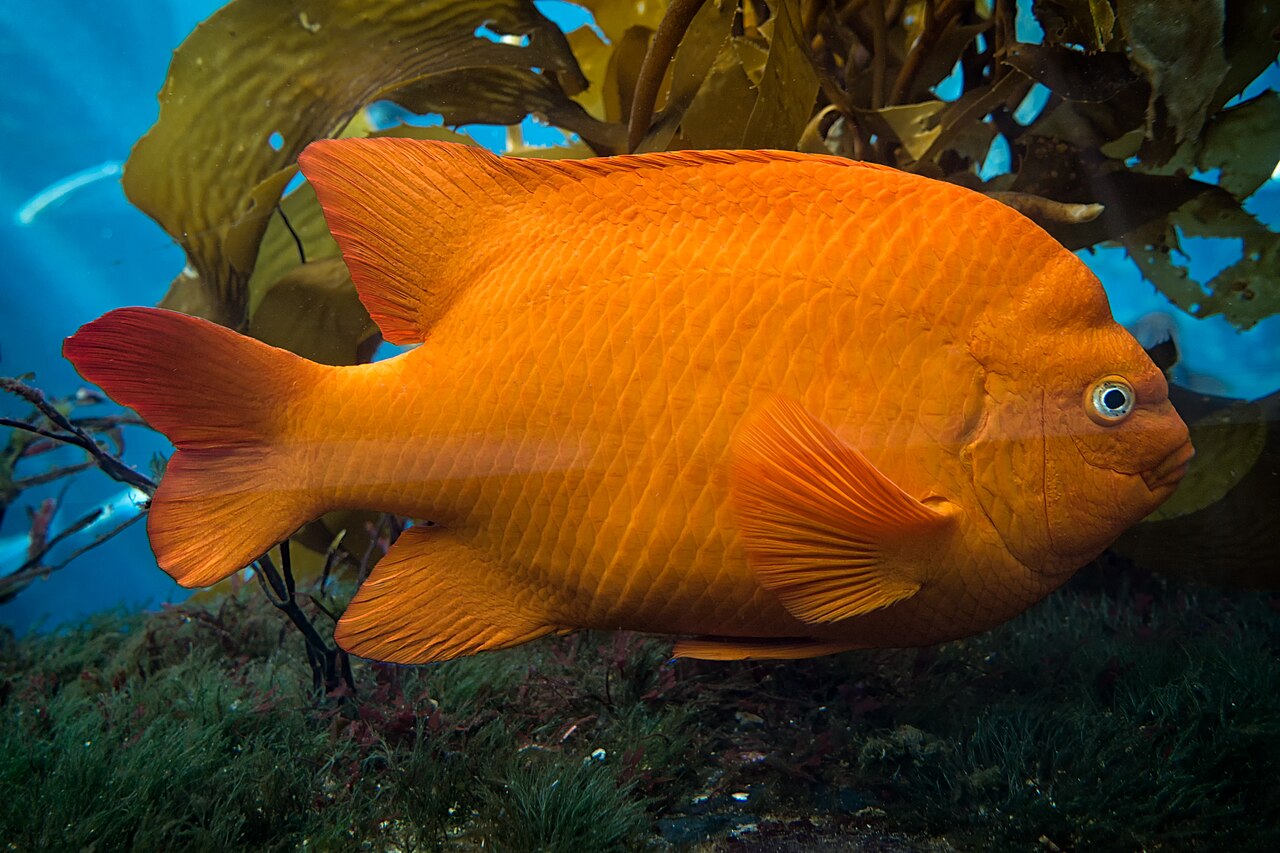
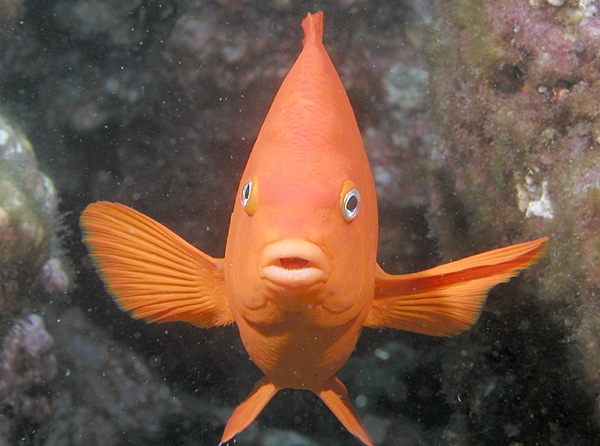
The Garibaldi (Hypsypops rubicundus), known historically as the Catalina goldfish and marine goldfish and now commonly as the Garibaldi damselfish, is a species of bright orange fish in the damselfish family. It occurs in the subtropical northeastern part of the Pacific Ocean. The Garibaldi was named the official marine state fish of California in 1995, and has since been protected in California coastal waters from recreation and commercial fishing.
- Scientific name
- Hypsypops rubicundus
- Authority
- (Girard, 1854)
- Family
- Pomacentridae
- Order
- Ovalentaria incertae sedis
- Maximum length
- 30 cm
- Depth range
- 0–30 m
- Habitat zone
- reef-associated
- Iucn red list
- Least Concern
- Gbif occurrence records
- 196,747
A Name Borrowed from History
The Garibaldi's English name traces back to Giuseppe Garibaldi, the 19th-century Italian general and political figure whose followers were known for wearing distinctive scarlet or red shirts. This connection to a revolutionary figure gives the fish a cultural resonance that few marine species enjoy. The species has also carried other names over the years, including Catalina goldfish and marine goldfish, reflecting its early encounters with coastal observers. In 1995, the Garibaldi earned the distinction of becoming California's official marine state fish, a designation that brought it legal protection against both recreational and commercial fishing in the state's coastal waters. This protection underscores the species' symbolic importance to the region, elevating a bright orange damselfish to a status of civic pride. The naming and legal recognition together illustrate how a single species can become woven into the identity of a place and its people, transforming a common reef fish into a symbol of regional heritage and conservation commitment.
The Puzzle of Juvenile Coloration
One of the most fascinating scientific questions surrounding the Garibaldi involves why juveniles display a deeper, more reddish orange laced with iridescent blue stripes and spots, while adults settle into a uniform bright orange. Caron and Rainboth's 1992 study proposed that vibrant coloration reduces aggressive territorial behavior among same-species fish, and that adding disruptive patterns to orange nullified the effect of pure orange. Their findings supported the intraspecific camouflage theory, suggesting juvenile markings help them go unrecognized as competitors by adults. However, Thomas J. Neal's follow-up experiments with live fish produced a contradictory result: normal-colored juveniles were attacked more frequently than adult-colored ones, undermining the camouflage explanation. An alternative hypothesis, adult-habituation, offers a different framework. It proposes that the juveniles' vivid coloring helps adults quickly learn to ignore them, much like the bright warning colors of poisonous organisms. Rather than hiding, juveniles signal their presence so adults stop wasting energy chasing them, allowing the young fish to forage safely within adult territories.
A Life Measured in Decades
The Garibaldi's life history reveals a species that takes its time maturing and, remarkably, lives far longer than previously believed. Breeding season stretches from March through July, during which males clear sheltered nest sites and females deposit bright yellow eggs that turn gray after roughly five days. The male guards the nest for 19 to 21 days until the embryos hatch, a process timed to occur within two hours after sunset to minimize predation risk. The young disperse as planktonic larvae before settling into tiny crevices in rocky habitats. Sexual maturity arrives at about six years, and adult coloration is typically reached around five. For decades, the maximum recorded age was thought to be 17 years, with an average lifespan near 12. That assumption was shattered in 2022 when Williams and colleagues collected a Garibaldi estimated at 57 years old, making it the longest-lived damselfish by a margin of two decades. The species also exhibits an unusual sexual size dimorphism: males average 25 millimeters larger than females, a reversal of the typical pattern seen in southern California marine fish.
Rocky Shores and Generalist Diets
The Garibaldi is a creature of the rocky coast, native to the subtropical northeastern Pacific from Monterey Bay in California down to Guadalupe Island off Baja California. Adults inhabit marine waters reaching depths of about 30 meters, favoring exposed or semi-protected coasts with clear water, abundant crevices, and small caves that offer cover. Juveniles, meanwhile, can be found in tide pools at depths of up to 40 feet. As generalist omnivores, Garibaldis feed primarily on invertebrates scraped from rocks, with a diet that includes fleshy red algae, polychaete worms, anemones, sponge fragments, encrusting bryozoans, hydroids, branching bryozoans, mollusks, and brown algae. They have even been observed consuming their own eggs. Adult Garibaldis face very few natural predators, and their legal protection against fishing further secures their survival. The only documented predator is the kelp bass, which preys on young-of-the-year individuals. This combination of habitat specificity, dietary flexibility, and low predation pressure paints a picture of a well-adapted coastal resident.
Gallery
Related in Garibaldi (fish)
Links follow this subject's own source article.
Elsewhere in Garibaldi (fish)
Spotted an error? Know more?
Reader corrections go straight into our review queue. Suggest an edit · How this site is sourced