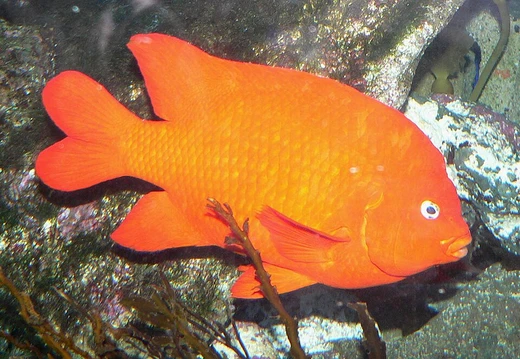
Where Garibaldi (fish) has been recorded
GBIF occurrence records for Hypsypops rubicundus, mapped and tabulated by country.

196,747 georeferenced occurrence records with coordinates are published for Hypsypops rubicundus through GBIF, from 3 countries or marine areas. This page maps those records and lists where they come from. Occurrence records reflect where people have looked as well as where the species lives, so well-surveyed coastlines are over-represented.
- Georeferenced records
- 196,747
- Countries / areas
- 3
- Mapped locations
- 18
- Records sampled for the map
- 3,000
- Inland records omitted
- 10
- Gbif taxonkey
- 2398736
From the Sea to the Secret Societies
Born in Nice on 4 July 1807 into a Ligurian family with roots in Chiavari and Loano, Giuseppe Maria Garibaldi grew up steeped in the rhythms of coastal commerce. His father's trade on the Mediterranean shaped his early years, and the political upheavals of the era—Nice being handed back to Sardinian rule by the Congress of Vienna in 1814—left their mark on a young man who would never fully settle. Between 1828 and 1832 he lived in the Pera district of Istanbul, where he earned his keep teaching Italian, French, and mathematics while weaving himself into the dense web of Sardinian exiles in the Ottoman Empire. A voyage in April 1833 aboard the orange-laden schooner Clorinda brought him to Taganrog, where a brief port stay introduced him to Giovanni Battista Cuneo, a committed member of Mazzini's Young Italy circle. That connection led to a fateful meeting with Mazzini himself in Genoa that November. Garibaldi threw himself into the Carbonari and, in February 1834, risked his life in a failed Piedmontese uprising—an act that would soon send him into a long exile across the Atlantic.
Fourteen Years of Fire in South America
Sentenced to death after the 1834 Piedmont uprising, Garibaldi escaped and spent fourteen years in South American exile, a period that forged him into a guerrilla tactician. After a stop in Tunis, he reached Brazil and threw in his lot with the Ragamuffin rebels fighting for the Riograndense Republic in 1835. It was during this conflict that he met Anita, who would become his wife and fiercest ally. When the Catarinense Republic was proclaimed in 1839, she sailed with him aboard the Rio Pardo and fought beside him at Imbituba and Laguna. By 1841 the couple had settled in Montevideo, where Garibaldi worked as a trader and schoolmaster before marrying Anita in the Church of St. Francis of Assisi. They went on to have four children. Anita is said to have introduced him to the gaucho culture of Argentina, southern Brazil, and Uruguay, and he adopted the red shirt, poncho, and hat commonly worn by local riders. In 1842 he commanded the Uruguayan fleet and recruited an Italian Legion of Redshirts for the Uruguayan Civil War, drawing on Montevideo's substantial Italian community, which numbered over four thousand souls in a city of thirty thousand.
The Campaigns That Forged a Nation
Returning to Italy in 1848, Garibaldi found himself thrust into the military leadership of the revolutionary cause. The provisional government of Milan elevated him to general, and the following year the Minister of War promoted him to General of the Roman Republic. His most celebrated Italian campaign came in April 1859, when he led his Hunters of the Alps through a rapid series of victories, seizing Lombard cities such as Varese and Como and pressing all the way to the South Tyrolean frontier before the war concluded with Lombardy's acquisition. The defining moment arrived in 1860, when, with the consent of King Victor Emmanuel II, he launched the Expedition of the Thousand. That daring crossing of the strait succeeded beyond expectation, rolling up Sicily, the southern Italian mainland, Marche, and Umbria into the Sardinian crown. On 17 March 1861 the Kingdom of Italy was formally proclaimed. Garibaldi's final military engagement came years later, commanding the Army of the Vosges during the Franco-Prussian War—a campaign that marked the close of a career spanning two continents and nearly four decades of armed struggle.
A Hero Beyond Borders
Garibaldi's reputation transcended Italian politics to become an international figurehead for republican liberty and national independence. Alongside Cavour, Victor Emmanuel II, and Mazzini, he is counted among Italy's 'fathers of the fatherland,' and his dual military record in South America and Europe earned him the enduring title 'Hero of the Two Worlds.' His volunteers, the Garibaldini, were instantly recognizable by the red shirts they wore in place of a standard uniform—a visual identity that outlived the campaigns themselves. Contemporaries from across the political spectrum lavished him with praise: Abraham Lincoln, Victor Hugo, Alexandre Dumas, George Sand, Charles Dickens, Friedrich Engels, Francesco de Sanctis, and others all expressed admiration for the man. His influence rippled into the twentieth century, inspiring figures as varied as Jawaharlal Nehru and Che Guevara. The historian A. J. P. Taylor went so far as to call him 'the only wholly admirable figure in modern history.' In Uruguay, where he helped raise the Redshirt Legion, he remains a celebrated contributor to the nation's reconstitution, a testament to how one man's commitment to freedom could echo across oceans and generations.
Related in Garibaldi (fish)
Links follow this subject's own source article.
Elsewhere in Garibaldi (fish)
Spotted an error? Know more?
Reader corrections go straight into our review queue. Suggest an edit · How this site is sourced