
Octopus coral (Galaxea astreata)
Source-cited species reference: taxonomy from WoRMS, biology from SeaLifeBase, occurrence map from GBIF, conservation from IUCN Red List, description from Wikipedia.
Galaxea astreata is a common and cosmopolitan large polyp scleractinian coral, (stony, hard coral) in the family Euphylliidae. It has a sub-massive morphology. It is found in the Indo-Pacific and is the most abundant coral species in Xuwen Coral Reef National Nature Reserve. G. astreata is acclimatized to water temperatures ranging from about 27 ± 0.5 °C. It is generally a shallow-water coral and is commonly seen at a depth of around 15 meters. It can range from a depth of 1 meter to 30 meters. It generally prefers clear, salt waters over turbid brackish waters.
- Scientific name
- Galaxea astreata
- Authority
- (Lamarck, 1816)
- Family
- Euphylliidae
- Order
- Scleractinia
- Depth range
- 0–57 m
- Habitat zone
- reef-associated
- Iucn red list
- Least Concern
- Gbif occurrence records
- 697
Classification (WoRMS)
Full classification as recorded by WoRMS: Kingdom: Animalia · Phylum: Cnidaria · Class: Hexacorallia · Order: Scleractinia · Family: Euphylliidae · Genus: Galaxea.
Accepted name: Galaxea astreata · Authority: (Lamarck, 1816) · Taxonomic status: accepted · AphiaID: 207368.
Synonyms and superseded combinations recorded for this taxon: Anthophyllum astraeatum (Lamarck, 1816); Anthophyllum astreatum (Lamarck, 1816); Anthophyllum clavus Dana, 1846; Anthophyllum musicale (Linnaeus, 1767); Anthophyllum sphaerula Ehrenberg, 1834; Caryophyllia astreata Lamarck, 1816; Caryophyllia musicalis (Linnaeus, 1767); Galaxea clava (Dana, 1846); Galaxea clavus (Dana, 1846); Galaxea musicalis (Linnaeus, 1767); Galaxea negrensis Nemenzo, 1979; Galaxea organum musicalis (Linnaeus, 1767); Galaxea susanae Nemenzo & Ferraris, 1982; Madrepora musicalis Linnaeus, 1767; Sarcinula astreata (Lamarck, 1816); Sarcinula erecta Milne Edwards & Haime, 1848; Sarcinula musicalis (Linnaeus, 1767).
Source: World Register of Marine Species (WoRMS) — https://www.marinespecies.org/aphia.php?p=taxdetails&id=207368 (CC BY 4.0). Accessed 2026-09-23.
Biology and life history (SeaLifeBase)
Measured values published by SeaLifeBase for Galaxea astreata. Only fields the database actually holds for this species are shown; these are database values, not aquarium guidance.
Depth range: 0–57 m · Habitat zone: reef-associated.
SeaLifeBase notes: Maximum depth from Ref. 100925. One of the most affected species with high bleaching level and high estimated mortality in Palau (Ref. 66144).
Source: SeaLifeBase species summary (SpecCode 45814) — https://www.sealifebase.se/summary/Galaxea-astreata.html (CC BY-NC 3.0 — non-commercial use only). Accessed 2026-09-23.
Distribution and occurrence records (GBIF)
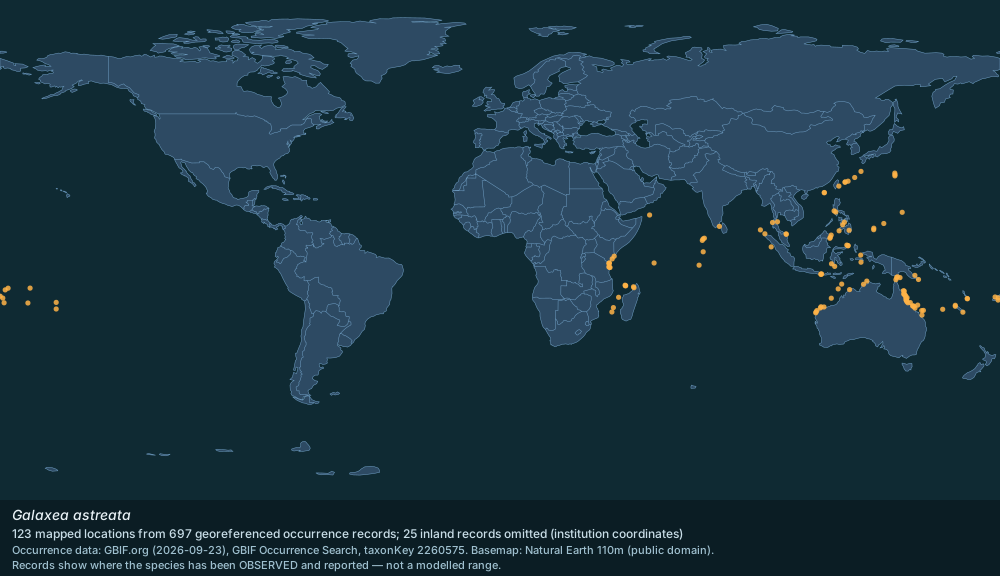
697 georeferenced occurrence records for Galaxea astreata are published through GBIF from 33 countries or marine areas. The map above plots 123 distinct locations from a sample of 697 records, omitting 25 inland records that carry an institution's coordinates rather than a collection site; it shows where the species has been observed and reported, not a modelled range.
Most records by country or area: Australia (435); Mayotte (52); Indonesia (42); Japan (32); Fiji (12); Kenya (12); Philippines (12); New Caledonia (10); Madagascar (9); Maldives (8); Malaysia (7); Chinese Taipei (7); Palau (6); Niue (5); Oman (5).
Marine regions with a valid WoRMS distribution record: Kenyan Exclusive Economic Zone; Chagos; Mauritian Exclusive Economic Zone; East Africa; Mozambican Exclusive Economic Zone; Seychellois Exclusive Economic Zone; Madagascar; Indo-West Pacific; Indian Ocean; Australian Exclusive Economic Zone; Papua New Guinean Exclusive Economic Zone; Maldives Exclusive Economic Zone; Ashmore-Cartier Is..
Source: GBIF Occurrence Search (taxonKey 2260575) — https://www.gbif.org/occurrence/search?taxon_key=2260575&has_coordinate=true (records CC0 / CC BY); WoRMS distribution records (MarineRegions) — https://www.marinespecies.org/aphia.php?p=taxdetails&id=207368 (CC BY 4.0); Natural Earth 110m basemap — https://www.naturalearthdata.com/ (public domain). Accessed 2026-09-23.
Conservation status (IUCN Red List)
The IUCN Red List assesses Galaxea astreata (Lamarck, 1816) as Least Concern (code LC). No trend, population estimate or threat analysis is given here, because none is available from this source without the Red List API; follow the source link for the full assessment, including its date.
Source: IUCN Red List of Threatened Species (taxon 133354) — https://www.iucnredlist.org/species/133354/0; GBIF IUCN Red List category endpoint (taxonKey 2260575) — https://api.gbif.org/v1/species/2260575/iucnRedListCategory. Accessed 2026-09-23.
Description and natural history (Wikipedia)
Galaxea astreata has a very distinctive skeleton structure, which is made of calcium carbonate (CaCO3). Corallites, the skeletal cup formed by individual polyps, are very plate-like. They are about 3–4.5 in diameter. They are also well spaced. The coral can has a symbiotic relationship with zooxanthellae living inside of the coral. Colonies of G. astreata are either sub-massive, columnar, or encrusting, meaning they can either be irregularly shaped, growing upward like columns, or impinging on a hard substrate. Colonies can grow to be over two meters long. The polyps are usually found to be pink, grey, green, or brown in color.
Galaxea astreata eat zooplankton and coral larvae that float by. Corals tend to feed at night since planktivorous fishes are sleeping. G. astreata expands its polyps to feed during the day, and contracts them at night. It is an effective predator, and like other massive growth forms, G. astreata will be an even more efficient when the larvae starts sinking in the water column so that it is easier for the coral to catch.
Galaxea astreata is a broadcast spawner, as gametes are released into the water for external fertilization. After the gamete is fertilized, the planulae, or the larval form of the coral, develops inside the plankton. G. astreata can either be a hermaphrodite, having both male and female gametes, or a gonochore, having gametes of only one sex.
The coral coverage rate in Xuwen rapidly decreased due to human activity and other environmental factors causing a decline in the G. astreata. Some detrimental human activities include overuse of fisheries and extraction, eutrophication and siltation, and pollution. Though G. astreata is more resistant to environmental changes than other coral species (i.e. Accropora spp.), it had a 100% mortality rate after the El Niño phenomenon of 1997–1998, starting with slow death of tissue fragments in the first 4 months after the disturbance. However, G. astreata was not the only coral affected, as this 1998 coral bleaching event reduced the richness of all coral species off the coast of Sesoko Island, Japan by 61% and reduced coral cover by 85%. Temperatures rose 2.8 °C above average from this one event alone. Coral bleaching events cause a loss of the symbiotic algae (zooxanthellae) and/or a loss of pigment (color mostly derived from zooxanthellae). It is a global phenomenon that is most likely linked to global climate change and rising ocean temperatures, as well as ocean acidification.
Source: Wikipedia: Galaxea astreata — https://en.wikipedia.org/wiki/Galaxea_astreata (CC BY-SA 4.0). Accessed 2026-09-23.
Gallery
Spotted an error? Know more?
Reader corrections go straight into our review queue. Suggest an edit · How this site is sourced