
Galapagos shark (Carcharhinus galapagensis)
Source-cited species reference: taxonomy from WoRMS, biology from FishBase, occurrence map from GBIF, conservation from IUCN Red List, description from Wikipedia.
The Galapagos shark (Carcharhinus galapagensis) is a species of requiem shark, in the family Carcharhinidae, found worldwide. It favors clear reef environments around oceanic islands, where it is often the most abundant shark species. A large species that often reaches 3.0 m, the Galapagos reef shark has a typical fusiform "reef shark" shape and is very difficult to distinguish from the dusky shark (C. obscurus) and the grey reef shark (C. amblyrhynchos). An identifying character of this species is its tall first dorsal fin, which has a slightly rounded tip and originates over the rear tips of the pectoral fins.
- Scientific name
- Carcharhinus galapagensis
- Authority
- (Snodgrass & Heller, 1905)
- Family
- Carcharhinidae
- Order
- Carcharhiniformes
- Maximum length
- 370 cm
- Depth range
- 1–286 m
- Habitat zone
- reef-associated
- Iucn red list
- Least Concern
- Gbif occurrence records
- 2,782
Classification (WoRMS)
Full classification as recorded by WoRMS: Kingdom: Animalia · Phylum: Chordata · Class: Elasmobranchii · Order: Carcharhiniformes · Family: Carcharhinidae · Genus: Carcharhinus.
Accepted name: Carcharhinus galapagensis · Authority: (Snodgrass & Heller, 1905) · Taxonomic status: accepted · AphiaID: 105790.
Synonyms and superseded combinations recorded for this taxon: Carcharias galapagensis Snodgrass & Heller, 1905; Carcharinus galapagensis (Snodgrass & Heller, 1905); Eulamia galapagensis (Snodgrass & Heller, 1905).
Source: World Register of Marine Species (WoRMS) — https://www.marinespecies.org/aphia.php?p=taxdetails&id=105790 (CC BY 4.0). Accessed 2026-09-23.
Biology and life history (FishBase)
Measured values published by FishBase for Carcharhinus galapagensis. Only fields the database actually holds for this species are shown; these are database values, not aquarium guidance.
Maximum length: 370 cm · Common length: 300 cm · Depth range: 1–286 m · Habitat zone: reef-associated · Body shape: fusiform / normal · Vulnerability index: 72.8 of 100 · Fishery importance: minor commercial · Aquarium trade: never/rarely.
FishBase notes: A common but habitat-limited tropical shark found close inshore to well as offshore near or on insular or continental shelves (Ref. 244). Prefers clear water with coral and rocky bottoms (Ref. 244). Although a coastal pelagic species, it is capable of crossing considerable distances of open ocean between islands (at least 50 km) (Ref. 244). Juveniles restricted to shallower water, in 25 m or less (Ref. 244; 37816). Found in superficial aggregations (Ref. 244). Tends to feed near the bottom but may take bait from the surface (Ref. 5485). Feeds mainly on bottom fishes, also squid and octopi (Ref. 244). In the Galapagos Is. it preys on sea lions and marine iguanas (Ref. 28023). Inquisitive and sometimes aggressive, displaying a 'hunch' position ( arched back, raised head and lowered caudal and pectoral fins, while twisting and rolling) near divers that may be followed by biting (Ref. 58085). Viviparous (Ref. 50449). 6 to 16 young of 57 to 80 cm are born per litter (Ref. 1602).
Source: FishBase species summary (SpecCode 870) — https://www.fishbase.se/summary/Carcharhinus-galapagensis.html (CC BY-NC 3.0 — non-commercial use only). Accessed 2026-09-23.
Distribution and occurrence records (GBIF)
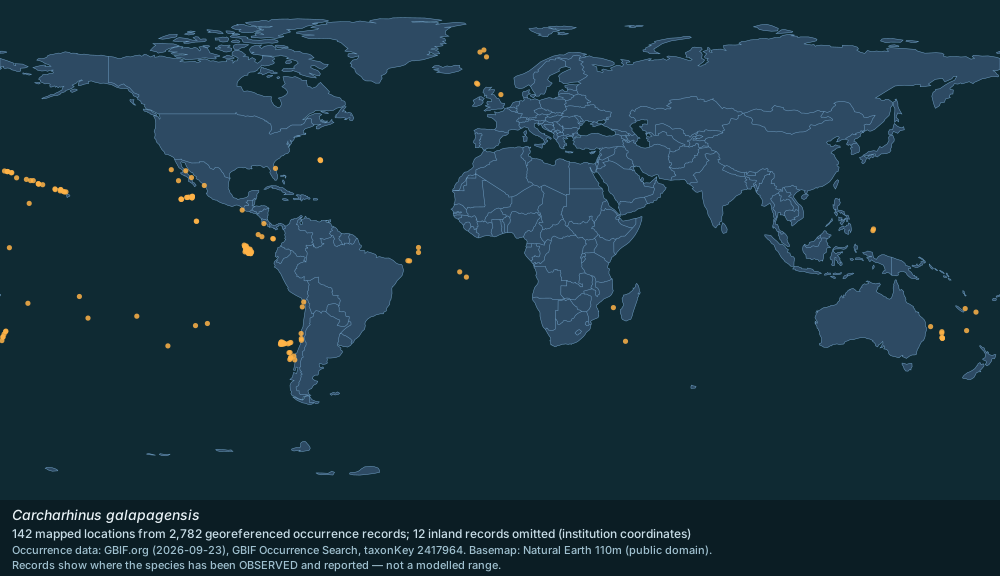
2,782 georeferenced occurrence records for Carcharhinus galapagensis are published through GBIF from 25 countries or marine areas. The map above plots 142 distinct locations from a sample of 2,782 records, omitting 12 inland records that carry an institution's coordinates rather than a collection site; it shows where the species has been observed and reported, not a modelled range.
Most records by country or area: Australia (1,239); United States of America (598); Ecuador (302); Colombia (205); Mexico (123).
The full country table, WoRMS marine regions and the sampling notes are on this species' Distribution page.
Source: GBIF Occurrence Search (taxonKey 2417964) — https://www.gbif.org/occurrence/search?taxon_key=2417964&has_coordinate=true (records CC0 / CC BY); WoRMS distribution records (MarineRegions) — https://www.marinespecies.org/aphia.php?p=taxdetails&id=105790 (CC BY 4.0); Natural Earth 110m basemap — https://www.naturalearthdata.com/ (public domain). Accessed 2026-09-23.
Conservation status (IUCN Red List)
The IUCN Red List assesses Carcharhinus galapagensis (Snodgrass & Heller, 1905) as Least Concern (code LC). No trend, population estimate or threat analysis is given here, because none is available from this source without the Red List API; follow the source link for the full assessment, including its date.
Source: IUCN Red List of Threatened Species (taxon 41736) — https://www.iucnredlist.org/species/41736/0; GBIF IUCN Red List category endpoint (taxonKey 2417964) — https://api.gbif.org/v1/species/2417964/iucnRedListCategory. Accessed 2026-09-23.
Description and natural history (Wikipedia)
The Galapagos shark is an active predator often encountered in large groups. It feeds mainly on bottom-dwelling bony fishes and cephalopods; larger individuals have a much more varied diet, consuming other sharks, marine iguanas, sea lions, and even garbage. As in other requiem sharks, reproduction is viviparous, with females bearing litters of 4–16 pups every 2 to 3 years. The juveniles tend to remain in shallow water to avoid predation by the adults. The International Union for Conservation of Nature (IUCN) has assessed this species as least concern, but it has a slow reproductive rate and there is heavy fishing pressure across its range.
The Galapagos shark was originally described as Carcharias galapagensis by Robert Evans Snodgrass and Edmund Heller in 1905; subsequent authors moved this species to the genus Carcharhinus. The holotype was a 65 cm long fetus from the Galapagos Islands, hence the specific epithet galapagensis.
Garrick (1982) placed the Galapagos shark and the dusky shark at the center of the "obscurus group", one of two major groupings within Carcharhinus. The group consisted of the bignose shark (C. altimus), Caribbean reef shark (C. perezi), sandbar shark (C. plumbeus), dusky shark (C. obscurus), and oceanic whitetip shark (C. longimanus), all large, triangular-toothed sharks and is defined by the presence of a ridge between the two dorsal fins. Based on allozyme data, naylor (1992) reaffirmed the integrity of this group, with the additions of the silky shark (C. falciformis) and the blue shark (Prionace glauca). The closest relatives of the Galapagos shark were found to be the dusky, oceanic whitetip, and blue sharks.
The Galapagos shark is found mainly off tropical oceanic islands. In the Atlantic Ocean, it occurs around Bermuda, the Virgin Islands, Madeira, Cape Verde, Ascension Island, Saint Helena and São Tomé Island. In the Indian Ocean, it is known from Walter's Shoal off southern Madagascar. In the Pacific Ocean, it occurs around Lord Howe Island, the Marianas Islands, the Marshall Islands, the Kermadec Islands, Tupai, the Tuamotu Archipelago, the Juan Fernández Islands, the Hawaiian Islands, the Galapagos Islands, Cocos Island, the Revillagigedo Islands, Clipperton Island, and Malpelo. There are a few reports of this species in continental waters off the Iberian Peninsula, Baja California, Guatemala, Colombia, and eastern Australia.
The Galapagos shark is generally found over continental and insular shelves near the coast, preferring rugged reef habitats with clear water and strong converging currents. It is also known to form groups around rocky islets and seamounts. This species is capable of crossing the open ocean between islands and has been reported at least 50 km from land. Juveniles seldom venture deeper than 25 m, while adults have been reported to a depth of 180 m.
One of the largest species in its genus, the Galapagos shark commonly reaches 3.0 m long. The maximum length has been variously recorded as 3.3 m to 3.7 m. The maximum recorded weight is 195 kg for a 3.0 m long female (longer specimens having apparently been unweighed). This species has a slender, streamlined body typical of the requiem sharks. The snout is wide and rounded, with indistinct anterior nasal flaps. The eyes are round and of medium size. The mouth usually contains 14 tooth rows (range 13–15) on either side of both jaws, plus one tooth at the symphysis (where the jaw halves meet). The upper teeth are stout and triangular in shape, while the lower teeth are narrower; both upper and lower teeth have serrated edges.
The first dorsal fin is tall and moderately falcate (sickle-shaped), with the origin over the pectoral fin rear tips. It is followed by a low midline ridge running to the second dorsal fin. The second dorsal fin originates over the anal fin. The pectoral fins are large with pointed tips. The coloration is brownish gray above and white below, with a faint white stripe on the sides. The edges of the fins are darker but not prominently marked. The Galapagos shark can be distinguished from the dusky shark in having taller first and second dorsal fins and larger teeth, and it can be distinguished from the grey reef shark in having a less robust body and less pointed first dorsal fin tip. However, these characters can be difficult to discern in the field. These similar species also have different numbers of precaudal (before the tail) vertebrae: 58 in the Galapagos shark, 86–97 in the dusky shark, 110–119 in the grey reef shark.
The Galapagos shark is often the most abundant shark in shallow island waters. In their original description of this species, Snodgrass and Heller noted that their schooner had taken "several hundred" adult Galapagos sharks and that "thousands" more could be seen in the water. At the isolated Saint Peter and Paul Rocks along the Mid-Atlantic Ridge, the resident Galapagos sharks have been described as "one of the densest shark populations of the Atlantic Ocean". At some locations they form large aggregations, though these are not true schools.
During group interactions, Galapagos sharks are dominant to blacktip sharks (C. limbatus) but deferent to silvertip sharks (C. albimarginatus) of equal size. When confronted or cornered, the Galapagos shark may perform a threat display similar to that of the grey reef shark, in which the shark performs an exaggerated, rolling swimming motion while arching its back, lowering its pectoral fins, puffing out its gills, and gaping its jaw. The shark may also swing its head from side to side, so as to keep the perceived threat within its field of vision. A known parasite of the Galapagos shark is the flatworm Dermophthirius carcharhini, which attaches to the shark's skin. In one account, a bluefin trevally (Caranax melampygus) was seen rubbing against the rough skin of a Galapagos shark to rid itself of parasites.
The primary food of Galapagos sharks is benthic bony fishes (including eels, sea bass, flatfish, flatheads, and triggerfish) and octopuses. They also occasionally take surface-dwelling prey such as mackerel, flyingfish and squid. As the sharks grow larger, they consume increasing numbers of elasmobranchs (rays and smaller sharks, including of their own species) and crustaceans, as well as indigestible items such as leaves, coral, rocks, and garbage. At the Galapagos Islands, this species has been observed attacking Galapagos fur seals (Arctophoca galapagoensis) and sea lions (Zalophus wollebaeki), and marine iguanas (Amblyrhynchus cristatus). While collecting fishes at Clipperton Island, Limbaugh (1963) noted that juvenile Galapagos sharks surrounded the boat, with multiple individuals rushing at virtually anything trailing in the water and striking the boat bottom, oars, and marker buoys. The sharks were not slowed by rotenone (a fish toxin) or shark repellent, and some followed the boat into water so shallow that their backs were exposed.
Like other requiem sharks, the Galapagos shark exhibits a viviparous mode of reproduction, in which the developing embryos are sustained by a placental connection formed from the depleted yolk sac. Females bear young once every 2–3 years. Mating takes place from January to March, at which time scars caused by male courtship bites appear on the females. The gestation period is estimated to be around one year; the spring following impregnation, females move into shallow nursery areas and give birth to 4–16 pups. The size at birth has been reported to be 61 - 80 cm, though observations of free-swimming juveniles as small as 57 cm long in the eastern Pacific suggest that birth size varies geographically. Juvenile sharks remain in shallow water to avoid predation by larger adults. Males mature at 2.1 - 2.5 m long and 6–8 years old, while females mature at 2.2 - 2.5 m long and 7–9 years old. Neither sex is thought to reproduce until 10 years of age. The lifespan of this species is at least 24 years.
Source: Wikipedia: Galapagos shark — https://en.wikipedia.org/wiki/Galapagos_shark (CC BY-SA 4.0). Accessed 2026-09-23.
Gallery
Related in Galapagos shark
Links follow this subject's own source article.
Elsewhere in Galapagos shark
Spotted an error? Know more?
Reader corrections go straight into our review queue. Suggest an edit · How this site is sourced