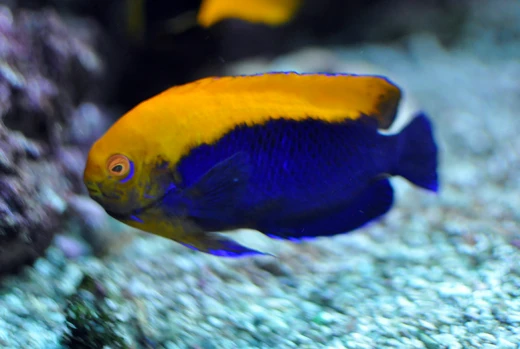
Flameback angelfish (Centropyge aurantonotus)
Source-cited species reference: taxonomy from WoRMS, biology from FishBase, occurrence map from GBIF, conservation from IUCN Red List, description from Wikipedia.

This photo has been taken by Matthieu Sontag (User:Mirgolth) and released under · CC BY-SA 3.0
The flameback angelfish (Centropyge aurantonotus), also known as the flameback pygmy angelfish, Brazilian flameback angelfish, Caribbean flameback angelfish or fireball angelfish, is a species of marine ray-finned fish, a marine angelfish belonging to the family Pomacanthidae. It is found in the western Atlantic Ocean.
- Scientific name
- Centropyge aurantonotus
- Authority
- Burgess, 1974
- Family
- Pomacanthidae
- Order
- Acanthuriformes
- Maximum length
- 7.5 cm
- Depth range
- 12–200 m
- Habitat zone
- reef-associated
- Iucn red list
- Least Concern
- Gbif occurrence records
- 510
Classification (WoRMS)
Full classification as recorded by WoRMS: Kingdom: Animalia · Phylum: Chordata · Class: Teleostei · Order: Acanthuriformes · Family: Pomacanthidae · Genus: Centropyge.
Accepted name: Centropyge aurantonotus · Authority: Burgess, 1974 · Taxonomic status: accepted · AphiaID: 278829.
Synonyms and superseded combinations recorded for this taxon: Centropyge aurantanota Burgess, 1974; Centropyge aurantonota Burgess, 1974.
Source: World Register of Marine Species (WoRMS) — https://www.marinespecies.org/aphia.php?p=taxdetails&id=278829 (CC BY 4.0). Accessed 2026-09-23.
Biology and life history (FishBase)
Measured values published by FishBase for Centropyge aurantonotus. Only fields the database actually holds for this species are shown; these are database values, not aquarium guidance.
Maximum length: 7.5 cm · Common length: 6 cm · Depth range: 12–200 m · Habitat zone: reef-associated · Body shape: short and / or deep · Vulnerability index: 10 of 100 · Fishery importance: commercial · Aquarium trade: commercial.
FishBase notes: Common among isolated patches of staghorn coral Acropora cervicornis . Feeds mainly on algae and sponges (Ref. 47377).
Source: FishBase species summary (SpecCode 10958) — https://www.fishbase.se/summary/Centropyge-aurantonotus.html (CC BY-NC 3.0 — non-commercial use only). Accessed 2026-09-23.
Distribution and occurrence records (GBIF)
510 georeferenced occurrence records for Centropyge aurantonotus are published through GBIF from 10 countries or marine areas. The map above plots 33 distinct locations from a sample of 510 records, omitting 5 inland records that carry an institution's coordinates rather than a collection site; it shows where the species has been observed and reported, not a modelled range.
Most records by country or area: Puerto Rico (443); Brazil (45); United States of America (6); Saint Lucia (4); Saint Barthélemy (3); Saint Helena, Ascension and Tristan da Cunha (3); Barbados (2); Bonaire, Sint Eustatius and Saba (2); Bahamas (1); Colombia (1).
Source: GBIF Occurrence Search (taxonKey 2396519) — https://www.gbif.org/occurrence/search?taxon_key=2396519&has_coordinate=true (records CC0 / CC BY); WoRMS distribution records (MarineRegions) — https://www.marinespecies.org/aphia.php?p=taxdetails&id=278829 (CC BY 4.0); Natural Earth 110m basemap — https://www.naturalearthdata.com/ (public domain). Accessed 2026-09-23.
Conservation status (IUCN Red List)
The IUCN Red List assesses Centropyge aurantonotus Burgess, 1974 as Least Concern (code LC). No trend, population estimate or threat analysis is given here, because none is available from this source without the Red List API; follow the source link for the full assessment, including its date.
Source: IUCN Red List of Threatened Species (taxon 165865) — https://www.iucnredlist.org/species/165865/0; GBIF IUCN Red List category endpoint (taxonKey 2396519) — https://api.gbif.org/v1/species/2396519/iucnRedListCategory. Accessed 2026-09-23.
Description and natural history (Wikipedia)
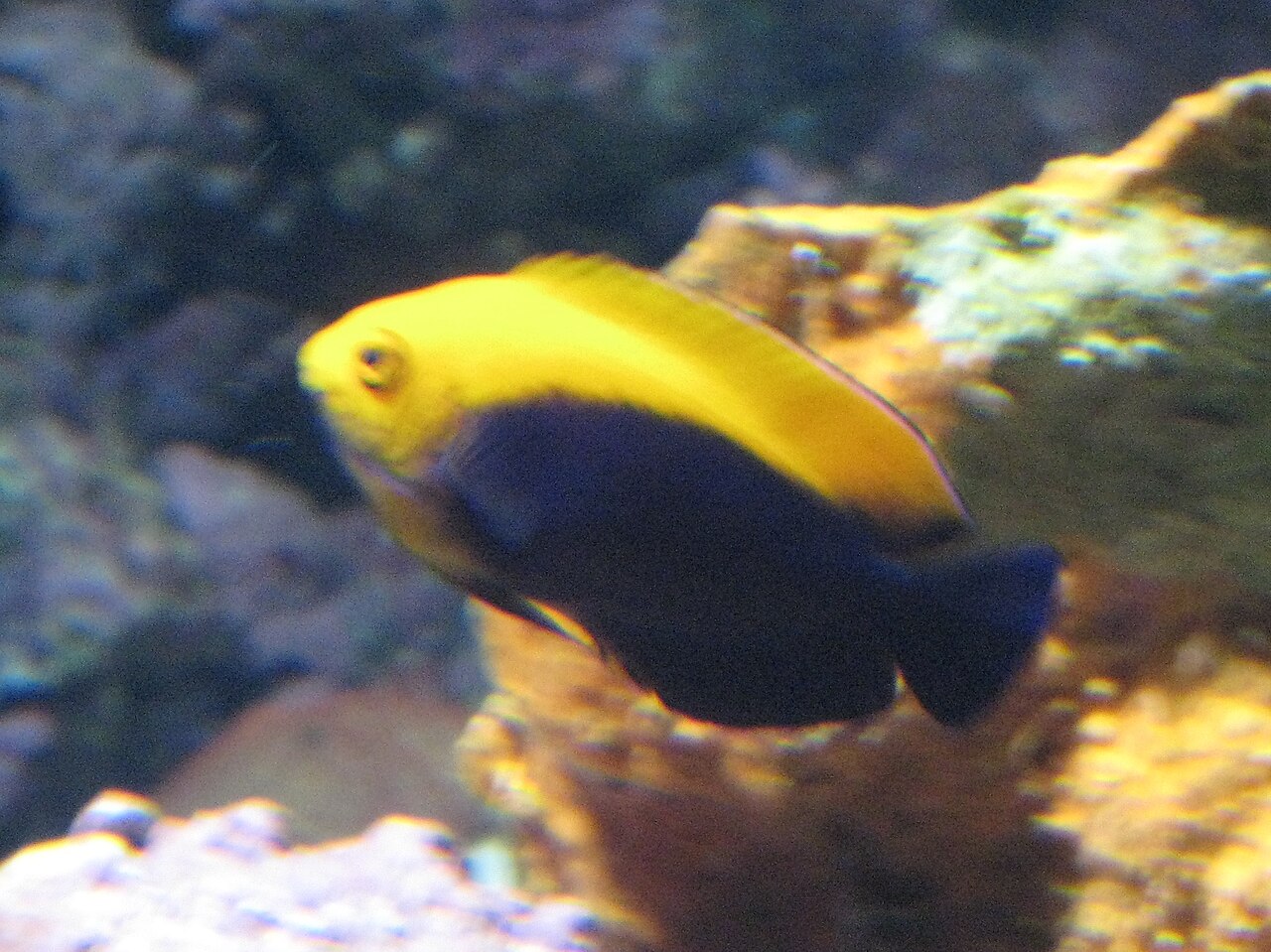
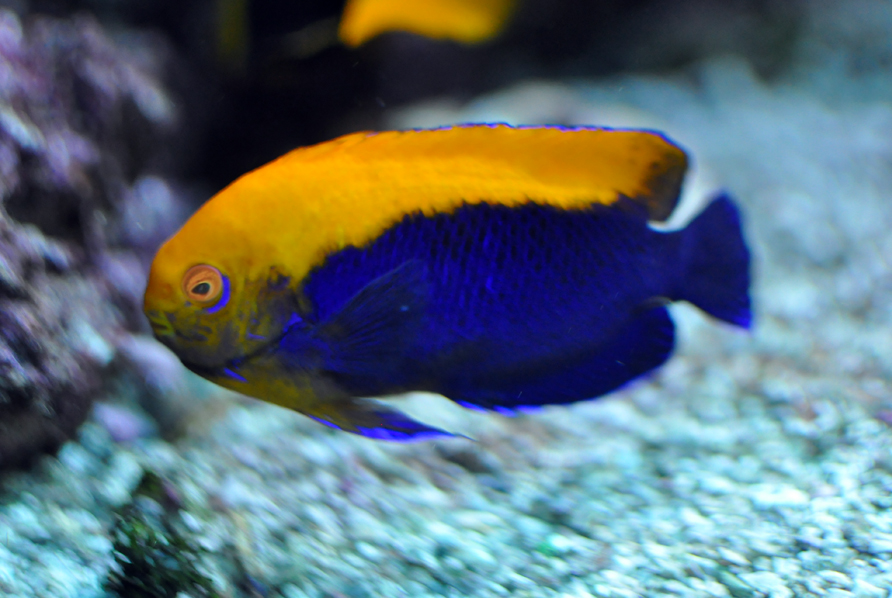
The flameback angelfish has an oval, deep and laterally compressed body with a short, blunt snout and a small mouth. There is a long, robust spine at the angle of the preopercle with vertical margin serrated. To the rear of the bone below the eye there are 2 large, rear-pointing spines and a series of smaller spines on the preopercle and on the opercle. It has a mainly blue body with the head and dorsal region being bright, golden yellow. It also has a blue ring around the eyes. The caudal and the anal fins are dark blue marked with many black spots. The dorsal fin contains 14-15 spines and 15-16 soft rays while the anal fin has 3 spines and 17 soft rays. This species attains a maximum total length of 7.5 cm.
The flameback angelfish is found in the tropical Western Atlantic Ocean. It occurs from the Lesser Antilles and Curaçao in the Netherlands Antilles and along the northern coast of South America from Venezuela to southern Brazil. It has been recorded in the eastern Atlantic at São Tomé in the Gulf of Guinea.
The flameback angelfish is found. At depths of between 15 and 300 m where it is found in areas of reef and rock rubble. It may also be common around isolated patches of staghorn coral (Acropora cervicornis). It feels on algae and sponges. Like other angelfish the flameback angelfish lays pelagic eggs and has pelagic larvae.
The flameback angelfish was first formally described in 1974 by Warren E. Burgess with the type locality given as off Oistins in Barbados. In some classifications it is placed in the subgenus Xiphipops.The specific name is a compound of aurantia meaning "orange" and notus meaning "back" and refers to the golden-orange back shown by this species.
The flameback angelfish is popular in the aquarium trade and in the 20th Century thousands were exported from Brazil.
Source: Wikipedia: Flameback angelfish — https://en.wikipedia.org/wiki/Flameback_angelfish (CC BY-SA 4.0). Accessed 2026-09-23.
Gallery
Spotted an error? Know more?
Reader corrections go straight into our review queue. Suggest an edit · How this site is sourced