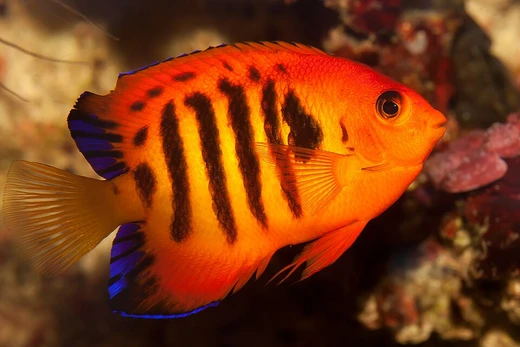
Flame angel (Centropyge loriculus)
Source-cited species reference: taxonomy from WoRMS, biology from FishBase, occurrence map from GBIF, conservation from IUCN Red List, description from Wikipedia, aquarium from Wikipedia (cited section).

The flame angelfish (Centropyge loricula) is a marine angelfish of the family Pomacanthidae found in tropical waters of the Pacific Ocean. Other common names include flame angel, flaming angelfish and Japanese pygmy angelfish.
- Scientific name
- Centropyge loriculus
- Authority
- (Günther, 1874)
- Family
- Pomacanthidae
- Order
- Acanthuriformes
- Maximum length
- 15 cm
- Depth range
- 0–60 m
- Habitat zone
- reef-associated
- Iucn red list
- Least Concern
- Gbif occurrence records
- 5,601
Classification (WoRMS)
Full classification as recorded by WoRMS: Kingdom: Animalia · Phylum: Chordata · Class: Teleostei · Order: Acanthuriformes · Family: Pomacanthidae · Genus: Centropyge.
Accepted name: Centropyge loriculus · Authority: (Günther, 1874) · Taxonomic status: accepted · AphiaID: 402161.
Synonyms and superseded combinations recorded for this taxon: Centropyge flammeus Woods & Schultz, 1953; Centropyge loricula (Günther, 1874); Holacanthus loriculus Günther, 1874.
Source: World Register of Marine Species (WoRMS) — https://www.marinespecies.org/aphia.php?p=taxdetails&id=402161 (CC BY 4.0). Accessed 2026-09-23.
Biology and life history (FishBase)
Measured values published by FishBase for Centropyge loriculus. Only fields the database actually holds for this species are shown; these are database values, not aquarium guidance.
Maximum length: 15 cm · Depth range: 0–60 m · Habitat zone: reef-associated · Body shape: short and / or deep · Vulnerability index: 10 of 100 · Fishery importance: commercial · Aquarium trade: commercial.
FishBase notes: Found in clear lagoon and seaward reefs from the lower surge zone to a depth of 57 m (Ref. 1602). Benthopelagic (Ref. 58302). Secretive and stays near shelter (Ref. 1602). Has been reared in captivity (Ref. 35409). Feeds on algae. Forms harems of 3-7 individuals. Frequently exported through the aquarium trade (Ref. 48391). Minimum depth reported taken from Ref. 128797.
Source: FishBase species summary (SpecCode 7814) — https://www.fishbase.se/summary/Centropyge-loriculus.html (CC BY-NC 3.0 — non-commercial use only). Accessed 2026-09-23.
Distribution and occurrence records (GBIF)
5,601 georeferenced occurrence records for Centropyge loriculus are published through GBIF from 22 countries or marine areas. The map above plots 100 distinct locations from a sample of 3,000 records, omitting 9 inland records that carry an institution's coordinates rather than a collection site; it shows where the species has been observed and reported, not a modelled range.
Most records by country or area: United States Minor Outlying Islands (3,113); American Samoa (1,427); French Polynesia (634); United States of America (131); Nauru (64).
The full country table, WoRMS marine regions and the sampling notes are on this species' Distribution page.
Source: GBIF Occurrence Search (taxonKey 2396548) — https://www.gbif.org/occurrence/search?taxon_key=2396548&has_coordinate=true (records CC0 / CC BY); WoRMS distribution records (MarineRegions) — https://www.marinespecies.org/aphia.php?p=taxdetails&id=402161 (CC BY 4.0); Natural Earth 110m basemap — https://www.naturalearthdata.com/ (public domain). Accessed 2026-09-23.
Conservation status (IUCN Red List)
The IUCN Red List assesses Centropyge loricula (Günther, 1874) as Least Concern (code LC). No trend, population estimate or threat analysis is given here, because none is available from this source without the Red List API; follow the source link for the full assessment, including its date.
Source: IUCN Red List of Threatened Species (taxon 155308) — https://www.iucnredlist.org/species/155308/0; GBIF IUCN Red List category endpoint (taxonKey 2396548) — https://api.gbif.org/v1/species/2396548/iucnRedListCategory. Accessed 2026-09-23.
Description and natural history (Wikipedia)
The flame angelfish's coloration is bright orange-red with a vertical elongated black spot and four or five bars on the sides, the posterior part of the dorsal, and anal fins, with alternating short purple-blue and black bands. Specimens from the Marquesas lack the vertical black bars. Males are generally larger and slightly more colored than females.
The life span of the flame angelfish is 5–7 years or more.
It is found in various reefs of Oceania, most common in Marshall, Line and Cook Islands. The fish is also less commonly found in the Hawaiian Islands. Particularly, the flame angelfish can be found on the foreslope of coral reefs and clear lagoons.
In the wild, the flame angelfish has a varied diet consisting of algae and crustaceans. There are occasional specimens that live very long lives in reef aquaria, but the majority of these fish will often die for no apparent reason when they are older. This may be easily explained as many of the Centropyge family are predominantly plankton eaters as juveniles and will switch to consuming its natural adult diet once fully grown. Sometimes, all it takes is for an underfed individual to "test" a food source. This being the case, angelfish are usually added to a well established tank and fed frozen mysis shrimp or meaty crustaceans such as shrimp and clam.
In captivity, this species feeds on a variety of food including brine shrimp, mysis shrimp, and other meat as well as spirulina, seaweed sheets, and pellets, also from personal experience they favor tuna and table shrimp.
The flame angelfish is known to be shy upon introduction to an established aquarium, especially smaller specimens; but, within a week, it will gain confidence and is then constantly seen grazing around live rock during the day.
The flame angelfish is often considered reef safe. They will adapt to a captive diet quickly which will usually prevent them from consuming soft or stony corals. Individual specimens that do pick at coral or clam mantles are more often than not under fed or under nourished.
The flame angelfish has been known to spawn in captivity, with successfully captive bred specimens offered by Atoll Farm Aquaculture in Thailand. The flame angelfish is haremic in the wild and can be kept in pairs or trios in an extra-large aquarium. The aquarium should contain only one male—the males have more blue on the outer edge of the dorsal and anal fins, and tend to be larger. The fish will spawn toward the end of the day and release pelagic gametes into the water column. Collecting the eggs and raising the larvae is the biggest challenge.
The flame angelfish are broadcast spawners, releasing eggs and sperm simultaneously at dusk. They rise into the water column and release their eggs and sperm at the top.
Source: Wikipedia: Flame angelfish — https://en.wikipedia.org/wiki/Flame_angelfish (CC BY-SA 4.0). Accessed 2026-09-23.
Related in Flame angel
Links follow this subject's own source article.
Elsewhere in Flame angel
Spotted an error? Know more?
Reader corrections go straight into our review queue. Suggest an edit · How this site is sourced