
Large star coral (Favites abdita)
Source-cited species reference: taxonomy from WoRMS, biology from SeaLifeBase, occurrence map from GBIF, conservation from IUCN Red List, description from Wikipedia.

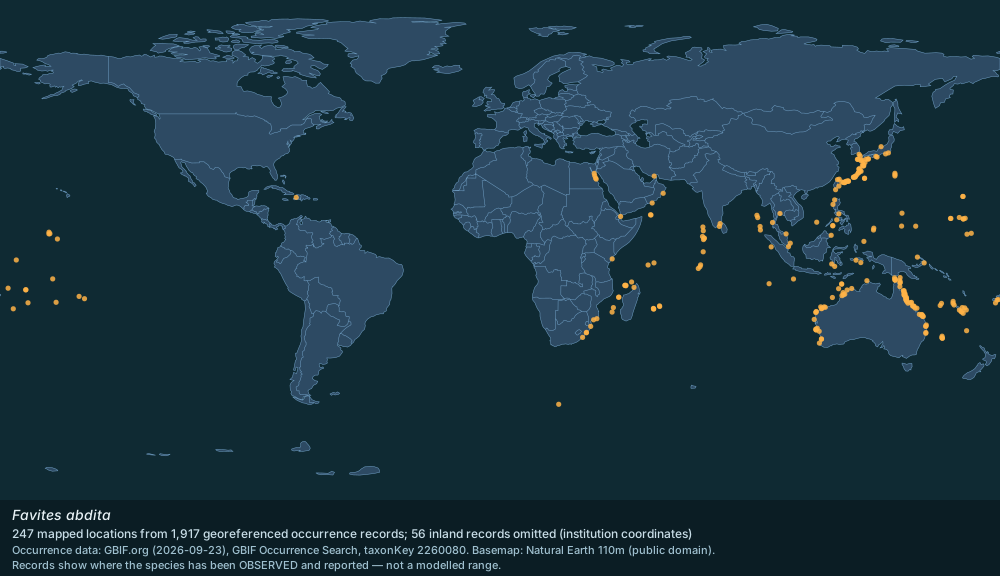
Distribution map plotted from GBIF.org occurrence records; basemap Natural Earth 110m · GBIF records CC0 / CC BY; Natural Earth public domain
Favites abdita, also known as the larger star coral, is a species of stony coral in the family Merulinidae. It is native to the Indo-Pacific region and its range extends from East Africa and the Red Sea through the Indian Ocean to the Western Pacific Ocean. The International Union for Conservation of Nature has rated its conservation status as being "near-threatened".
- Scientific name
- Favites abdita
- Authority
- (Ellis & Solander, 1786)
- Family
- Merulinidae
- Order
- Scleractinia
- Depth range
- 0–47 m
- Habitat zone
- reef-associated
- Iucn red list
- Least Concern
- Gbif occurrence records
- 1,917
Classification (WoRMS)
Full classification as recorded by WoRMS: Kingdom: Animalia · Phylum: Cnidaria · Class: Hexacorallia · Order: Scleractinia · Family: Merulinidae · Genus: Favites.
Accepted name: Favites abdita · Authority: (Ellis & Solander, 1786) · Taxonomic status: accepted · AphiaID: 207449.
Synonyms and superseded combinations recorded for this taxon: Astraea (Favastraea) magnifica de Blainville, 1834; Astraea (Fissicella) abdita (Ellis & Solander, 1786); Astraea (Fissicella) filicosa Dana, 1846; Astraea (Fissicella) fuscoviridis (Quoy & Gaimard, 1833); Astraea (Fissicella) magnifica Blainville, 1834; Astraea (Fissicella) magnifica (de Blainville, 1834); Astraea (Fissicella) robusta Dana, 1846; Astraea (Fissicella) virens Dana, 1846; Astraea abdita (Ellis & Solander, 1786); Astraea filicosa Dana, 1846; Astraea fuscoviridis (Quoy & Gaimard, 1833); Astraea magnifica Blainville, 1830; Astraea robusta Dana, 1846; Astraea virens Dana, 1846; Astrea abdita (Ellis & Solander, 1786); Astrea filicosa (Dana, 1846); Astrea fuscoviridis Quoy & Gaimard, 1833; Astrea hemprichii (Ehrenberg, 1834); Astrea magnifica Blainville, 1830; Astrea robusta (Dana, 1846); Astrea virens (Dana, 1846); Favastrea magnifica (Blainville, 1830); Favia abdita (Ellis & Solander, 1786); Favia crassior (Milne Edwards & Haime, 1849); Favia hemprichii (Ehrenberg, 1834).
Source: World Register of Marine Species (WoRMS) — https://www.marinespecies.org/aphia.php?p=taxdetails&id=207449 (CC BY 4.0). Accessed 2026-09-23.
Biology and life history (SeaLifeBase)
Measured values published by SeaLifeBase for Favites abdita. Only fields the database actually holds for this species are shown; these are database values, not aquarium guidance.
Depth range: 0–47 m · Habitat zone: reef-associated.
SeaLifeBase notes: Maximum depth from Ref. 107542. Found in most reef environments (Ref. 848).
Source: SeaLifeBase species summary (SpecCode 46737) — https://www.sealifebase.se/summary/Favites-abdita.html (CC BY-NC 3.0 — non-commercial use only). Accessed 2026-09-23.
Distribution and occurrence records (GBIF)
1,917 georeferenced occurrence records for Favites abdita are published through GBIF from 50 countries or marine areas. The map above plots 247 distinct locations from a sample of 1,917 records, omitting 56 inland records that carry an institution's coordinates rather than a collection site; it shows where the species has been observed and reported, not a modelled range.
Most records by country or area: Australia (1,088); Japan (431); Mayotte (60); Indonesia (34); New Caledonia (32).
The full country table, WoRMS marine regions and the sampling notes are on this species' Distribution page.
Source: GBIF Occurrence Search (taxonKey 2260080) — https://www.gbif.org/occurrence/search?taxon_key=2260080&has_coordinate=true (records CC0 / CC BY); WoRMS distribution records (MarineRegions) — https://www.marinespecies.org/aphia.php?p=taxdetails&id=207449 (CC BY 4.0); Natural Earth 110m basemap — https://www.naturalearthdata.com/ (public domain). Accessed 2026-09-23.
Conservation status (IUCN Red List)
The IUCN Red List assesses Favites abdita (Ellis & Solander, 1786) as Least Concern (code LC). No trend, population estimate or threat analysis is given here, because none is available from this source without the Red List API; follow the source link for the full assessment, including its date.
Source: IUCN Red List of Threatened Species (taxon 133290) — https://www.iucnredlist.org/species/133290/0; GBIF IUCN Red List category endpoint (taxonKey 2260080) — https://api.gbif.org/v1/species/2260080/iucnRedListCategory. Accessed 2026-09-23.
Description and natural history (Wikipedia)
Favites abdita is a massive colonial coral forming rounded irregular mounds. The corallites are 10 to 14 mm in diameter and have thick walls. The septa are straight with well-developed teeth. Various colours occur, ranging from reddish brown to greyish green, and the oral discs are usually green.
Favites abdita is native to the Indo-Pacific region where it occurs in shallow tropical and subtropical seas. Its range extends from the Red Sea and South Africa to India, Indonesia, Japan, Australia and the Central Pacific island groups. Its depth range is down to about 15 m and it is common on rocks and rocky reefs, outer reef channels, reef slopes and lagoons. It is also found at greater depths on coral rubble between reefs.
Favites abdita is a common species and has a wide range and is likely to be more resilient than some other coral species. There is no precise information on population trends but this coral faces the same threats as other species; global warming, ocean acidification and degradation of its coral reef habitats. It is collected for the reef aquarium trade. The International Union for Conservation of Nature has assessed its conservation status as being "near-threatened".
Source: Wikipedia: Favites abdita — https://en.wikipedia.org/wiki/Favites_abdita (CC BY-SA 4.0). Accessed 2026-09-23.
Gallery
Related in Large star coral
Links follow this subject's own source article.
Elsewhere in Large star coral
Spotted an error? Know more?
Reader corrections go straight into our review queue. Suggest an edit · How this site is sourced