
Golfball coral (Favia fragum)
Source-cited species reference: taxonomy from WoRMS, biology from SeaLifeBase, occurrence map from GBIF, conservation from IUCN Red List, description from Wikipedia.

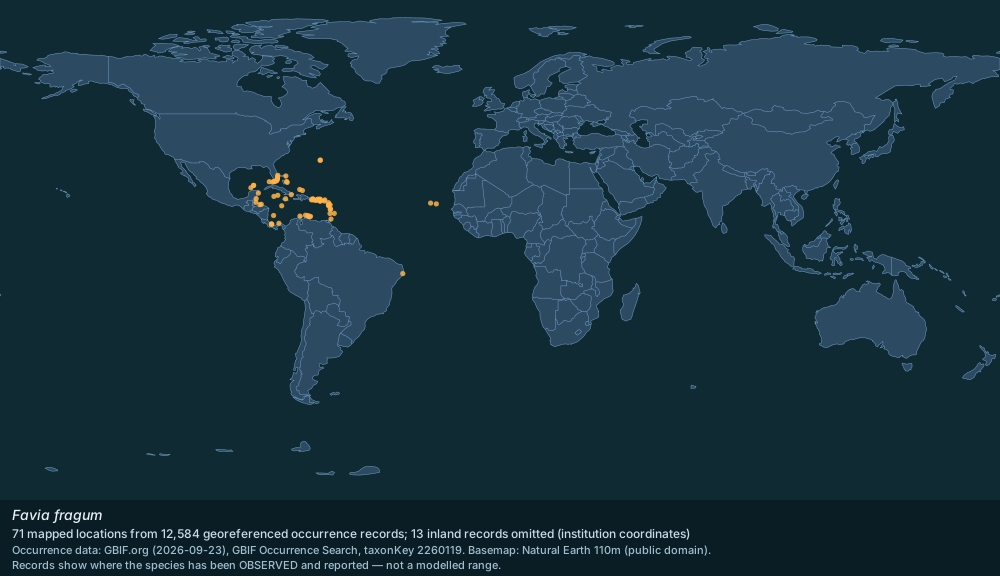
Distribution map plotted from GBIF.org occurrence records; basemap Natural Earth 110m · GBIF records CC0 / CC BY; Natural Earth public domain
Favia fragrum is a species of colonial stony coral in the family Mussidae. It is commonly known as the golfball coral and is found in tropical waters on either side of the Atlantic Ocean.
- Scientific name
- Favia fragum
- Authority
- (Esper, 1793)
- Family
- Faviidae
- Order
- Scleractinia
- Maximum length
- 5 cm
- Depth range
- 0–30 m
- Habitat zone
- reef-associated
- Iucn red list
- Least Concern
- Gbif occurrence records
- 12,584
Classification (WoRMS)
Full classification as recorded by WoRMS: Kingdom: Animalia · Phylum: Cnidaria · Class: Hexacorallia · Order: Scleractinia · Family: Faviidae · Genus: Favia.
Accepted name: Favia fragum · Authority: (Esper, 1793) · Taxonomic status: accepted · AphiaID: 207432.
Synonyms and superseded combinations recorded for this taxon: Astraea coarctata (Duchassaing & Michelotti, 1860); Astraea fragum (Esper, 1793); Astraea incerta (Duchassaing & Michelotti, 1860); Astrea ananas (Linnaeus, 1758); Favia ananas (Linnaeus, 1758); Favia coarctata Duchassaing & Michelotti, 1860; Favia incerta Duchassaing & Michelotti, 1860; Favia whitfieldi Verrill, 1901; Madrepora fragrum Esper, 1793; Madrepora fragum Esper, 1793; Matrepora fragum (Esper, 1793); Parastrea fragum (Esper, 1793).
Source: World Register of Marine Species (WoRMS) — https://www.marinespecies.org/aphia.php?p=taxdetails&id=207432 (CC BY 4.0). Accessed 2026-09-23.
Biology and life history (SeaLifeBase)
Measured values published by SeaLifeBase for Favia fragum. Only fields the database actually holds for this species are shown; these are database values, not aquarium guidance.
Maximum length: 5 cm · Depth range: 0–30 m · Habitat zone: reef-associated · Vulnerability index: 10 of 100.
SeaLifeBase notes: Zooxanthellate (Ref. 116012). Common in shallow less than 15 m; reef habitats and sometimes seagrass beds (Ref. 415). Also in intertidal rock pools and shallow reef environments (Ref. 848).
Source: SeaLifeBase species summary (SpecCode 46714) — https://www.sealifebase.se/summary/Favia-fragum.html (CC BY-NC 3.0 — non-commercial use only). Accessed 2026-09-23.
Distribution and occurrence records (GBIF)
12,584 georeferenced occurrence records for Favia fragum are published through GBIF from 42 countries or marine areas. The map above plots 71 distinct locations from a sample of 3,000 records, omitting 13 inland records that carry an institution's coordinates rather than a collection site; it shows where the species has been observed and reported, not a modelled range.
Most records by country or area: Virgin Islands (U.S.) (5,707); United States of America (4,234); Colombia (1,140); Puerto Rico (627); Bermuda (136).
The full country table, WoRMS marine regions and the sampling notes are on this species' Distribution page.
Source: GBIF Occurrence Search (taxonKey 2260119) — https://www.gbif.org/occurrence/search?taxon_key=2260119&has_coordinate=true (records CC0 / CC BY); WoRMS distribution records (MarineRegions) — https://www.marinespecies.org/aphia.php?p=taxdetails&id=207432 (CC BY 4.0); Natural Earth 110m basemap — https://www.naturalearthdata.com/ (public domain). Accessed 2026-09-23.
Conservation status (IUCN Red List)
The IUCN Red List assesses Favia fragum (Esper, 1793) as Least Concern (code LC). No trend, population estimate or threat analysis is given here, because none is available from this source without the Red List API; follow the source link for the full assessment, including its date.
Source: IUCN Red List of Threatened Species (taxon 133594) — https://www.iucnredlist.org/species/133594/0; GBIF IUCN Red List category endpoint (taxonKey 2260119) — https://api.gbif.org/v1/species/2260119/iucnRedListCategory. Accessed 2026-09-23.
Description and natural history (Wikipedia)
The golfball coral is small and usually hemispherical in shape with a number of large corallites packed closely together, but It can occur in groups or may occasionally grow as an encrusting coral. The corallites contain one to three polyps and are normally round but can become elongated into an oval shape when the polyps are budding and a new corallite is being formed. The corallite walls usually consist of four complete whorls of septa and do not project appreciably from the surface of the coral. The costae of different corallites are distinct from one another. The colour is usually yellow or pale brown.
The golfball coral is found in the tropical Atlantic Ocean at depths down to 30 m with its range extending from the west coast of equatorial Africa to South America, the Caribbean Sea and the southern United States. It is an inconspicuous species and occurs on coral reefs, on rocks, in seagrass meadows and among seaweed. The IUCN Red List of Threatened Species lists it as being of "least concern". This is because it is widespread and common and a loss of habitat from coral reef destruction is unlikely to impact it significantly.
Where degraded reefs have abundant macroalgae, it has been shown experimentally that coral larvae will settle in as great quantities on the seaweed as it will on the rubble substrate. Researchers showed that larvae of Favia fragum settled on Halimeda opuntia, an ephemeral alga that is unsuitable for post-settlement survival, and this may have significant consequences for the recruitment of corals on degraded reefs.
Source: Wikipedia: Favia fragum — https://en.wikipedia.org/wiki/Favia_fragum (CC BY-SA 4.0). Accessed 2026-09-23.
Gallery
Related in Golfball coral
Links follow this subject's own source article.
Elsewhere in Golfball coral
Spotted an error? Know more?
Reader corrections go straight into our review queue. Suggest an edit · How this site is sourced