
Pink sea fan (Eunicella verrucosa)
Source-cited species reference: taxonomy from WoRMS, biology from SeaLifeBase, occurrence map from GBIF, conservation from IUCN Red List, description from Wikipedia.
Eunicella verrucosa, the broad sea fan, pink sea fan or warty gorgonian, is a species of colonial Gorgonian "soft coral" in the family Gorgoniidae. It is native to the north-eastern Atlantic Ocean and the western Mediterranean Sea.
- Scientific name
- Eunicella verrucosa
- Authority
- (Pallas, 1766)
- Family
- Eunicellidae
- Order
- Malacalcyonacea
- Habitat zone
- sessile
- Iucn red list
- Vulnerable
- Gbif occurrence records
- 7,264
Classification (WoRMS)
Full classification as recorded by WoRMS: Kingdom: Animalia · Phylum: Cnidaria · Class: Octocorallia · Order: Malacalcyonacea · Family: Eunicellidae · Genus: Eunicella.
Accepted name: Eunicella verrucosa · Authority: (Pallas, 1766) · Taxonomic status: accepted · AphiaID: 125366.
Synonyms and superseded combinations recorded for this taxon: Eunicella multituberculata Stiasny, 1935; Eunicella tenuis Verrill, 1869; Gorgonia verrucosa Pallas, 1766.
Source: World Register of Marine Species (WoRMS) — https://www.marinespecies.org/aphia.php?p=taxdetails&id=125366 (CC BY 4.0). Accessed 2026-09-23.
Biology and life history (SeaLifeBase)
Measured values published by SeaLifeBase for Eunicella verrucosa. Only fields the database actually holds for this species are shown; these are database values, not aquarium guidance.
Habitat zone: sessile · Aquarium trade: never/rarely.
SeaLifeBase notes: Found in the infra- and circalittoral zones as well as the bathyal zones (Ref. 85338).
Source: SeaLifeBase species summary (SpecCode 94426) — https://www.sealifebase.se/summary/Eunicella-verrucosa.html (CC BY-NC 3.0 — non-commercial use only). Accessed 2026-09-23.
Distribution and occurrence records (GBIF)
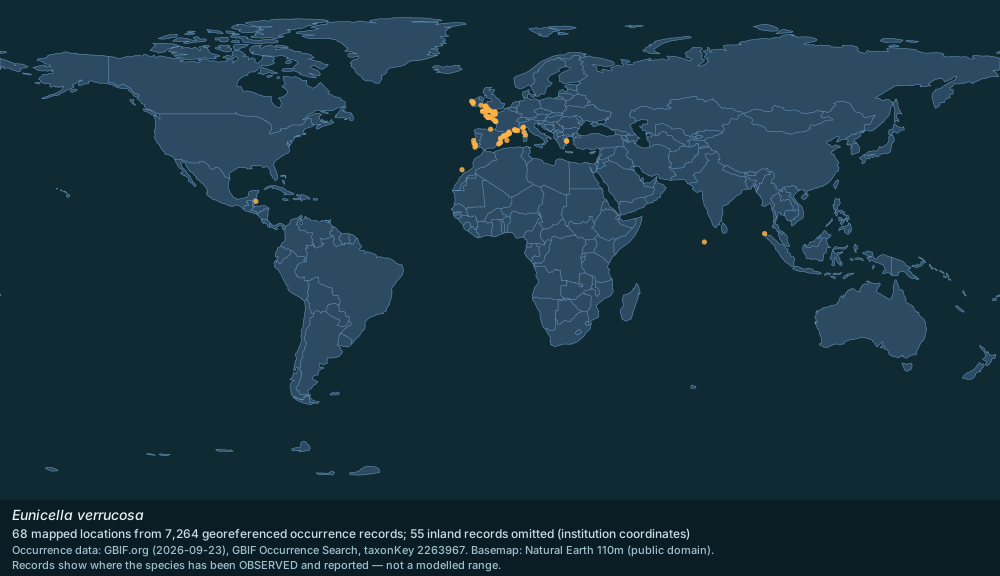
7,264 georeferenced occurrence records for Eunicella verrucosa are published through GBIF from 29 countries or marine areas. The map above plots 68 distinct locations from a sample of 3,000 records, omitting 55 inland records that carry an institution's coordinates rather than a collection site; it shows where the species has been observed and reported, not a modelled range.
Most records by country or area: United Kingdom of Great Britain and Northern Ireland (4,672); France (1,463); Ireland (312); Spain (221); Guernsey (181).
The full country table, WoRMS marine regions and the sampling notes are on this species' Distribution page.
Source: GBIF Occurrence Search (taxonKey 2263967) — https://www.gbif.org/occurrence/search?taxon_key=2263967&has_coordinate=true (records CC0 / CC BY); WoRMS distribution records (MarineRegions) — https://www.marinespecies.org/aphia.php?p=taxdetails&id=125366 (CC BY 4.0); Natural Earth 110m basemap — https://www.naturalearthdata.com/ (public domain). Accessed 2026-09-23.
Conservation status (IUCN Red List)
The IUCN Red List assesses Eunicella verrucosa (Pallas, 1766) as Vulnerable (code VU). No trend, population estimate or threat analysis is given here, because none is available from this source without the Red List API; follow the source link for the full assessment, including its date.
Source: IUCN Red List of Threatened Species (taxon 8262) — https://www.iucnredlist.org/species/8262/0; GBIF IUCN Red List category endpoint (taxonKey 2263967) — https://api.gbif.org/v1/species/2263967/iucnRedListCategory. Accessed 2026-09-23.
Description and natural history (Wikipedia)
Eunicella verrucosa has a densely branching, fan-like stem and usually grows in a single plane. It orientates itself at right angles to the direction of water movement and can grow to a height of 50 cm, although 25 cm is a more usual size. Stems and branches are covered with wart-like growths from which the polyps protrude. The colour can vary from red, through pink to white.
Eunicella verrucosa is native to the northeastern Atlantic and the western Mediterranean Sea. Its range extends from the southwestern coasts of Britain and Ireland to France, Spain, Italy, Algeria, Morocco, Western Sahara and Mauritania. A recent study of genetic connectivity in Eunicella verrucosa identified marked population structure between samples from northwest Ireland, Britain, France and southern Portugal. It is found growing on rock, timber, metal or concrete and its depth range is 4 to 50 m. In British waters this sea fan has become scarcer, possibly being damaged by dredging but may benefit from higher seawater temperatures.
Eunicella verrucosa is usually orientated at right angles to the direction of water flow across the colony. The polyps expand and spread out their tentacles to feed. The nutrients are passed to other parts of the colony through the internal channels connecting the polyps.
Reproduction in Eunicella verrucosa has been little studied. The planula larvae are likely to be lecithotrophic (sustained by a yolk-sac) and able to drift for a short time before settling on the seabed where they develop into polyps and found new colonies. The growth rate of colonies varies; in Lyme Bay in southern Britain, some colonies grew by 6 cm in one year while in another year, did not grow at all. The sea fan anemone (Amphianthus dohrnii) is often found living on Eunicella verrucosa.
Source: Wikipedia: Eunicella verrucosa — https://en.wikipedia.org/wiki/Eunicella_verrucosa (CC BY-SA 4.0). Accessed 2026-09-23.
Gallery
Related in Pink sea fan
Links follow this subject's own source article.
Elsewhere in Pink sea fan
Spotted an error? Know more?
Reader corrections go straight into our review queue. Suggest an edit · How this site is sourced