
Eunicella cavolini
Source-cited species reference: taxonomy from WoRMS, biology from SeaLifeBase, occurrence map from GBIF, description from Wikipedia.
Eunicella cavolini, commonly known as the yellow gorgonian or yellow sea whip, is a species of colonial soft coral in the family Gorgoniidae. It is native to parts of the eastern Atlantic Ocean, Mediterranean Sea and Ionian Sea where it is a common species.
- Scientific name
- Eunicella cavolini
- Authority
- (Koch, 1887)
- Family
- Eunicellidae
- Order
- Malacalcyonacea
- Habitat zone
- sessile
- Gbif occurrence records
- 6,781
Classification (WoRMS)
Full classification as recorded by WoRMS: Kingdom: Animalia · Phylum: Cnidaria · Class: Octocorallia · Order: Malacalcyonacea · Family: Eunicellidae · Genus: Eunicella.
Accepted name: Eunicella cavolini · Authority: (Koch, 1887) · Taxonomic status: accepted · AphiaID: 125361.
Synonyms and superseded combinations recorded for this taxon: Gorgonia blancoana Barreiro, 1917; Gorgonia cavolini Koch, 1887.
Source: World Register of Marine Species (WoRMS) — https://www.marinespecies.org/aphia.php?p=taxdetails&id=125361 (CC BY 4.0). Accessed 2026-09-23.
Biology and life history (SeaLifeBase)
Measured values published by SeaLifeBase for Eunicella cavolini. Only fields the database actually holds for this species are shown; these are database values, not aquarium guidance.
Habitat zone: sessile · Aquarium trade: never/rarely.
SeaLifeBase notes: Found in infra- and circalittoral zones as well as bathyal zones (Ref. 85338).
Source: SeaLifeBase species summary (SpecCode 139323) — https://www.sealifebase.se/summary/Eunicella-cavolini.html (CC BY-NC 3.0 — non-commercial use only). Accessed 2026-09-23.
Distribution and occurrence records (GBIF)
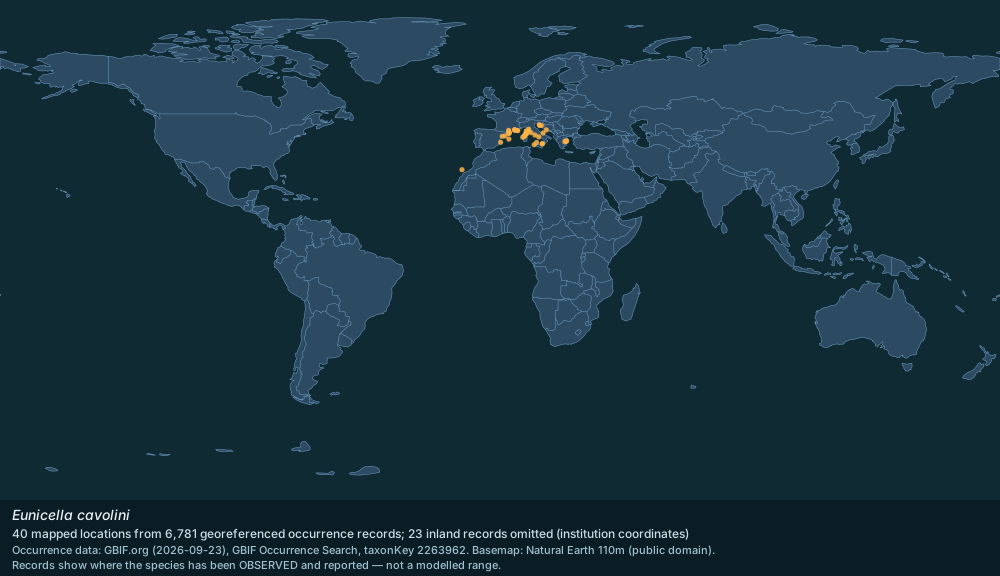
6,781 georeferenced occurrence records for Eunicella cavolini are published through GBIF from 10 countries or marine areas. The map above plots 40 distinct locations from a sample of 3,000 records, omitting 23 inland records that carry an institution's coordinates rather than a collection site; it shows where the species has been observed and reported, not a modelled range.
Most records by country or area: France (6,249); Spain (214); Italy (167); Greece (63); Croatia (62).
The full country table, WoRMS marine regions and the sampling notes are on this species' Distribution page.
Source: GBIF Occurrence Search (taxonKey 2263962) — https://www.gbif.org/occurrence/search?taxon_key=2263962&has_coordinate=true (records CC0 / CC BY); WoRMS distribution records (MarineRegions) — https://www.marinespecies.org/aphia.php?p=taxdetails&id=125361 (CC BY 4.0); Natural Earth 110m basemap — https://www.naturalearthdata.com/ (public domain). Accessed 2026-09-23.
Description and natural history (Wikipedia)
Eunicella cavolini is a much-branched soft coral growing to a height of about 50 cm. It is fan-shaped with the irregular, cylindrical branches largely growing in a single plane. The stem has an enlarged base fixed to the substrate and the branches are smooth, short and about 3 mm thick. The coenenchyme (the thin fleshy covering of the stiff skeleton) is yellowish-orange. The polyps are white to yellow, about 2 mm long and arranged in four rows. Eunicella cavolini can be confused with the warty gorgonian (Eunicella verrucosa), but that sea fan has rougher branches, or with Leptogorgia sarmentosa, but that species has straighter, more slender branches with smaller polyps.
Eunicella cavolini is common throughout the Mediterranean Sea. It grows mainly between 10 and 30 m but can be found as deep as 150 m. It is normally found in a shallower zone than the violescent sea-whip (Paramuricea clavata). It is often found growing in association with other soft corals, sponges, polychaete worms, bryozoans, barnacles and winged oysters.
The polyps expand their tentacles to catch zooplankton. The food fragments are passed to the mouth and then move into the gut to be digested. The nutrients are then transferred to all parts of the colony via channels in the living matrix of the branches. The fan is usually orientated perpendicular to the current so as to maximise the capture of prey.
Colonies are either male or female and breeding takes place during the summer. Polyps in male colonies liberate sperm into the water and the eggs are fertilised inside the gastric chambers of female polyps in other colonies. The embryos develop into planula larvae which are released into the sea. After drifting as part of the plankton for one to four weeks, these settle on suitable surface and undergo metamorphosis into new polyps. These develop into new colonies by budding. The growth rate is slow, at about 1 to 2 cm per year.
Source: Wikipedia: Eunicella cavolini — https://en.wikipedia.org/wiki/Eunicella_cavolini (CC BY-SA 4.0). Accessed 2026-09-23.
Gallery
Related in Eunicella cavolini
Links follow this subject's own source article.
Elsewhere in Eunicella cavolini
Spotted an error? Know more?
Reader corrections go straight into our review queue. Suggest an edit · How this site is sourced