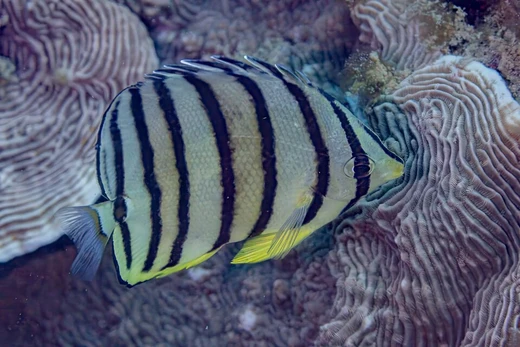
Eightband butterflyfish (Chaetodon octofasciatus)
Source-cited species reference: taxonomy from WoRMS, biology from FishBase, occurrence map from GBIF, conservation from IUCN Red List, description from Wikipedia.

The eight-banded Butterflyfish (Chaetodon octofasciatus), also known as the eightband butterflyfish or eight-striped butterflyfish, is a species of marine ray-finned fish, a butterflyfish belonging to the family Chaetodontidae. It is found in the Indo-Pacific region where it is associated with reefs.
- Scientific name
- Chaetodon octofasciatus
- Authority
- Bloch, 1787
- Family
- Chaetodontidae
- Order
- Acanthuriformes
- Maximum length
- 12 cm
- Depth range
- 3–20 m
- Habitat zone
- reef-associated
- Iucn red list
- Least Concern
- Gbif occurrence records
- 1,298
Classification (WoRMS)
Full classification as recorded by WoRMS: Kingdom: Animalia · Phylum: Chordata · Class: Teleostei · Order: Acanthuriformes · Family: Chaetodontidae · Genus: Chaetodon.
Accepted name: Chaetodon octofasciatus · Authority: Bloch, 1787 · Taxonomic status: accepted · AphiaID: 218746.
Synonyms and superseded combinations recorded for this taxon: Cahetodon octofasciatus Bloch, 1787; Chaetodon octolineatus Gronow, 1854; Tetragonopterus octofasciatus (Bloch, 1787).
Source: World Register of Marine Species (WoRMS) — https://www.marinespecies.org/aphia.php?p=taxdetails&id=218746 (CC BY 4.0). Accessed 2026-09-23.
Biology and life history (FishBase)
Measured values published by FishBase for Chaetodon octofasciatus. Only fields the database actually holds for this species are shown; these are database values, not aquarium guidance.
Maximum length: 12 cm · Depth range: 3–20 m · Habitat zone: reef-associated · Body shape: short and / or deep · Vulnerability index: 10 of 100 · Fishery importance: commercial · Aquarium trade: commercial.
FishBase notes: Swim in pairs in coral rich areas of sheltered lagoon and inshore reefs; juveniles seen in groups among Acropora corals. Feed exclusively on coral polyps. Oviparous (Ref. 205). Form pairs during breeding (Ref. 205).
Source: FishBase species summary (SpecCode 5570) — https://www.fishbase.se/summary/Chaetodon-octofasciatus.html (CC BY-NC 3.0 — non-commercial use only). Accessed 2026-09-23.
Distribution and occurrence records (GBIF)
1,298 georeferenced occurrence records for Chaetodon octofasciatus are published through GBIF from 23 countries or marine areas. The map above plots 163 distinct locations from a sample of 1,298 records, omitting 58 inland records that carry an institution's coordinates rather than a collection site; it shows where the species has been observed and reported, not a modelled range.
Most records by country or area: Thailand (288); Philippines (200); Indonesia (193); Malaysia (191); Palau (77).
The full country table, WoRMS marine regions and the sampling notes are on this species' Distribution page.
Source: GBIF Occurrence Search (taxonKey 2385381) — https://www.gbif.org/occurrence/search?taxon_key=2385381&has_coordinate=true (records CC0 / CC BY); WoRMS distribution records (MarineRegions) — https://www.marinespecies.org/aphia.php?p=taxdetails&id=218746 (CC BY 4.0); Natural Earth 110m basemap — https://www.naturalearthdata.com/ (public domain). Accessed 2026-09-23.
Conservation status (IUCN Red List)
The IUCN Red List assesses Chaetodon octofasciatus Bloch, 1787 as Least Concern (code LC). No trend, population estimate or threat analysis is given here, because none is available from this source without the Red List API; follow the source link for the full assessment, including its date.
Source: IUCN Red List of Threatened Species (taxon 165623) — https://www.iucnredlist.org/species/165623/0; GBIF IUCN Red List category endpoint (taxonKey 2385381) — https://api.gbif.org/v1/species/2385381/iucnRedListCategory. Accessed 2026-09-23.
Description and natural history (Wikipedia)
The eightband butterflyfish has a flat, circular disk-shaped body with a slightly pointed snout. The body is white turning yellowish towards the belly and is marked with 7 black stripes over the head and the flanks. One runs centrally along the snout and another as a clear black margin to the dorsal and anal fins. The third line reaches on to the pelvic fin. All of the fins are yellow. There is a white ringed black spot on the caudal peduncle. Some specimens have black or brownish horizontal bars connecting the rear pairs of vertical bars. The background colour is also dependent on the environment inhabited by the fish, with paler, creamier fish in clear waters over coral reefs and the yellower fish being associated with less clear water coloured green by algae near river mouths. There are 10-12 spines and 17-19 soft rays in the dorsal fin while the anal fin has 3-4 spines and 14-17 soft rays. This relatively small species of butterflyfish attains a maximum total length of 12 cm.
The eightband butterflyfish is found in the eastern Indian Ocean and the western Pacific Ocean from the Maldives, India and Sri Lanka east to the Solomon Islands, north to southern Japan and south to the Scott Reef in Western Australia.
The eightband butterflyfish is found at depths between3 and 20 m in coral reefs. Adults swim in pairs in coral-rich areas of sheltered inshore and lagoon reefs; juveniles can often be seen in groups among Acropora corals. This species feeds exclusively on coral polyps.
The eightband butterflyfish was first formally described in 1787 by the German zoologist Marcus Elieser Bloch (1723–1799) with the type locality given as the INdian Ocean. It is a close relative of the golden butterflyfish (C. aureofasciatus) and less close to Rainford's Butterflyfish (C. rainfordi). Alongside the three-striped Butterflyfish (C. tricinctus), these diverse but always high-bodied species make up the subgenus Discochaetodon, of which C. octofasciatus is the type species. They appear to be close relatives of the subgenus Tetrachaetodon which includes for example the mirror butterflyfish (C. speculum) and together with these would probably go in Megaprotodon if Chaetodon is split up.
The eightband butterflyfish is occasionally traded in the aquarium trade but as an obligate corallivore it is difficult to maintain in the aquarium and they frequently starve.
Source: Wikipedia: Eightband butterflyfish — https://en.wikipedia.org/wiki/Eightband_butterflyfish (CC BY-SA 4.0). Accessed 2026-09-23.
Related in Eightband butterflyfish
Links follow this subject's own source article.
Elsewhere in Eightband butterflyfish
Spotted an error? Know more?
Reader corrections go straight into our review queue. Suggest an edit · How this site is sourced