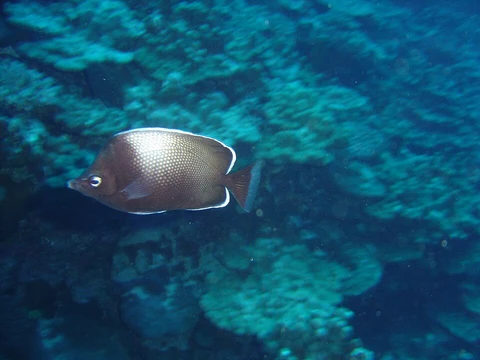
Easter Island butterflyfish (Chaetodon litus)
Source-cited species reference: taxonomy from WoRMS, biology from FishBase, occurrence map from GBIF, conservation from IUCN Red List, description from Wikipedia.

The Easter Island butterflyfish (Chaetodon litus) or white-tip butterflyfish, is a species of subtropical fish in the family Chaetodontidae. It is endemic to the seas around Easter Island, 3500 km off the coast of mainland Chile.
- Scientific name
- Chaetodon litus
- Authority
- Randall & Caldwell, 1973
- Family
- Chaetodontidae
- Order
- Acanthuriformes
- Maximum length
- 15.5 cm
- Depth range
- 1–25 m
- Habitat zone
- reef-associated
- Iucn red list
- Least Concern
- Gbif occurrence records
- 51
Classification (WoRMS)
Full classification as recorded by WoRMS: Kingdom: Animalia · Phylum: Chordata · Class: Teleostei · Order: Acanthuriformes · Family: Chaetodontidae · Genus: Chaetodon.
Accepted name: Chaetodon litus · Authority: Randall & Caldwell, 1973 · Taxonomic status: accepted · AphiaID: 273345.
Source: World Register of Marine Species (WoRMS) — https://www.marinespecies.org/aphia.php?p=taxdetails&id=273345 (CC BY 4.0). Accessed 2026-09-23.
Biology and life history (FishBase)
Measured values published by FishBase for Chaetodon litus. Only fields the database actually holds for this species are shown; these are database values, not aquarium guidance.
Maximum length: 15.5 cm · Depth range: 1–25 m · Habitat zone: reef-associated · Body shape: short and / or deep · Vulnerability index: 10 of 100 · Fishery importance: commercial · Aquarium trade: commercial.
FishBase notes: Found in algal covered rocky reefs. Juveniles in tide pools, observed to pick bodies of other fishes for parasites (Ref. 9710). Oviparous (Ref. 205). Form pairs during breeding (Ref. 205).
Source: FishBase species summary (SpecCode 12538) — https://www.fishbase.se/summary/Chaetodon-litus.html (CC BY-NC 3.0 — non-commercial use only). Accessed 2026-09-23.
Distribution and occurrence records (GBIF)
51 georeferenced occurrence records for Chaetodon litus are published through GBIF from 1 countries or marine areas. The map above plots 1 distinct locations from a sample of 51 records, omitting 1 inland record that carry an institution's coordinates rather than a collection site; it shows where the species has been observed and reported, not a modelled range.
Most records by country or area: Chile (51).
Source: GBIF Occurrence Search (taxonKey 2385499) — https://www.gbif.org/occurrence/search?taxon_key=2385499&has_coordinate=true (records CC0 / CC BY); WoRMS distribution records (MarineRegions) — https://www.marinespecies.org/aphia.php?p=taxdetails&id=273345 (CC BY 4.0); Natural Earth 110m basemap — https://www.naturalearthdata.com/ (public domain). Accessed 2026-09-23.
Conservation status (IUCN Red List)
The IUCN Red List assesses Chaetodon litus Randall & Caldwell, 1973 as Least Concern (code LC). No trend, population estimate or threat analysis is given here, because none is available from this source without the Red List API; follow the source link for the full assessment, including its date.
Source: IUCN Red List of Threatened Species (taxon 4361) — https://www.iucnredlist.org/species/4361/0; GBIF IUCN Red List category endpoint (taxonKey 2385499) — https://api.gbif.org/v1/species/2385499/iucnRedListCategory. Accessed 2026-09-23.
Description and natural history (Wikipedia)
Butterflyfish have deep, laterally flattened bodies, a slightly upturned snout, uninterrupted dorsal fins and unforked, broadly wedge-shaped tail fins with flat ends. Chaetodon litus has a rectangular outline and is silvery-grey with white-edged scales. The maximum length is 15.5 cm long. The dorsal fin has 13 spines and 23 to 25 soft rays while the anal fin has 3 spines and 19 or 20 soft rays.
The Easter Island butterflyfish is native to the waters around Easter Island and is found nowhere else. Its preferred habitat is on reefs and among volcanic boulders heavily clad in brown algae at depths down to about 20 m. Juvenile fish are sometimes found among corals in rock pools.
Juvenile Easter Island butterflyfish have been observed to act as cleaner fish, picking parasites off the skin of larger fish. During the breeding season, male and female adult fish form pair bonds.
The Easter Island butterflyfish is a bottom feeding fish. Examination of its stomach contents have shown that it feeds on polychaete worms, shrimps, fish eggs and barnacles, and fragments of the black sponge Amphimedon sp. were also found. This was unexpected as butterfly fish are not known to feed on sponges, however the explanation may be that the sponge was ingested in error when the fish was feeding on the barnacles which had become entangled in the sponge.
At one time this fish was listed as "Vulnerable" by the International Union for Conservation of Nature in their Red List of Threatened Species but in 2010, this was changed to being of "Least Concern". The reason given for this change was that, although its range was very limited, this fish was quite common within that range and did not face any significant threats. A small number of fish were collected for the reef aquarium trade but the number was not believed to reduce the population to any great extent.
Source: Wikipedia: Easter Island butterflyfish — https://en.wikipedia.org/wiki/Easter_Island_butterflyfish (CC BY-SA 4.0). Accessed 2026-09-23.
Spotted an error? Know more?
Reader corrections go straight into our review queue. Suggest an edit · How this site is sourced