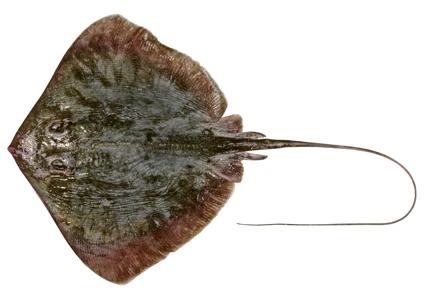
Dwarf black stingray (Hemitrygon parvonigra)
Source-cited species reference: taxonomy from WoRMS, biology from FishBase, conservation from IUCN Red List, description from Wikipedia.

The dwarf black stingray (Hemitrygon parvonigra) is a little-known species of stingray in the family Dasyatidae, found off northwestern Australia and perhaps throughout Southeast Asia at depths of 60 - 185 m. Growing to a width of 51 cm, this species is characterized by an angular, diamond-shaped pectoral fin disc with a short row of spear-like thorns along the midline of the back and few dermal denticles elsewhere. Its tail bears a long fin fold along the bottom and a much shorter ridge along the top, both past the stinging spine. Plain brownish in color above, this ray can range from light to very dark. In some parts of its range, this species is occasionally caught incidentally by fisheries and sold for meat.
- Scientific name
- Hemitrygon parvonigra
- Authority
- (Last & White, 2008)
- Family
- Dasyatidae
- Order
- Myliobatiformes
- Maximum length
- 51 cm
- Depth range
- 60–185 m
- Habitat zone
- benthopelagic
- Iucn red list
- Vulnerable
Classification (WoRMS)
Full classification as recorded by WoRMS: Kingdom: Animalia · Phylum: Chordata · Class: Elasmobranchii · Order: Myliobatiformes · Family: Dasyatidae · Genus: Hemitrygon.
Accepted name: Hemitrygon parvonigra · Authority: (Last & White, 2008) · Taxonomic status: accepted · AphiaID: 1042853.
Synonyms and superseded combinations recorded for this taxon: Dasyatis parvonigra Last & White, 2008.
Source: World Register of Marine Species (WoRMS) — https://www.marinespecies.org/aphia.php?p=taxdetails&id=1042853 (CC BY 4.0). Accessed 2026-09-23.
Biology and life history (FishBase)
Measured values published by FishBase for Hemitrygon parvonigra. Only fields the database actually holds for this species are shown; these are database values, not aquarium guidance.
Maximum length: 51 cm · Depth range: 60–185 m · Habitat zone: benthopelagic · Body shape: other · Vulnerability index: 90 of 100 · Aquarium trade: never/rarely.
FishBase notes: This demersal species lives offshore on continental shelf, probably occasionally shallower; caught incidentally in trawl and net fisheries; llfe history unknown (Ref. 114953). Maximum length for females of similar form, possibly up to 49.8 cm WD (Ref. 76959).
Source: FishBase species summary (SpecCode 64143) — https://www.fishbase.se/summary/Hemitrygon-parvonigra.html (CC BY-NC 3.0 — non-commercial use only). Accessed 2026-09-23.
Conservation status (IUCN Red List)
The IUCN Red List assesses Hemitrygon parvonigra (Last & White, 2008) as Vulnerable (code VU). No trend, population estimate or threat analysis is given here, because none is available from this source without the Red List API; follow the source link for the full assessment, including its date.
Source: IUCN Red List of Threatened Species (taxon 195442) — https://www.iucnredlist.org/species/195442/0; GBIF IUCN Red List category endpoint (taxonKey 9554944) — https://api.gbif.org/v1/species/9554944/iucnRedListCategory. Accessed 2026-09-23.
Description and natural history (Wikipedia)
Peter Last and William White described the dwarf black stingray in a 2008 Commonwealth Scientific and Industrial Research Organisation (CSIRO) publication; it had previously been termed Dasyatis "sp. A". The new stingray was given the specific epithet parvonigra, from the Latin parvus ("little") and nigra ("black"), because of its superficial resemblance to the much larger black stingray (B. thetidis). The type specimen is a male 38 cm across, collected north of Cape Lambert in Western Australia. This species seems to be most related to the longtail stingray (H. longus), and belongs to a poorly known species complex that also includes the red stingray (H. akajei).
The dwarf black stingray has been found off northwestern Australia (north of Port Hedland), Indonesia (including Bali and Sabah in Borneo), and Malaysia. Possible records also exist off West Papua and the Philippines, suggesting it has a wide range. Australian rays inhabit the outer continental shelf at a depth of 125 - 185 m, while Indonesian rays occur over insular and continental shelves at a depth of 60 - 125 m. It is bottom-dwelling in nature.
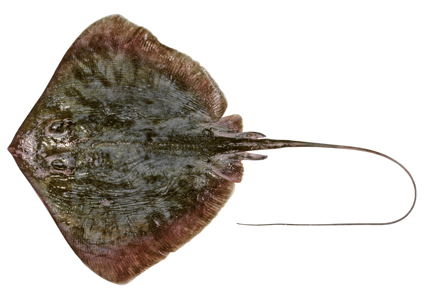
The dwarf black stingray has a diamond-shaped pectoral fin disc slightly wider than long, with rather angular outer corners and nearly straight anterior corners. The snout is a broadly triangular, with a pointed tip. The eyes are large and elevated, and immediately followed by larger spiracles. There is a wide, skirt-shaped curtain of skin with a minutely fringed posterior margin between the short, oval nostrils. The medium-sized mouth forms a strong arch, and contains four papillae (nipple-like structures) across the floor and an additional, tiny papilla near the corner of each jaw. The teeth are small and number approximately 43 rows in either jaw; those toward the center of the jaw have long, thin cusps, while those toward the corners have very low crowns. The five pairs of gill slits are slightly S-shaped. The pelvic fins are small with nearly straight margins; males have rather flattened claspers.
The tail measures around 1.5 times as long as the disc and is relatively broad and flattened at the base. One, rarely two serrated stinging spines are dorsally placed about a third of a disc width back from the tail base. Beyond the sting, the tail becomes thin and whip-like, bearing a long, low ventral fin fold and a much shorter dorsal ridge. There is a short row of closely spaced, spear-shaped thorns along the midline of the back, starting behind the head; 1–2 small, seed-shaped thorns are also present on each "shoulder". This species is a plain ochre to dark grayish brown above, becoming lighter towards the disc margins, on the thorns, and past the sting, and white below. Reaching 51 cm across and 1.1 m long, the dwarf black stingray is less than a third as wide as the 1.8 m wide black stingray. The two species also differ in denticle coverage and meristic counts.
Virtually nothing is known of the dwarf black stingray's natural history. It is presumably aplacental viviparous, with the developing embryos sustained by maternally produced histotroph ("uterine milk") as in other stingrays. Males attain sexual maturity at around 35 cm across.
The International Union for Conservation of Nature (IUCN) has not assessed the status of the dwarf black stingray. In Indonesian waters, it contributes to the bycatch of bottom trawl and trammel net fisheries, and is sold for meat.
Source: Wikipedia: Dwarf black stingray — https://en.wikipedia.org/wiki/Dwarf_black_stingray (CC BY-SA 4.0). Accessed 2026-09-23.
Gallery
Spotted an error? Know more?
Reader corrections go straight into our review queue. Suggest an edit · How this site is sourced