
White frond-aeolis (Dendronotus albus)
Source-cited species reference: taxonomy from WoRMS, biology from SeaLifeBase, occurrence map from GBIF, description from Wikipedia.
Dendronotus albus is a species of sea slug, a dendronotid nudibranch, a shell-less marine gastropod mollusc in the family Dendronotidae.
- Scientific name
- Dendronotus albus
- Authority
- MacFarland, 1966
- Family
- Dendronotidae
- Order
- Nudibranchia
- Maximum length
- 3.5 cm
- Habitat zone
- benthic
- Gbif occurrence records
- 1,127
Classification (WoRMS)
Full classification as recorded by WoRMS: Kingdom: Animalia · Phylum: Mollusca · Class: Gastropoda · Order: Nudibranchia · Family: Dendronotidae · Genus: Dendronotus.
Accepted name: Dendronotus albus · Authority: MacFarland, 1966 · Taxonomic status: accepted · AphiaID: 548242.
Synonyms and superseded combinations recorded for this taxon: Dendronotus diversicolor Robilliard, 1970.
Source: World Register of Marine Species (WoRMS) — https://www.marinespecies.org/aphia.php?p=taxdetails&id=548242 (CC BY 4.0). Accessed 2026-09-23.
Biology and life history (SeaLifeBase)
Measured values published by SeaLifeBase for Dendronotus albus. Only fields the database actually holds for this species are shown; these are database values, not aquarium guidance.
Maximum length: 3.5 cm · Habitat zone: benthic · Vulnerability index: 10 of 100.
SeaLifeBase notes: Assumed maximum length from Ref. 822. Feeds on thecate hydroids (Ref. 822).
Source: SeaLifeBase species summary (SpecCode 8357) — https://www.sealifebase.se/summary/Dendronotus-albus.html (CC BY-NC 3.0 — non-commercial use only). Accessed 2026-09-23.
Distribution and occurrence records (GBIF)
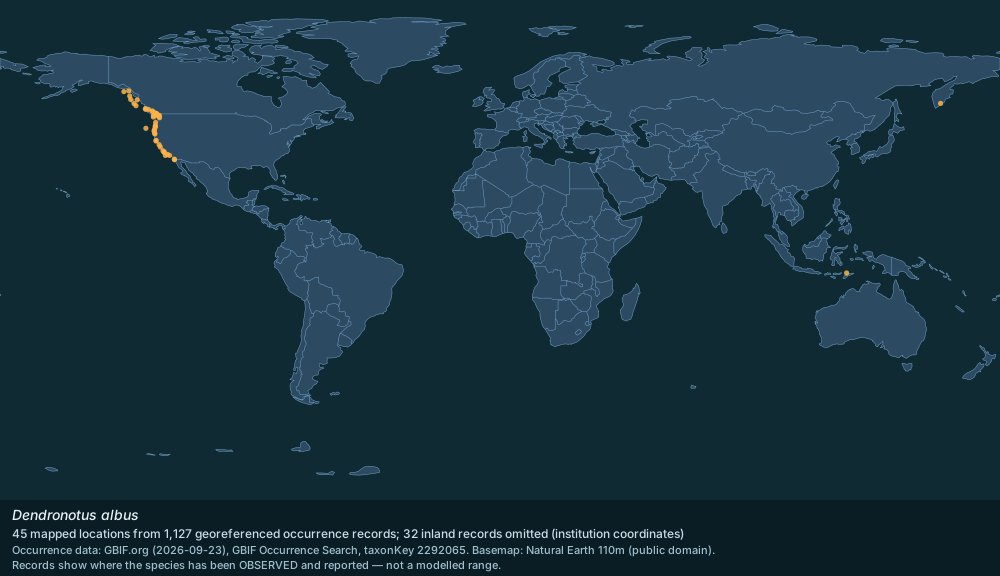
1,127 georeferenced occurrence records for Dendronotus albus are published through GBIF from 5 countries or marine areas. The map above plots 45 distinct locations from a sample of 1,127 records, omitting 32 inland records that carry an institution's coordinates rather than a collection site; it shows where the species has been observed and reported, not a modelled range.
Most records by country or area: United States of America (1,027); Canada (95); Mexico (2); Russian Federation (2); Indonesia (1).
The full country table, WoRMS marine regions and the sampling notes are on this species' Distribution page.
Source: GBIF Occurrence Search (taxonKey 2292065) — https://www.gbif.org/occurrence/search?taxon_key=2292065&has_coordinate=true (records CC0 / CC BY); WoRMS distribution records (MarineRegions) — https://www.marinespecies.org/aphia.php?p=taxdetails&id=548242 (CC BY 4.0); Natural Earth 110m basemap — https://www.naturalearthdata.com/ (public domain). Accessed 2026-09-23.
Description and natural history (Wikipedia)
This species was described from shallow water at Point Pinos, Monterey Bay, California, United States. It has been reported from the west coast of North America from Alaska to Baja California, Mexico.
Robilliard correctly recognised that there were two species of Dendronotus in the NE Pacific and described Dendronotus diversicolor as a new species. D. albus and D. diversicolor were synonymised by Stout et al., 2010, probably because the specimens they studied did not include both species. In fact Robilliard consistently used the name D. albus for Dendronotus robilliardi and redescribed the true D. albus as D. diversicolor.
This species grows to a maximum length of 73 mm. It is distinguished from Dendronotus robilliardi by having only four pairs of large cerata (and two extra, small cerata in big animals). D. robilliardi is a smaller animal but has 5–7 pairs. The body and cerata are translucent white with opaque white and orange-yellow tips to the cerata, although in some cases the orange-yellow is absent.
This species feeds preferentially on the hydroids Abietinaria greenei, Hydrallmania distans and Abietinaria amphora. Dendronotus robilliardi is said to prefer Thuiaria argentea in the family Sertulariidae.
Source: Wikipedia: Dendronotus albus — https://en.wikipedia.org/wiki/Dendronotus_albus (CC BY-SA 4.0). Accessed 2026-09-23.
Gallery
Related in White frond-aeolis
Links follow this subject's own source article.
Elsewhere in White frond-aeolis
Spotted an error? Know more?
Reader corrections go straight into our review queue. Suggest an edit · How this site is sourced