
Dendronotus elegans
Source-cited species reference: taxonomy from WoRMS, biology from SeaLifeBase, occurrence map from GBIF, description from Wikipedia.
Dendronotus niveus is a species of sea slug, a dendronotid nudibranch, a shell-less marine gastropod mollusc in the family Dendronotidae.
- Scientific name
- Dendronotus elegans
- Authority
- A. E. Verrill, 1880
- Family
- Dendronotidae
- Order
- Nudibranchia
- Depth range
- 10–120 m
- Habitat zone
- benthic
- Gbif occurrence records
- 86
Classification (WoRMS)
Full classification as recorded by WoRMS: Kingdom: Animalia · Phylum: Mollusca · Class: Gastropoda · Order: Nudibranchia · Family: Dendronotidae · Genus: Dendronotus.
Accepted name: Dendronotus elegans · Authority: A. E. Verrill, 1880 · Taxonomic status: accepted · AphiaID: 156710.
Synonyms and superseded combinations recorded for this taxon: Dendronotus niveus Ekimova, Korshunova, Schepetov, Neretina, Sanamyan & Martynov, 2015.
Source: World Register of Marine Species (WoRMS) — https://www.marinespecies.org/aphia.php?p=taxdetails&id=156710 (CC BY 4.0). Accessed 2026-09-23.
Biology and life history (SeaLifeBase)
Measured values published by SeaLifeBase for Dendronotus elegans. Only fields the database actually holds for this species are shown; these are database values, not aquarium guidance.
Depth range: 10–120 m · Habitat zone: benthic.
SeaLifeBase notes: Subtidal at depth of 10 to 120 m. Feeds on tecaphoran hydrozoan colonies (Ref. 122606).
Source: SeaLifeBase species summary (SpecCode 2384866) — https://www.sealifebase.se/summary/Dendronotus-elegans.html (CC BY-NC 3.0 — non-commercial use only). Accessed 2026-09-23.
Distribution and occurrence records (GBIF)
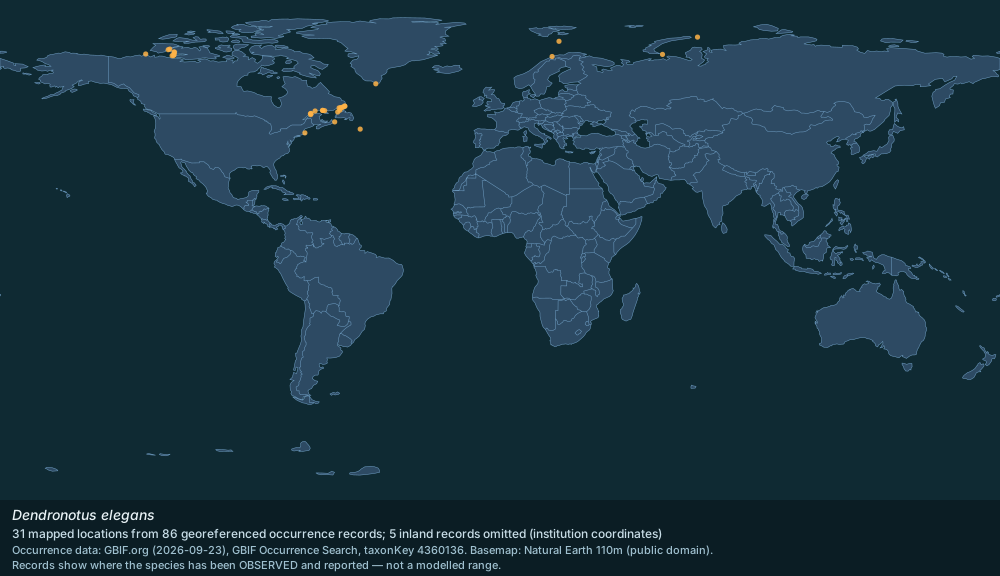
86 georeferenced occurrence records for Dendronotus elegans are published through GBIF from 6 countries or marine areas. The map above plots 31 distinct locations from a sample of 86 records, omitting 5 inland records that carry an institution's coordinates rather than a collection site; it shows where the species has been observed and reported, not a modelled range.
Most records by country or area: Canada (72); Russian Federation (6); Norway (3); United States of America (2); Greenland (1); Svalbard and Jan Mayen (1).
Marine regions with a valid WoRMS distribution record: North West Atlantic.
Source: GBIF Occurrence Search (taxonKey 4360136) — https://www.gbif.org/occurrence/search?taxon_key=4360136&has_coordinate=true (records CC0 / CC BY); WoRMS distribution records (MarineRegions) — https://www.marinespecies.org/aphia.php?p=taxdetails&id=156710 (CC BY 4.0); Natural Earth 110m basemap — https://www.naturalearthdata.com/ (public domain). Accessed 2026-09-23.
Description and natural history (Wikipedia)
This species is named from the Latin niveus, meaning snowy white, which refers to the most common colour pattern of this species.
This species was described from a specimen collected at 17 m depth at Velikaya Salma Strait, Kandalaksha Bay, White Sea, Russia. Numerous specimens from the White Sea and the Barents Sea to a maximum depth of 156 m are included in the material described.
Dendronotus niveus has a translucent white, pinkish or beige body which is similar to Dendronotus dalli and white morphs of Dendronotus frondosus with which it has been confused in the past. It has opaque white pigment within the tips of the dorsal appendages and rhinophore sheaths which may disappear in adults. It is distinguished from other Dendronotus species by the branching of the dorsal appendages (cerata), the smooth median tooth of the radula in adults and molecular characters.
Dendronotus niveus feeding on Diphasia fallax (Johnston, 1847) were pink in colour but after feeding on Hydrallmania falcata (Linnaeus, 1758) and Sertularia mirabilis (Verrill, 1873) in the laboratory became milky white.
Source: Wikipedia: Dendronotus niveus — https://en.wikipedia.org/wiki/Dendronotus_niveus (CC BY-SA 4.0). Accessed 2026-09-23.
Gallery
Spotted an error? Know more?
Reader corrections go straight into our review queue. Suggest an edit · How this site is sourced