Cubera snapper (Lutjanus cyanopterus)
Source-cited species reference: taxonomy from WoRMS, biology from FishBase, occurrence map from GBIF, conservation from IUCN Red List, description from Wikipedia.
Last updated

Yinan Chen · via Wikipedia: Cubera snapper · Public Domain
The cubera snapper (Lutjanus cyanopterus), also known as the Cuban snapper, is a species of marine ray-finned fish, a snapper belonging to the family Lutjanidae. It is native to the western Atlantic Ocean. It is a commercially important species and is a sought-after game fish, though it has been reported to cause ciguatera poisoning.
Scientific classification
- KingdomAnimalia
- PhylumChordata
- ClassActinopterygii
- DivisionTeleostei
- OrderAcanthuriformes
- FamilyLutjanidae
- GenusLutjanus
- SpeciesLutjanus cyanopterus
Named by (G. Cuvier, 1828)
Close relatives
Other species of Lutjanus with a Codexery entry.
- African brown snapper Lutjanus dentatus
- Blackfin snapper Lutjanus buccanella
- Blue and gold snapper Lutjanus viridis
- Bluestriped snapper Lutjanus notatus
- Lutjanus alexandrei
- Lutjanus kasmira
- Lutjanus jocu
- Lutjanus fulgens
Sources: Wikipedia taxobox: Cubera snapper (CC BY-SA 4.0) · differs from this box at order: WoRMS AphiaID 159796 (CC BY 4.0)
Conservation status
Vulnerable (VU)
- LC
- NT
- VU▲ this species
- EN
- CR
- EW
- EX
Source: IUCN Red List assessment · GBIF copy of the Red List category
How big is it?
Largest length in the source, 1.6 m, next to a 1.8 m person.
Diagram: drawn by Codexery, schematic shapes to scale (not a likeness). Length: Wikipedia: Cubera snapper
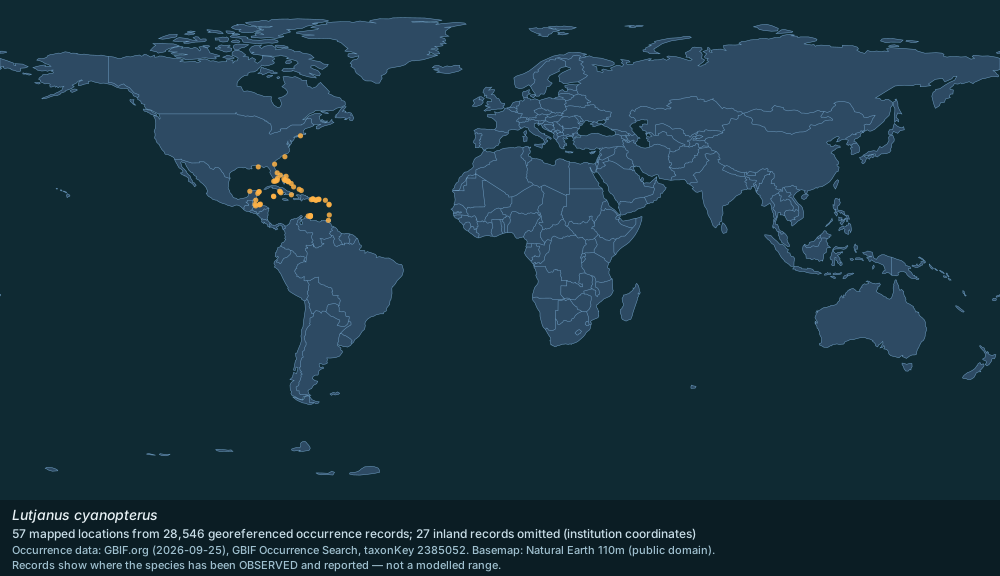
Where the cubera snapper (lutjanus cyanopterus) has been recorded
Each dot is a place where the species has been observed and reported (28,546 records, half-degree grid) — not a modelled range. 19 inland records left out (institution coordinates).
Map: drawn by Codexery. Data: GBIF occurrence search (records CC0 / CC BY) · Natural Earth basemap (public domain) · place coordinates: Wikipedia (CC BY-SA 4.0)
Classification (WoRMS)
Full classification as recorded by WoRMS: Kingdom: Animalia · Phylum: Chordata · Class: Teleostei · Order: Eupercaria incertae sedis · Family: Lutjanidae · Genus: Lutjanus.
Accepted name: Lutjanus cyanopterus · Authority: (Cuvier, 1828) · Taxonomic status: accepted · AphiaID: 159796.
Synonyms and superseded combinations recorded for this taxon: Lutjanus cianopterus (Cuvier, 1828); Lutjanus cubera Poey, 1871; Lutjanus cynodon Poey, 1868; Mesoprion cyanopterus Cuvier, 1828; Mesoprion pargus Cuvier, 1828.
Source: World Register of Marine Species (WoRMS) — https://www.marinespecies.org/aphia.php?p=taxdetails&id=159796 (CC BY 4.0). Accessed 2026-09-25.
Biology and life history (FishBase)
Measured values published by FishBase for Lutjanus cyanopterus. Only fields the database actually holds for this species are shown; these are database values, not aquarium guidance.
Maximum length: 160 cm · Common length: 90 cm · Depth range: 18–70 m · Habitat zone: reef-associated · Body shape: fusiform / normal · Vulnerability index: 82.8 of 100 · Fishery importance: commercial · Aquarium trade: never/rarely.
FishBase notes: Adults are found mainly around ledges over rocky bottoms or around reefs. Young sometimes inhabit mangrove areas.
Maximum depth from Ref. 126840. Feed mainly on fishes, shrimps and crabs (Ref. 55) and lobsters using their strong canines (Ref. 123493). A wary fish, not easily approached underwater (Ref. 13442).
Source: FishBase species summary (SpecCode 1427) — https://www.fishbase.se/summary/Lutjanus-cyanopterus.html (CC BY-NC 3.0 — non-commercial use only). Accessed 2026-09-25.
Distribution and occurrence records (GBIF)
28,546 georeferenced occurrence records for Lutjanus cyanopterus are published through GBIF from 30 countries or marine areas. The map above plots 57 distinct locations from a sample of 3,000 records, omitting 27 inland records that carry an institution's coordinates rather than a collection site; it shows where the species has been observed and reported, not a modelled range.
Most records by country or area: United States of America (16,912); Puerto Rico (11,163); Virgin Islands (U.S.) (108); Mexico (49); Bonaire, Sint Eustatius and Saba (46).
The full country table, WoRMS marine regions and the sampling notes are on this species' Distribution page.
Source: GBIF Occurrence Search (taxonKey 2385052) — https://www.gbif.org/occurrence/search?taxon_key=2385052&has_coordinate=true (records CC0 / CC BY); WoRMS distribution records (MarineRegions) — https://www.marinespecies.org/aphia.php?p=taxdetails&id=159796 (CC BY 4.0); Natural Earth 110m basemap — https://www.naturalearthdata.com/ (public domain). Accessed 2026-09-25.
Conservation status (IUCN Red List)
The IUCN Red List assesses Lutjanus cyanopterus (Cuvier, 1828) as Vulnerable (code VU). No trend, population estimate or threat analysis is given here, because none is available from this source without the Red List API; follow the source link for the full assessment, including its date.
Source: IUCN Red List of Threatened Species (taxon 12417) — https://www.iucnredlist.org/species/12417/0; GBIF IUCN Red List category endpoint (taxonKey 2385052) — https://api.gbif.org/v1/species/2385052/iucnRedListCategory. Accessed 2026-09-25.
Description and natural history (Wikipedia)
The cubera snapper was first formally described as Mesoprion cyanopterus in 1828 by the French zoologist Georges Cuvier with the type locality given as Brazil. The specific name is a compound of cyano meaning "blue" and pterus which means "fin" as Cuvier described it as having bluish-black membranes on its median fins.
Description
The cubera snapper has an oval-shaped, rather streamlined, elongate body, which is less deep than many other snapper species. It has a pair of front nostrils and a pair of rear nostrils that are simple holes in its snout.
The mouth is relatively large with thick lips. The jaws are equipped with canine teeth, one enlarged pair being visible when the mouth is closed. The vomerine teeth are arranged in a crescent-shaped or triangular patch with no central posterior extension, with a tooth patch on each side of the roof of the mouth.
The preoperculum has a weakly developed knob and notch. This species has long pectoral fins, a continuous dorsal fin, and a truncated caudal fin. The dorsal fin contains 10 spines and 14 soft rays, while the anal fin has three spines and seven or eight soft rays, sometimes, a notch is seen behind the spiny part of the dorsal fin. The maximum total length recorded for this species is 160 cm, although a length of 90 cm is more typical; the maximum published weight is 57 kg.
The overall colour of this species is grey to dark brown with pale to dark-grey flanks with some individuals showing a slight reddish hue on the body. The caudal fin is light grey, the pectoral fins may be translucent to pale grey, and a bluish hue is seen on the anal, pectoral, and pelvic fins. The juveniles show an indistinct barred pattern on their flanks.
Distribution and habitat
The cubera snapper is found in the western Atlantic Ocean, from as far north as Nova Scotia to as far south as Santa Catarina in Brazil, and throughout the Caribbean Sea and the Gulf of Mexico and around Bermuda. It has been recorded from the Flores Islands in the Azores.
It occurs at depths between 1 and 85 m. The juveniles shelter within beds of sea grass in in-shore waters or in mangroves, and have been recorded entering fresh water. The adults move off-shore, where they inhabit rocky ledge and reef habitats.
Biology
Cubera snapper adults are solitary fish that have a maximum longevity of 55 years.
Feeding
The cubera snapper is the largest species of snapper and is a predatory fish, its main prey being other fishes, with some crustaceans. The large canine teeth allow this species to feed on large crustaceans such as lobsters and crabs. They forage near the bottom or in the vicinity of hard structures. The whale shark (Rhincodon typus) feeds on the newly laid pelagic spawn of cubera snappers, while the larger fish are prey to moray eels, barracudas, groupers, other snappers, and large sharks.
The cubera snapper spawns from May until August, when their gathering into large spawning aggregations is determined by the lunar cycles. They gather in large numbers, up to 10,000 fish over shallow spawning sites in off-shore waters at places such as outer reef slopes and sandy drop-offs. The eggs hatch within a day of fertilisation and the larvae are pelagic, drifting with the currents until they settle.
The cubera snapper is considered to be a good-quality food fish, although larger fish in some areas are known to cause ciguatera poisoning in humans who consume their flesh. It is caught using hook-and-line with bottom longlines, gill nets, and bottom trawls, and occasionally by spearfishing. In areas where the larger fish are ciguatoxic, no fishery exists, as in Puerto Rico and the Lesser Antilles, or only smaller fish are consumed, as happens in the Florida Keys.
In the United States, this species is subject to bag and size limits for both commercial and recreational fisheries. The predictable and accessible spawning aggregations of this species make it vulnerable to overfishing, and the catch decreased by over 60% off the Atlantic coast of the United States in the 20 years up to 2015; the numbers spawning off Cuba and Brazil had also decreased. In Brazil, some stocks have declined so much that they are commercially extinct. The IUCN predict further declines unless aggregations are protected, so listed the species as vulnerable.
Source: Wikipedia: Cubera snapper — https://en.wikipedia.org/wiki/Cubera_snapper (CC BY-SA 4.0). Accessed 2026-09-25.
Related in Cubera snapper
Links follow this subject's own source article.
Elsewhere in Cubera snapper
Test yourself
Three questions drawn from this entry’s sources. Pick an answer to check it.
Answers checked against the source article
Sources
Compiled from Wikipedia and the sources listed below. Text from Wikipedia is available under CC BY-SA 4.0; this entry is adapted from it.
- Wikipedia: Cubera snapper (CC BY-SA 4.0).
- Classification: the source article's taxobox; compare WoRMS, the World Register of Marine Species (CC BY 4.0).
- Conservation status: IUCN Red List assessment.
- Occurrence records: GBIF (CC0 / CC BY). Basemap: Natural Earth (public domain).
- Biology values: FishBase species summary (CC BY-NC 3.0, non-commercial).
- Word definitions: the , each quoted from its Wikipedia article.
Spotted an error? Know more?
Reader corrections go straight into our review queue. Suggest an edit · How this site is sourced