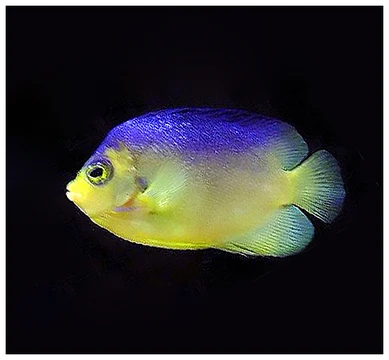
Cocos-Keeling angelfish (Centropyge colini)
Source-cited species reference: taxonomy from WoRMS, biology from FishBase, occurrence map from GBIF, conservation from IUCN Red List, description from Wikipedia.

Poseidon822 · CC0
The Cocos-Keeling angelfish (Centropyge colini), or Colin's angelfish is a small species of ray-finned fish, a marine angelfish belonging to the family Pomacanthidae. It is found in the Indo-West Pacific region.
- Scientific name
- Centropyge colini
- Authority
- Smith-Vaniz & Randall, 1974
- Family
- Pomacanthidae
- Order
- Acanthuriformes
- Maximum length
- 9 cm
- Depth range
- 20–110 m
- Habitat zone
- reef-associated
- Iucn red list
- Least Concern
- Gbif occurrence records
- 30
Classification (WoRMS)
Full classification as recorded by WoRMS: Kingdom: Animalia · Phylum: Chordata · Class: Teleostei · Order: Acanthuriformes · Family: Pomacanthidae · Genus: Centropyge.
Accepted name: Centropyge colini · Authority: Smith-Vaniz & Randall, 1974 · Taxonomic status: accepted · AphiaID: 278832.
Source: World Register of Marine Species (WoRMS) — https://www.marinespecies.org/aphia.php?p=taxdetails&id=278832 (CC BY 4.0). Accessed 2026-09-23.
Biology and life history (FishBase)
Measured values published by FishBase for Centropyge colini. Only fields the database actually holds for this species are shown; these are database values, not aquarium guidance.
Maximum length: 9 cm · Depth range: 20–110 m · Habitat zone: reef-associated · Body shape: short and / or deep · Vulnerability index: 10 of 100 · Fishery importance: of no interest · Aquarium trade: commercial.
FishBase notes: This rare species is a secretive dweller of crevices and clefts in caves of outer reef drop-offs (Ref. 1602). Natural diet unknown; forms harems of 3-7 individuals. Almost never exported through the aquarium trade (Ref. 48391). Maximum depth reported taken from Ref. 128797.
Source: FishBase species summary (SpecCode 8773) — https://www.fishbase.se/summary/Centropyge-colini.html (CC BY-NC 3.0 — non-commercial use only). Accessed 2026-09-23.
Distribution and occurrence records (GBIF)
30 georeferenced occurrence records for Centropyge colini are published through GBIF from 9 countries or marine areas. The map above plots 15 distinct locations from a sample of 30 records; it shows where the species has been observed and reported, not a modelled range.
Most records by country or area: Australia (14); Palau (4); Marshall Islands (3); New Caledonia (3); Cocos (Keeling) Islands (2); Christmas Island (1); Micronesia (Federated States of) (1); Philippines (1); Vanuatu (1).
Source: GBIF Occurrence Search (taxonKey 2396529) — https://www.gbif.org/occurrence/search?taxon_key=2396529&has_coordinate=true (records CC0 / CC BY); WoRMS distribution records (MarineRegions) — https://www.marinespecies.org/aphia.php?p=taxdetails&id=278832 (CC BY 4.0); Natural Earth 110m basemap — https://www.naturalearthdata.com/ (public domain). Accessed 2026-09-23.
Conservation status (IUCN Red List)
The IUCN Red List assesses Centropyge colini Smith-Vaniz & Randall, 1974 as Least Concern (code LC). No trend, population estimate or threat analysis is given here, because none is available from this source without the Red List API; follow the source link for the full assessment, including its date.
Source: IUCN Red List of Threatened Species (taxon 165838) — https://www.iucnredlist.org/species/165838/0; GBIF IUCN Red List category endpoint (taxonKey 2396529) — https://api.gbif.org/v1/species/2396529/iucnRedListCategory. Accessed 2026-09-23.
Description and natural history (Wikipedia)
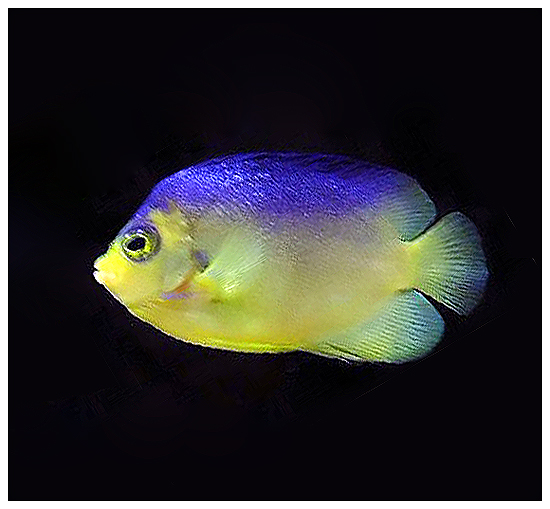
The Cocos-Keeling angelfish is mainly lemon-yellow in colour with a wide blue stripe from the nape along the back to the middle of the dorsal fin. There is a thin purplish ring around the eye. The dorsal fin contains 14 spines and 16-17 soft rays while the anal fin has 3 spines and 17 soft rays. This species attains a maximum total length of 9 cm.
The Cocos-Keeling angelfish has been recorded from a scattering of sites in the Indo-West Pacific. These include the Spratly Islands, Palau, Papua New Guinea, Indonesia, Marshall Islands, Cocos Keeling Islands, Fiji and Guam, with an unconfirmed report from the Ogasawara Islands off Japan.
The Cocos-Keeling angelfish is found at depths between 20 and 100 m. It is a shy and secretive species which lives in crevices and caves in deep reef drop offs. It is found in groups which consist of a male and a harem of 2-6 females. The male is replaced by the most dominant female if he disappears. Very little is known about the diet of this species.
The Cocos-Keeling angelfish was first formally described in 1974 by William F. Smith-Vaniz and Ernest J. Randall (1924-2020) with the type locality given as Turks Reef in the Cocos-Keeling Islands. Some authorities place this species in the subgenus Centropyge.
The specific name honours the biologist Patrick L. Colin who helped collect the type.
The Cocos-Keeling angelfish rarely appears in the aquarium trade.
Source: Wikipedia: Cocos-Keeling angelfish — https://en.wikipedia.org/wiki/Cocos-Keeling_angelfish (CC BY-SA 4.0). Accessed 2026-09-23.
Gallery
Frequently Asked Questions
What is the Cocos-Keeling angelfish (Centropyge colini)?
It is a small marine angelfish native to the Indo-West Pacific, also widely known as Colin's angelfish. As a ray-finned member of the Pomacanthidae family, it occupies reef-associated habitats across its range.
Where does the Cocos-Keeling angelfish (Centropyge colini) live in the wild?
This species is distributed throughout the Indo-West Pacific region. It is typically encountered at depths ranging from roughly 20 metres down to about 110 metres.
How big does the Cocos-Keeling angelfish (Centropyge colini) get?
Colin's angelfish is a compact species that tops out at around 9 centimetres in total length. That places it among the smaller members of the angelfish family.
Who described the Cocos-Keeling angelfish (Centropyge colini) and when?
The species was formally described by Smith-Vaniz and Randall in 1974. It is classified within the order Acanthuriformes and the family Pomacanthidae.
What are the common names for Centropyge colini?
Besides its binomial name, the fish is known as both the Cocos-Keeling angelfish and Colin's angelfish. The two common names are used interchangeably in field guides and the aquarium trade.
Spotted an error? Know more?
Reader corrections go straight into our review queue. Suggest an edit · How this site is sourced