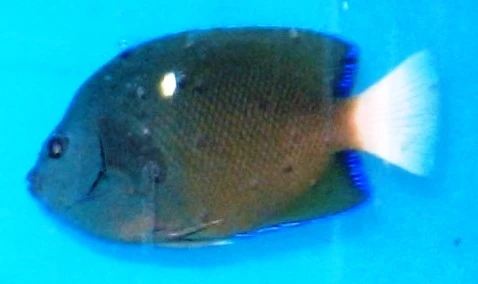
Clipperton angelfish (Holacanthus limbaughi)
Source-cited species reference: taxonomy from WoRMS, biology from FishBase, occurrence map from GBIF, conservation from IUCN Red List, description from Wikipedia.

Pacific Southwest Region USFWS from Sacramento, US · Public domain
The Clipperton angelfish (Holacanthus limbaughi) is a species of marine ray-finned fish, a marine angelfish belonging to the family Pomacanthidae. It is endemic to Clipperton Island, a French possession in the eastern Pacific Ocean.
- Scientific name
- Holacanthus limbaughi
- Authority
- Baldwin, 1963
- Family
- Pomacanthidae
- Order
- Acanthuriformes
- Maximum length
- 25 cm
- Habitat zone
- reef-associated
- Iucn red list
- Near Threatened
- Gbif occurrence records
- 59
Classification (WoRMS)
Full classification as recorded by WoRMS: Kingdom: Animalia · Phylum: Chordata · Class: Teleostei · Order: Acanthuriformes · Family: Pomacanthidae · Genus: Holacanthus.
Accepted name: Holacanthus limbaughi · Authority: Baldwin, 1963 · Taxonomic status: accepted · AphiaID: 276015.
Source: World Register of Marine Species (WoRMS) — https://www.marinespecies.org/aphia.php?p=taxdetails&id=276015 (CC BY 4.0). Accessed 2026-09-23.
Biology and life history (FishBase)
Measured values published by FishBase for Holacanthus limbaughi. Only fields the database actually holds for this species are shown; these are database values, not aquarium guidance.
Maximum length: 25 cm · Habitat zone: reef-associated · Body shape: short and / or deep · Vulnerability index: 15 of 100 · Aquarium trade: never/rarely.
Source: FishBase species summary (SpecCode 11177) — https://www.fishbase.se/summary/Holacanthus-limbaughi.html (CC BY-NC 3.0 — non-commercial use only). Accessed 2026-09-23.
Distribution and occurrence records (GBIF)
59 georeferenced occurrence records for Holacanthus limbaughi are published through GBIF from 4 countries or marine areas. The map above plots 3 distinct locations from a sample of 59 records, omitting 3 inland records that carry an institution's coordinates rather than a collection site; it shows where the species has been observed and reported, not a modelled range.
Most records by country or area: France (53); Mexico (3); Brazil (2); Egypt (1).
Source: GBIF Occurrence Search (taxonKey 5211466) — https://www.gbif.org/occurrence/search?taxon_key=5211466&has_coordinate=true (records CC0 / CC BY); WoRMS distribution records (MarineRegions) — https://www.marinespecies.org/aphia.php?p=taxdetails&id=276015 (CC BY 4.0); Natural Earth 110m basemap — https://www.naturalearthdata.com/ (public domain). Accessed 2026-09-23.
Conservation status (IUCN Red List)
The IUCN Red List assesses Holacanthus limbaughi Baldwin, 1963 as Near Threatened (code NT). No trend, population estimate or threat analysis is given here, because none is available from this source without the Red List API; follow the source link for the full assessment, including its date.
Source: IUCN Red List of Threatened Species (taxon 165836) — https://www.iucnredlist.org/species/165836/0; GBIF IUCN Red List category endpoint (taxonKey 5211466) — https://api.gbif.org/v1/species/5211466/iucnRedListCategory. Accessed 2026-09-23.
Description and natural history (Wikipedia)
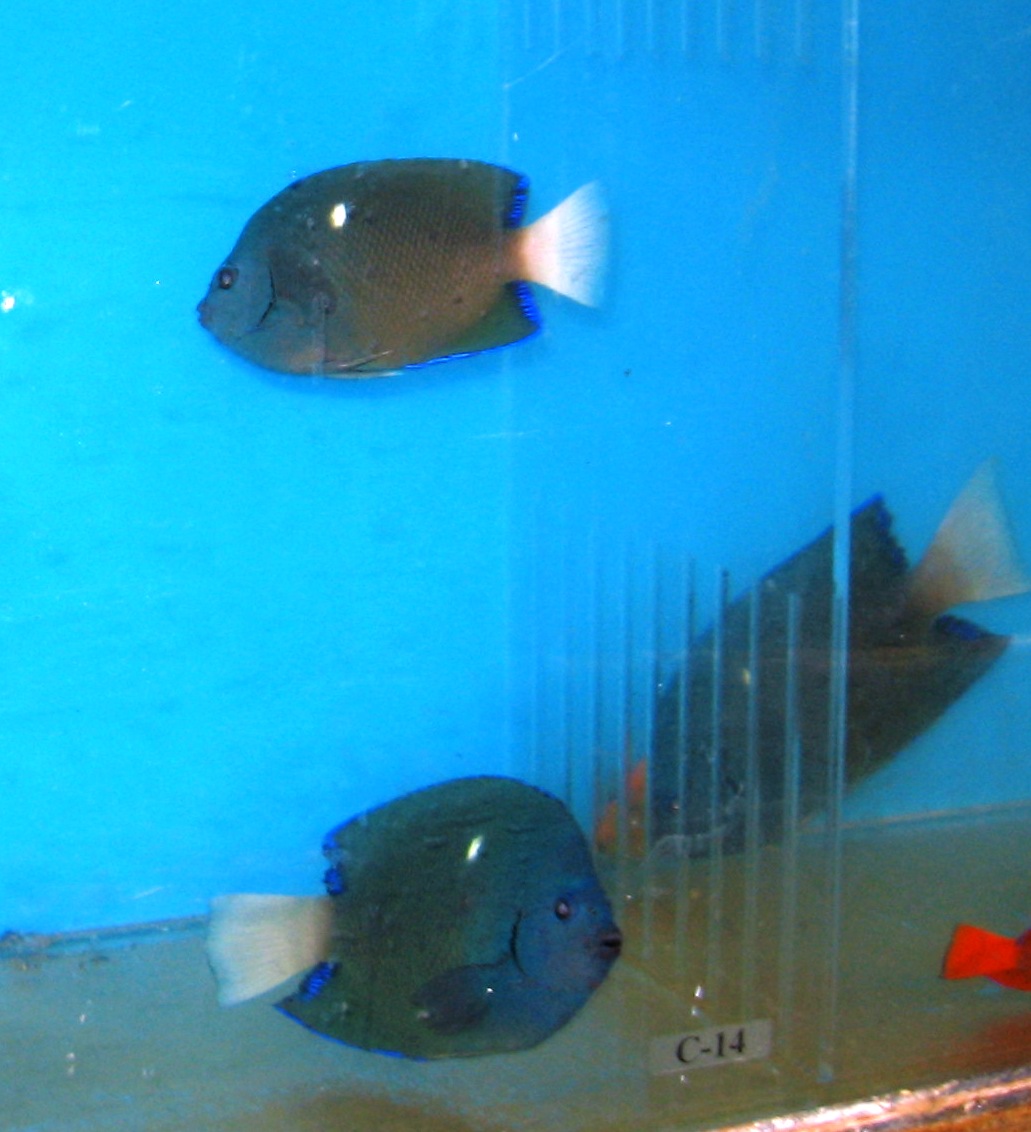
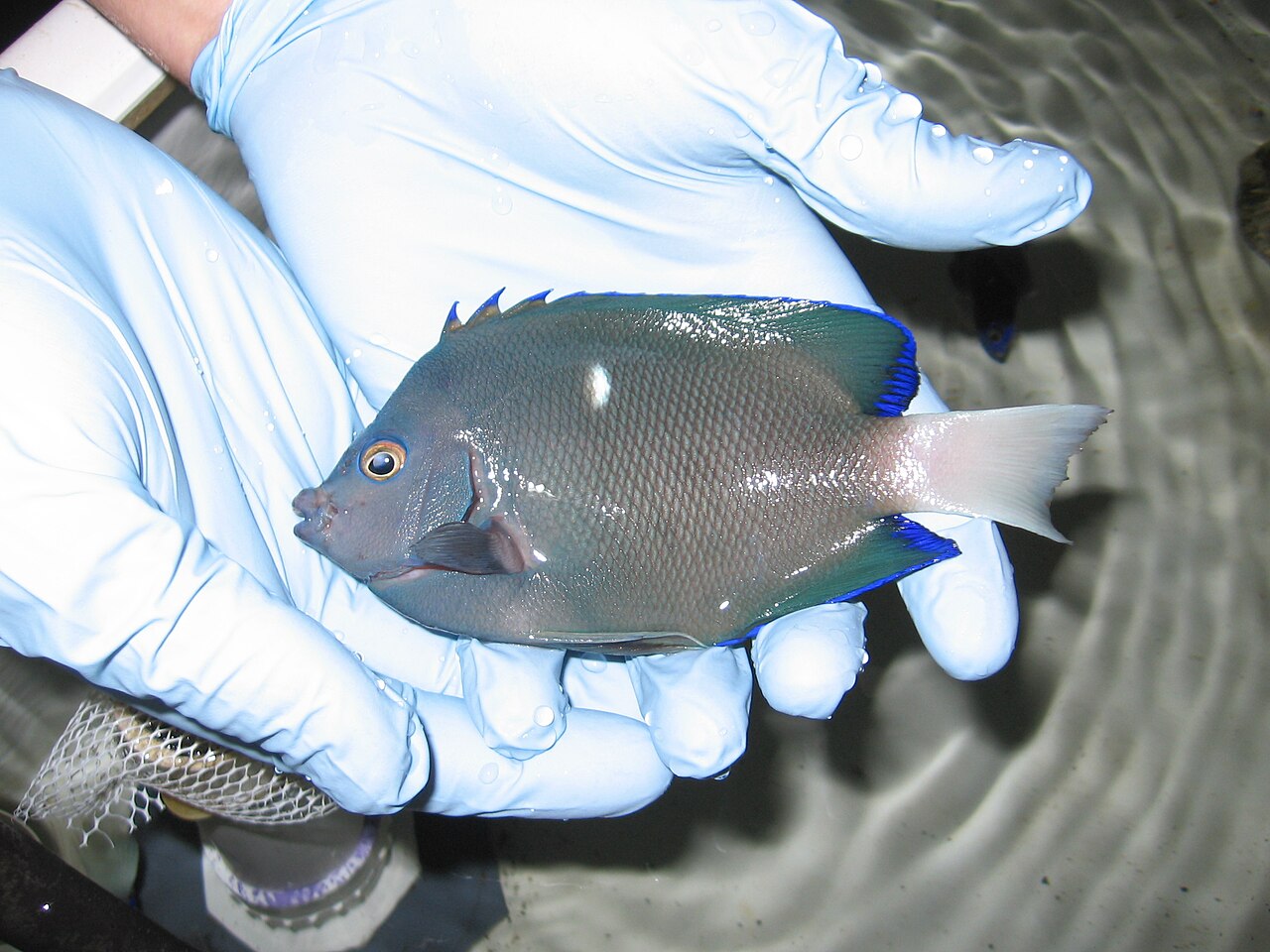
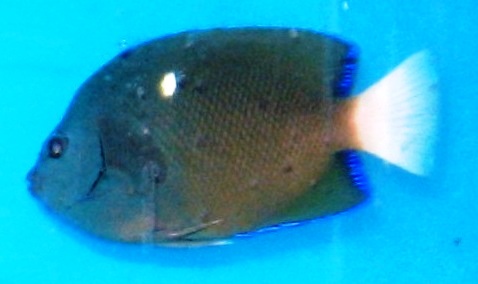
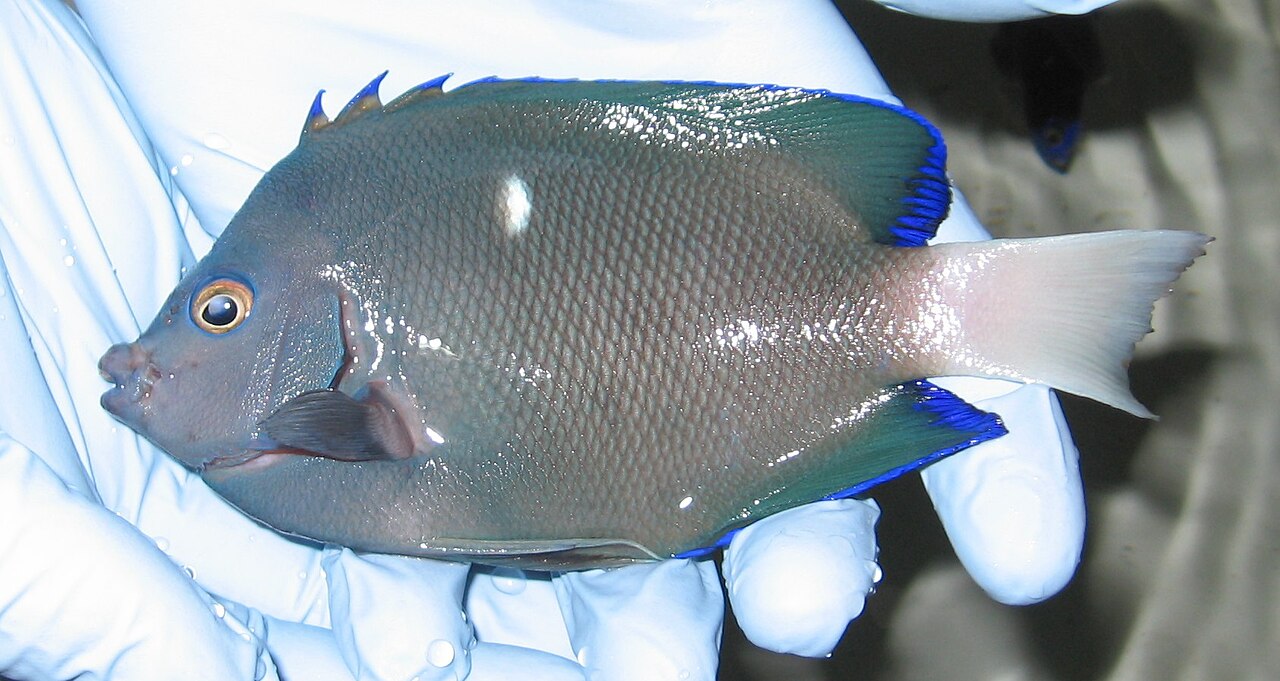
The Clipperton angelfish has a deep, laterally compressed body. It has a small mouth that has bristle-like teeth. The preoperculum has a sizeable spine at its corner and a serrated rear margin while there are 4 spines between the preoperculum and the operculum. The juveniles are a dark bluish-grey on their bodies, which is marked with a number of vertical blue bars, 2 on the head and 5 on the flanks, these fade as they mature into adults. They also have a white spot on the upper side and white caudal and pectoral fins. The adults are similar, lacking the barring, and have vivid blue margins to the dorsal, anal and pelvic fins. The dorsal fin contains 14 spines and 17-18 soft rays while the anal fin has 3 spines and 17-18 soft rays. This species attains a maximum total length of 30 cm.
The Clipperton angelfish is endemic to the waters of the French overseas territory of Clipperton Island, which is 2,560 km west of Costa Rica, in the Eastern Pacific Ocean.
The Clipperton angelfish is found at depths between 6 and 100 m. Very little is known about its habitat preferences and biology.
The Clipperton angelfish was first formally described in 1963 by the American ichthyologist Wayne J. Baldwin. The specific name honours the American scuba diver, zoologist and underwater photographer Conrad Limbaugh (1925–1960) who played a vital role in the collection of the type.
The Clipperton angelfish has such a remote and restricted distribution that it is extremely scarce in the aquarium trade. When it has appeared in that trade it has commanded very high prices. In 2009, a California tropical fish dealer was caught trying to bring 52 illegally collected Clipperton angelfish into the United States, falsely declaring them as king angelfish to federal wildlife authorities. He intended to sell the fish for $10,000 each.
Source: Wikipedia: Clipperton angelfish — https://en.wikipedia.org/wiki/Clipperton_angelfish (CC BY-SA 4.0). Accessed 2026-09-23.
Gallery
Frequently Asked Questions
What is the Clipperton angelfish (Holacanthus limbaughi)?
It is a small, reef-dwelling marine angelfish in the family Pomacanthidae, first formally described by Baldwin in 1963. It sits within the order Acanthuriformes and is one of the most geographically restricted species in the genus Holacanthus.
Where does the Clipperton angelfish live?
This species is found exclusively around Clipperton Island, a remote French territory in the eastern Pacific Ocean. It is tied to the reef structures encircling that single island and has no confirmed populations anywhere else on the planet.
How large does the Clipperton angelfish grow?
Adults reach a maximum total length of roughly 25 centimeters, placing it in the smaller end of the angelfish family. Its compact size is typical of reef-associated species that navigate tight crevices and coral heads.
Why is the Clipperton angelfish so hard to find in the aquarium trade?
Because it is strictly endemic to the waters around one isolated island, there are no alternative wild populations to source from. The extreme remoteness of Clipperton Island makes collection and live transport logistically impractical, so the fish is virtually absent from the hobby.
What is the conservation outlook for the Clipperton angelfish?
The species is assessed on the IUCN Red List, a designation that reflects concern over its vanishingly small geographic range. Relying on a single, isolated reef system leaves it especially exposed to localized environmental shifts or disturbances.
Spotted an error? Know more?
Reader corrections go straight into our review queue. Suggest an edit · How this site is sourced