
Reddish scallop (Chlamys rubida)
Source-cited species reference: taxonomy from WoRMS, biology from SeaLifeBase, occurrence map from GBIF, description from Wikipedia.
Chlamys rubida is a species of bivalve mollusc in the family Pectinidae found on the west coast of North America from the Gulf of Alaska to San Diego, California.
- Scientific name
- Chlamys rubida
- Authority
- (Hinds, 1845)
- Family
- Pectinidae
- Order
- Pectinida
- Maximum length
- 7 cm
- Depth range
- 1–1600 m
- Habitat zone
- benthic
- Gbif occurrence records
- 1,302
Classification (WoRMS)
Full classification as recorded by WoRMS: Kingdom: Animalia · Phylum: Mollusca · Class: Bivalvia · Order: Pectinida · Family: Pectinidae · Genus: Chlamys.
Accepted name: Chlamys rubida · Authority: (Hinds, 1845) · Taxonomic status: accepted · AphiaID: 254460.
Synonyms and superseded combinations recorded for this taxon: Chlamys (Chlamys) rubida (Hinds, 1845); Chlamys (Chlamys) rubida prerubida MacNeil, 1967; Chlamys hindsi P. P. Carpenter, 1864; Chlamys jordani (R. Arnold, 1906); Chlamys picoensis (Waterfall, 1929); Pecten (Chlamys) hericeus var. navarchus Dall, 1898; Pecten (Chlamys) islandicus picoensis Waterfall, 1929; Pecten (Chlamys) jordani R. Arnold, 1903; Pecten (Chlamys) venturaensis Waterfall, 1929; Pecten hindsii P. P. Carpenter, 1864; Pecten hindsii kincaidi I. S. Oldroyd, 1920; Pecten kincaidi I. S. Oldroyd, 1920; Pecten rubidus Hinds, 1845.
Source: World Register of Marine Species (WoRMS) — https://www.marinespecies.org/aphia.php?p=taxdetails&id=254460 (CC BY 4.0). Accessed 2026-09-23.
Biology and life history (SeaLifeBase)
Measured values published by SeaLifeBase for Chlamys rubida. Only fields the database actually holds for this species are shown; these are database values, not aquarium guidance.
Maximum length: 7 cm · Depth range: 1–1600 m · Habitat zone: benthic · Vulnerability index: 10 of 100.
SeaLifeBase notes: Found on gravel-mud substrates (Ref. 95344).
Source: SeaLifeBase species summary (SpecCode 47719) — https://www.sealifebase.se/summary/Chlamys-rubida.html (CC BY-NC 3.0 — non-commercial use only). Accessed 2026-09-23.
Distribution and occurrence records (GBIF)
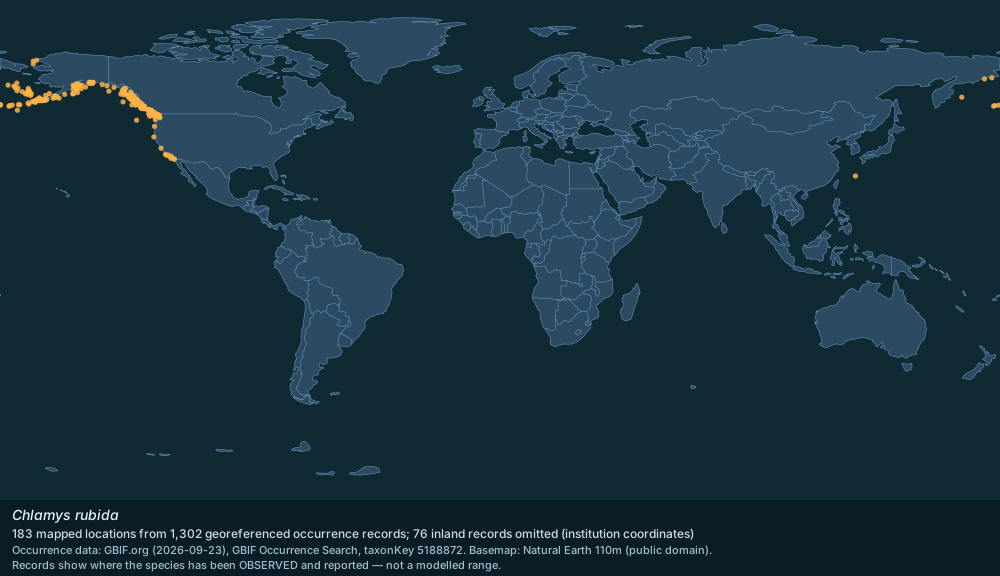
1,302 georeferenced occurrence records for Chlamys rubida are published through GBIF from 5 countries or marine areas. The map above plots 183 distinct locations from a sample of 1,302 records, omitting 76 inland records that carry an institution's coordinates rather than a collection site; it shows where the species has been observed and reported, not a modelled range.
Most records by country or area: United States of America (681); Canada (612); Russian Federation (4); Japan (2); Mexico (2).
The full country table, WoRMS marine regions and the sampling notes are on this species' Distribution page.
Source: GBIF Occurrence Search (taxonKey 5188872) — https://www.gbif.org/occurrence/search?taxon_key=5188872&has_coordinate=true (records CC0 / CC BY); WoRMS distribution records (MarineRegions) — https://www.marinespecies.org/aphia.php?p=taxdetails&id=254460 (CC BY 4.0); Natural Earth 110m basemap — https://www.naturalearthdata.com/ (public domain). Accessed 2026-09-23.
Description and natural history (Wikipedia)
The pink scallop has two convex valves joined by a hinge joint and grows to a diameter of about 6 cm. Each valve has an umbo or knoblike protuberance from which 20 to 30 shallow ridges radiate to the margin at the other side of the shell. The left valve is usually uppermost as it lies on the seabed and is some shade of red intermixed with white streaks. The annual growth rings can be seen and there is concentric sculpturing parallel to the margin, often in a different shade of pink. The lower valve is either a paler shade of pink or dull white. There is a large auricle or flap on one side of the umbo. When the animal is feeding, it holds the valves apart and the mantle becomes visible, fringed with short tentacles and with a ring of tiny eyes near the margin of each valve.
The pink scallop can be distinguished from its close relative the spiny scallop (Chlamys hastata) by the valves being rather more rounded and by the lack of spines on the ribs which gives it a smooth texture. The glossy white interior of the shell does not have the purplish markings that are sometimes present in the spiny scallop.
The pink scallop is found on the Pacific Coast of North America at depths down to about 300 m. Its range extends from Alaska to San Diego, California but it is more common in the northern half of this range. It is also found in Kamchatka, the Sea of Okhotsk and Japan. It is found on rocks or on sandy or muddy sea beds.
The pink scallop usually has a symbiotic relationship with an encrusting sponge, usually the orange Myxilla incrustans, which grows on its left valve. The sponge provides camouflage for the scallop, and may deter predators from attacking it. The sponge also makes it harder for a starfish to pull open the scallop with its tube feet, because it makes manipulating the shell more difficult. The sponge benefits from not being submerged by sediment in turbid conditions. In the laboratory, a study showed that when the sediment in seawater tanks was frequently stirred up, sponges on empty scallop shells all died, whereas those on living shells flourished. When a starfish such as the mottled star (Evasterias troschelii) approaches, the scallop "smells" its presence with chemoreceptors at the tips of its tentacles. It then takes evasive action, repeatedly clapping its valves together and swimming away, margin first. If a starfish succeeds in touching a sponge growing on the shell, it often turns away, apparently repelled by this distasteful coating.
Source: Wikipedia: Chlamys rubida — https://en.wikipedia.org/wiki/Chlamys_rubida (CC BY-SA 4.0). Accessed 2026-09-23.
Gallery
Related in Reddish scallop
Links follow this subject's own source article.
Elsewhere in Reddish scallop
Spotted an error? Know more?
Reader corrections go straight into our review queue. Suggest an edit · How this site is sourced