
Cherubfish (Centropyge argi)
Source-cited species reference: taxonomy from WoRMS, biology from FishBase, occurrence map from GBIF, conservation from IUCN Red List, description from Wikipedia.

Brian Gratwicke · CC BY 2.0
The cherubfish (Centropyge argi), also known as the pygmy angelfish, is a species of marine ray-finned fish, a marine angelfish belonging to the family Pomacanthidae. It is found in the western Atlantic Ocean.
- Scientific name
- Centropyge argi
- Authority
- Woods & Kanazawa, 1951
- Family
- Pomacanthidae
- Order
- Acanthuriformes
- Maximum length
- 8 cm
- Depth range
- 5–80 m
- Habitat zone
- reef-associated
- Iucn red list
- Least Concern
- Gbif occurrence records
- 18,670
Form and Coloration
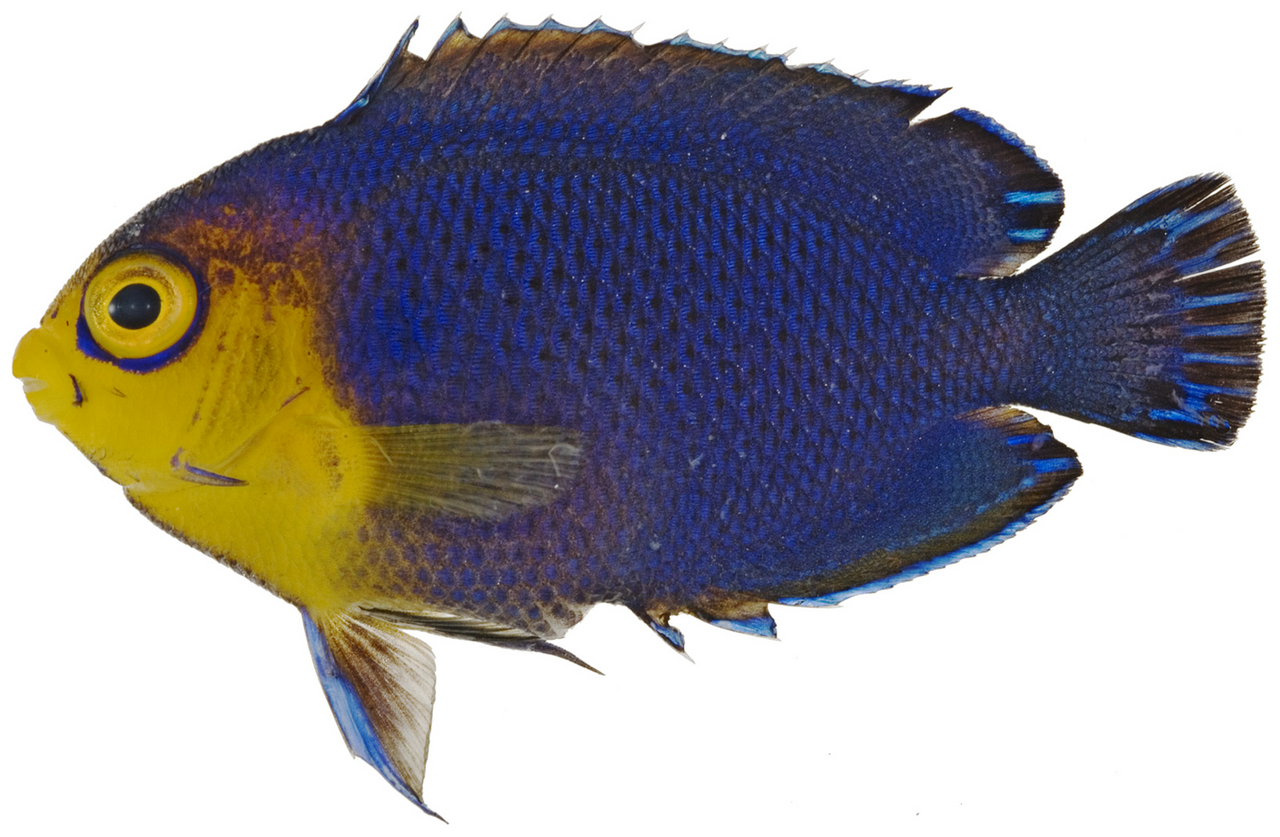
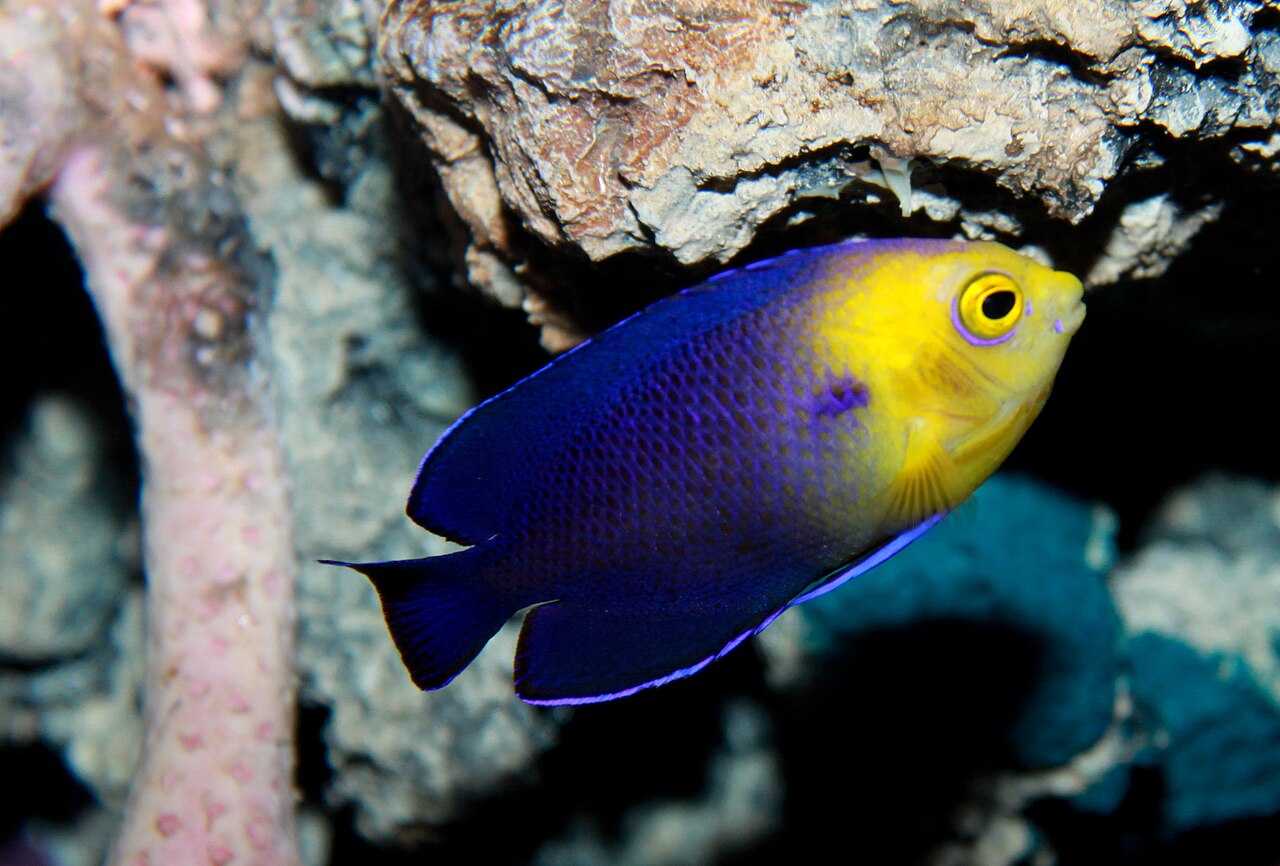
The cherubfish presents a strikingly compact silhouette among marine angelfish. Its body is oval, deep, and laterally compressed, giving it a disc-like profile well suited to life among coral rubble. The snout is short and blunt, paired with a small mouth that reflects its role as a grazer on algae and tiny benthic invertebrates. A notable defensive feature is the long, robust spine at the angle of the preoperculum, whose vertical edge is serrated—a built-in deterrent against predators. Coloration is bold: the body is a rich deep blue, while the head and chest blaze in orange-yellow. A thin blue ring encircles the eye, and a small dark blue blotch sits just behind the mouth. The pectoral fins are a pale yellowish tone, contrasting with the remaining fins, which are dark blue edged in light blue. The dorsal fin carries fourteen to fifteen spines alongside fifteen to sixteen soft rays, while the anal fin bears three spines and seventeen soft rays. At a maximum of eight centimetres, the species remains a true pygmy among its angelfish relatives.
Range Across the Western Atlantic
The cherubfish is a species of the western Atlantic Ocean, and its distribution stretches across a remarkably broad corridor of tropical and subtropical waters. Its range begins off the waters surrounding Bermuda, a location that also holds taxonomic significance as the type locality. From there, the species is recorded along the coast of North Carolina, continuing southward through the Caribbean Sea and the Gulf of Mexico. The distribution extends further along the Caribbean coast of South America, reaching as far east as the waters off French Guiana. This wide but exclusively western-Atlantic presence places the cherubfish in a distinct biogeographic zone, separate from the many angelfish species that populate the Indo-Pacific. Within this range, the fish occupies relatively shallow to moderate depths, typically found between five and eighteen metres, with occurrences also noted at greater depths. Its preference for coral rubble habitats means it is most often encountered where broken coral and rocky substrates provide both food and shelter, a niche common throughout the Caribbean and Gulf regions.
Social Structure and Daily Life
In the wild, the cherubfish is far from a solitary creature. It typically assembles into small social groups numbering around ten individuals, with the composition usually consisting of a single dominant male accompanied by several females and juveniles. This loose grouping suggests a degree of social cohesion, though the species is not described as forming the tightly bonded pairs seen in some other reef fish. When threatened or startled, the cherubfish's immediate response is to retreat into nearby cavities within the coral rubble that forms its preferred habitat. This behavior underscores the importance of structural complexity in its environment—open water offers little refuge, while crevices and holes in broken coral provide instant safety. The fish's diet consists of algae and small benthic invertebrates, both abundant on the rubble and rocky substrates it favors. Its small size, capped at eight centimetres, and its compact, laterally compressed body make it well adapted for maneuvering through tight spaces in search of food and shelter. The serrated spine at the preoperculum adds a further layer of defense should a predator attempt to approach.
Taxonomic History and the Aquarium World
The cherubfish entered formal scientific record in 1951, when Loren Paul Woods and Robert H. Kanazawa provided its first description. The type locality they designated was the Argus Bank near Bermuda, a detail that also gave the species its specific epithet, argi. In certain taxonomic frameworks, the cherubfish is assigned to the subgenus Xiphipops within the family Pomacanthidae, a classification that reflects ongoing refinement in how angelfish lineages are organized. Beyond its scientific identity, the species has carved out a prominent place in the hobbyist world. It is regarded as one of the most popular marine angelfish kept in aquaria, a testament to its vivid coloration—deep blue body, orange-yellow head, and contrasting fin tones—combined with its manageable size of just eight centimetres. For aquarists, the cherubfish offers the visual drama of a larger angelfish in a compact form, making it a favorite for reef and community tanks. Its preference for coral rubble in the wild translates naturally to an aquarium setting with rockwork and hiding spots, mirroring the cavities it uses in the wild when alarmed.
Gallery
Frequently Asked Questions
What is the Cherubfish (Centropyge argi)?
It is a small marine angelfish in the family Pomacanthidae, commonly called the pygmy angelfish. It is a ray-finned species native to the western Atlantic Ocean.
Where can you find the Cherubfish (Centropyge argi) in the wild?
This species inhabits the western Atlantic, typically ranging from shallow depths of about 5 meters down to roughly 80 meters.
How large does the Cherubfish (Centropyge argi) get?
At full size, an adult Cherubfish reaches a maximum length of about 8 centimeters, making it one of the smaller members of the angelfish family.
What is the Cherubfish (Centropyge argi)'s taxonomic classification?
It belongs to the family Pomacanthidae within the order Acanthuriformes. The species was formally described by Woods and Kanazawa in 1951.
Why do fans and aquarists care about the Cherubfish (Centropyge argi)?
Its compact size and distinctive angelfish coloration make it a popular subject in marine hobbyist circles. As a western Atlantic endemic, it also holds interest for regional biodiversity enthusiasts tracking species in that basin.
Related in Cherubfish
Links follow this subject's own source article.
Elsewhere in Cherubfish
Spotted an error? Know more?
Reader corrections go straight into our review queue. Suggest an edit · How this site is sourced