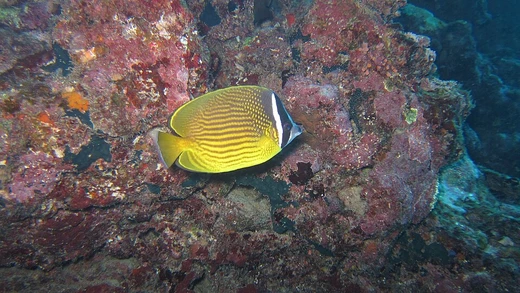
Oriental butterflyfish (Chaetodon auripes)
Source-cited species reference: taxonomy from WoRMS, biology from FishBase, occurrence map from GBIF, conservation from IUCN Red List, description from Wikipedia.

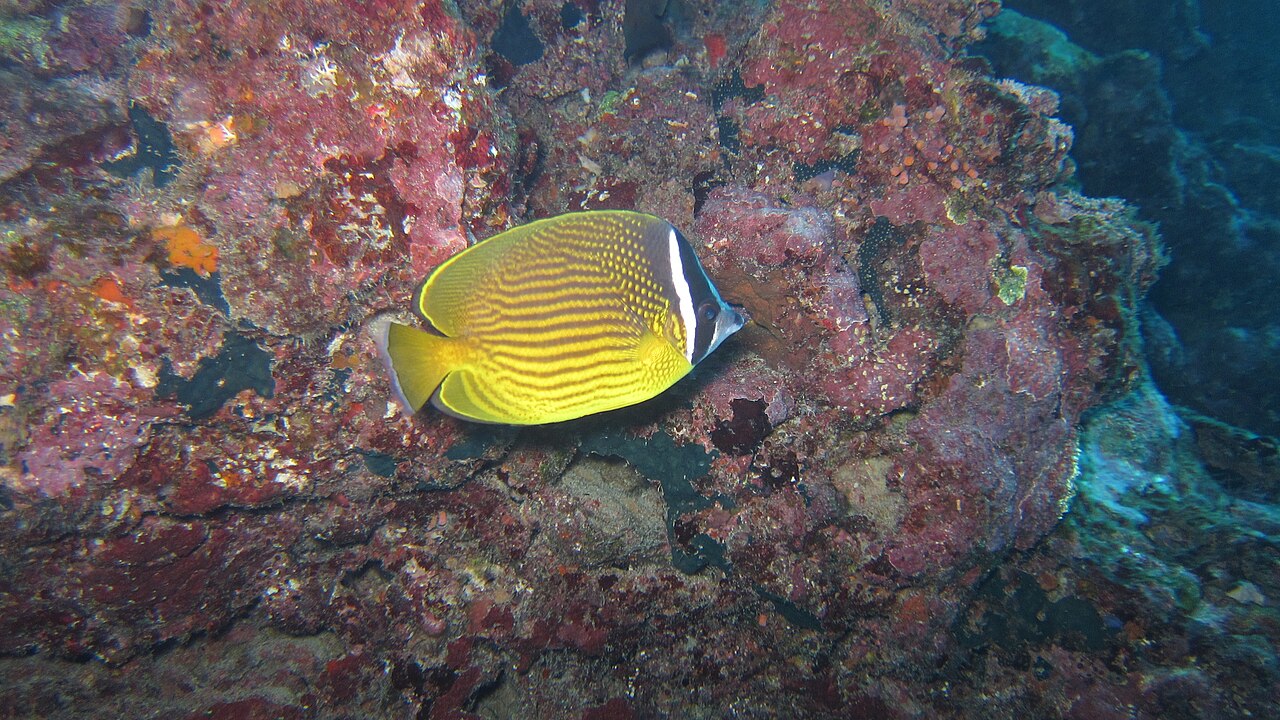
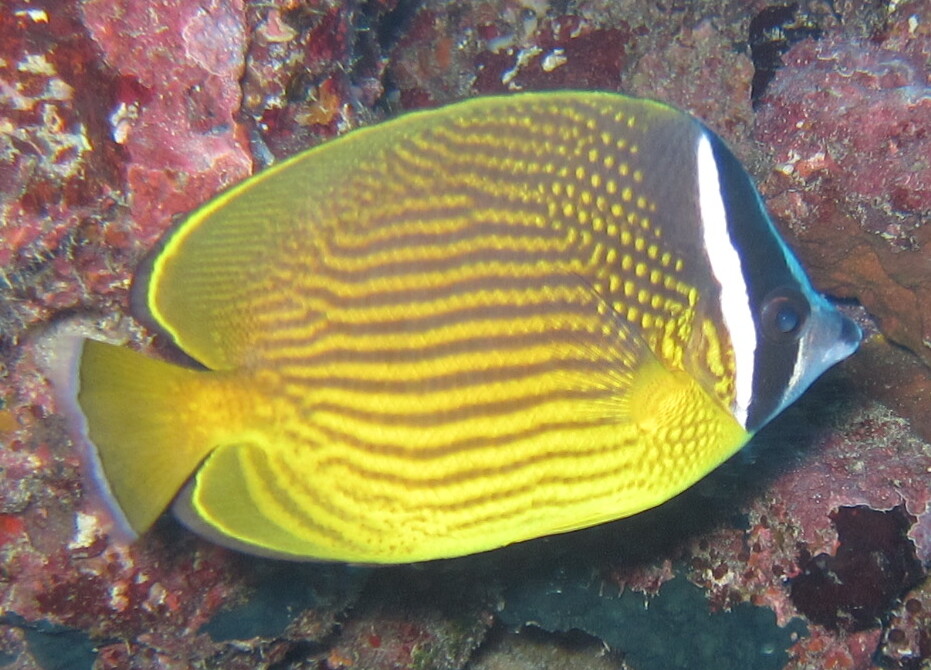
Chaetodon auripes, the oriental butterflyfish, is a species of marine ray-finned fish in the butterflyfish family Chaetodontidae. It is found in the western Pacific Ocean, off the coasts of East Asia.
- Scientific name
- Chaetodon auripes
- Authority
- Jordan & Snyder, 1901
- Family
- Chaetodontidae
- Order
- Acanthuriformes
- Maximum length
- 20 cm
- Depth range
- 1–30 m
- Habitat zone
- reef-associated
- Iucn red list
- Least Concern
- Gbif occurrence records
- 717
Taxonomic Architecture and Proposed Subgenera
The genus Chaetodon stands as the dominant lineage within the butterflyfish family, housing roughly ninety living species that together form a remarkably diverse assemblage. Yet this very breadth has made the group's internal architecture a persistent puzzle for taxonomists. DNA sequence analyses across large portions of the genus have largely corroborated the osteology-based phylogenetic framework that S.D. Blum established in his landmark 1988 assessment. Under the emerging consensus, a core assemblage anchored by the type species Chaetodon capistratus would retain the Chaetodon name, while approximately four additional clades would be elevated to separate genera. Candidate names for these offshoots include Lepidochaetodon, Megaprotodon, and Rabdophorus, alongside an as-yet-unnamed lineage encompassing the three-banded butterflyfish and its kin. Complicating matters further, the monophyly of the Lepidochaetodon cluster remains unconfirmed, and its precise relationship to neighboring groups such as Exornator or Megaprotodon lineages is still debated. Two former members, Prognathodes and Roa, are now widely regarded as deserving independent genus status.
Species Diversity and Classification Challenges
With eighty-seven currently recognized species, Chaetodon dwarfs every other genus in the butterflyfish family. The sheer number of lineages makes clean classification extraordinarily difficult, and the group's species are distributed across several tentative clusters: a strict-sense Chaetodon core, the C. robustus group, the Lepidochaetodon group, the Megaprotodon group, and the Rabdophorus group, among others. Many species sit in incertae sedis limbo, with most likely belonging to either the strict-sense group or the C. robustus cluster. The classification history is also marred by past errors driven by superficial resemblance. The common scat, Scatophagus argus, was once lumped in because of its similar body shape, size, and armored larval stage. Even the unrelated paradise fish was at one point catalogued as Chaetodon chinensis simply because of its vivid coloration, small stature, and unusual appearance. These historical misplacements underscore how easily convergent traits and superficial beauty can mislead taxonomic judgment in a visually striking group.
Fossil Record and Deep Evolutionary Roots
The fossil record of Chaetodon is remarkably thin, yet the few specimens that exist push the genus's origins deep into the Cenozoic. The earliest confidently identified material comes from Early Oligocene coral reef deposits in Italy, represented by the extinct species Chaetodon wattsi, described by Marramà, Giusberti, and Carnevale in 2022. This timing is significant because it roughly coincides with the period when the butterflyfish family is believed to have radiated into its present diversity of genera. A second fossil, Chaetodon ficheuri, was named by Arambourg in 1927 from Late Miocene strata in Algeria. Additional indeterminate specimens, including both articulated skeletons and otoliths, have been tentatively referred to Chaetodon hoefleri from Late Oligocene deposits in Slovenia and mid-to-late Miocene layers in Poland. However, distinguishing Chaetodon from close relatives in the fossil record is notoriously difficult, so some Oligocene material may actually belong to other chaetodontids. Molecular clock estimates suggest that the Chaetodon and Chelmops lineages had already diverged by the Late Eocene, leaving a vast gap that only new fossil discoveries can begin to fill.
The Rabdophorus Group and C. auripes' Placement
Among the several tentative subgroups that taxonomists are working to formalize, the Rabdophorus cluster occupies a particularly interesting position. This grouping, which would potentially be elevated to full genus status, is thought to include the lineages Aspilurochaetodon and Chaetodontops. Within this assemblage, several species are tentatively assigned, including Chaetodon auripes—the Oriental butterflyfish—alongside C. gardineri, C. leucopleura, C. nigropunctatus, and C. xanthocephalus. The placement of C. auripes here is provisional, reflecting the broader uncertainty that pervades the genus's internal classification. The Rabdophorus group sits alongside other candidate clades such as Lepidochaetodon, Megaprotodon, and the C. robustus group, all of which are being evaluated against DNA sequence data and the osteological framework established by Blum's 1988 phylogenetic work. Because the monophyly of several of these clusters has not been fully confirmed, the exact boundaries of the Rabdophorus group—and therefore the precise taxonomic home of C. auripes—remain subjects of ongoing revision.
Gallery
Frequently Asked Questions
Who is Oriental butterflyfish (Chaetodon auripes)?
The oriental butterflyfish is a small marine ray-finned fish in the butterflyfish family Chaetodontidae, native to western Pacific waters off East Asian coastlines. It was first formally described by Jordan and Snyder in 1901.
What are Oriental butterflyfish (Chaetodon auripes)'s powers or ecological role?
As a reef-dwelling butterflyfish, it occupies the 1-to-30-meter depth band and forages within coral reef communities. Its compact body, reaching up to 20 cm, lets it slip through the intricate structures of its habitat.
Why is Oriental butterflyfish (Chaetodon auripes) important?
It contributes to the biodiversity of East Asian coral reef systems as a member of the order Acanthuriformes. Its presence helps indicate the overall health of the reef communities it inhabits throughout the western Pacific.
Where can fans spot Oriental butterflyfish (Chaetodon auripes) in the wild?
This species is restricted to the western Pacific Ocean, specifically off the coastlines of East Asian nations. It typically inhabits shallow reef zones between 1 and 30 meters depth.
Spotted an error? Know more?
Reader corrections go straight into our review queue. Suggest an edit · How this site is sourced