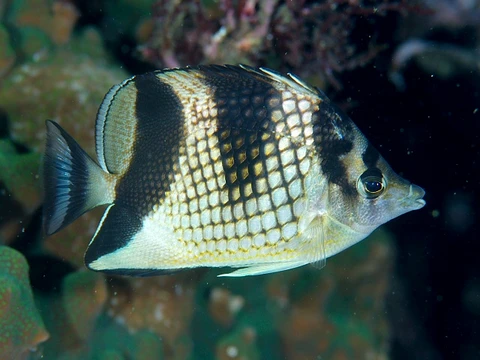
Asian butterflyfish (Chaetodon argentatus)
Source-cited species reference: taxonomy from WoRMS, biology from FishBase, occurrence map from GBIF, conservation from IUCN Red List, description from Wikipedia.

Daiju Azuma · CC BY-SA 4.0
Chaetodon argentatus, the Asian butterflyfish, three band butterflyfish or black pearlscaled butterflyfish, is a species of marine ray-finned fish a butterflyfish belonging to the family Chaetodontidae. It is native to the western Pacific Ocean.
- Scientific name
- Chaetodon argentatus
- Authority
- Smith & Radcliffe, 1911
- Family
- Chaetodontidae
- Order
- Acanthuriformes
- Maximum length
- 20 cm
- Depth range
- 5–20 m
- Habitat zone
- reef-associated
- Iucn red list
- Least Concern
- Gbif occurrence records
- 108
A Study in Pearly Contrast
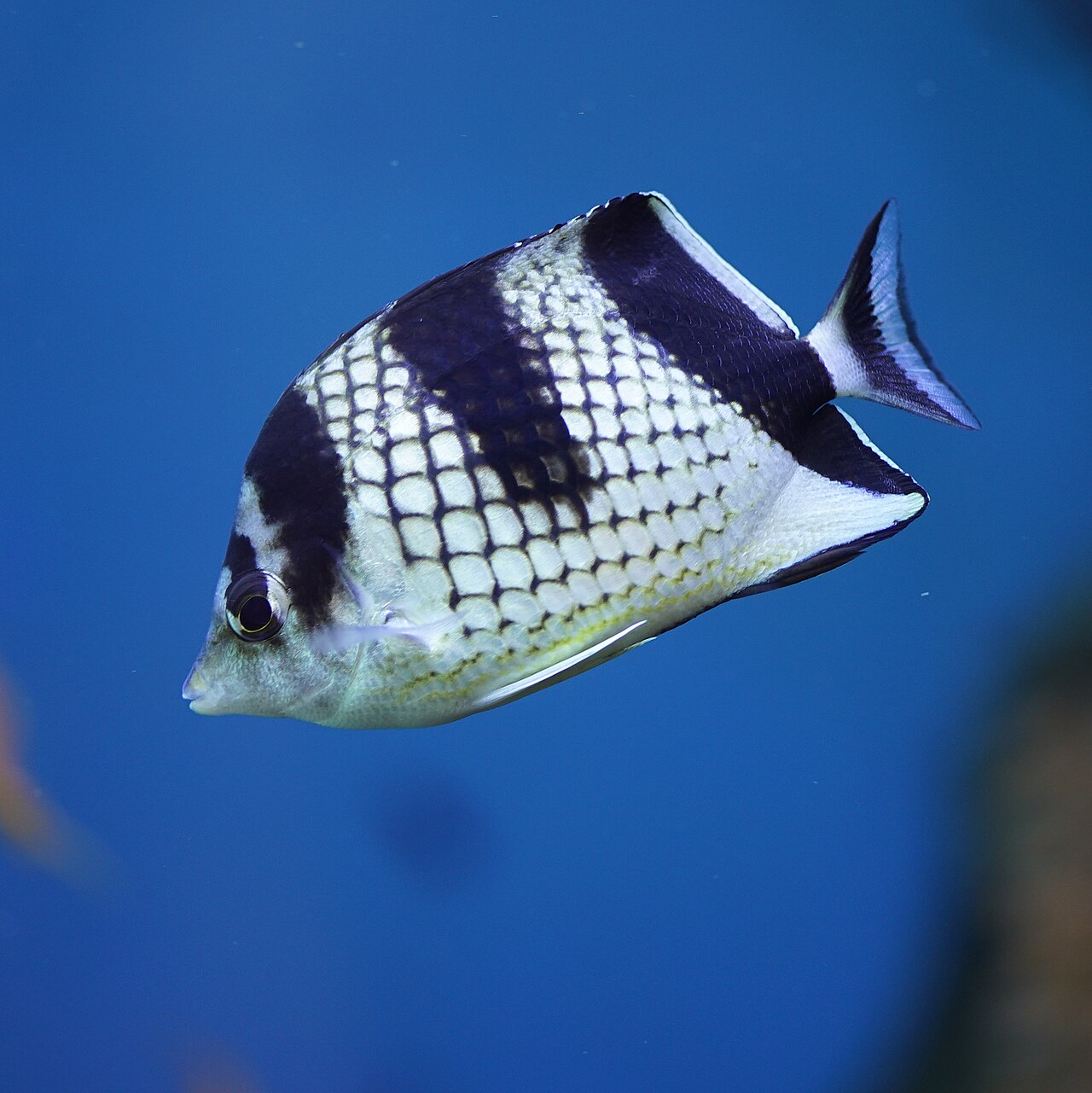
The Pearlscale butterflyfish, a ray-finned marine species within the family Chaetodontidae, is instantly recognizable by its striking cross-hatched coloration. Growing to a standard length of roughly fifteen centimetres, it shows no visible sexual dimorphism. Its body gleams in a pearly white, but each individual scale is bordered in black, producing a distinctive grid-like or cross-hatched effect along the flanks rather than the bold chevron markings seen in its close relatives. The rear portion of the body shifts to a warm orangey-yellow, while the base of the tail fin remains clean white. The head sits in a noticeably darker tone than the trunk and carries the signature markings of its lineage: bold vertical black stripes running through the eye region and a black crown spot neatly outlined in white. This combination of silvery tones, dark edging, and warm posterior hues has earned the species several common names, including yellow-tailed, crosshatch, and Philippines chevron butterflyfish.
Life on the Indo-Pacific Reefs
Native to the central Indo-Pacific, this species ranges from the waters around Indonesia and the Philippines northward to the Ryukyu Islands. It is a strictly diurnal fish, spending its active hours on clear coastal and outer reef slopes as well as steep drop-offs, typically at depths exceeding six metres. Acropora staghorn corals are a particularly favoured microhabitat. In the wild, its temperament is generally calm; individuals are encountered singly, in mated pairs, or in loose small groups. However, the Pearlscale can become aggressively territorial when confronted by species that share a similar color scheme, and it may actively harass them. Its diet in nature consists of algae, soft coral polyps, and tiny benthic invertebrates, placing it firmly among the coral-feeding members of its genus. These foraging habits, while natural, become a significant concern in captive settings where living corals are at risk of being stripped or damaged.
The Aquarium Challenge
Because of its eye-catching pearly-and-yellow palette, the Pearlscale butterflyfish has become a popular choice among marine aquarists. Keeping one successfully, however, demands careful planning. A minimum tank volume of fifty gallons is recommended, with water temperature maintained between roughly seventy-four and eighty degrees Fahrenheit. Despite its generally peaceful disposition, the species is delicate and requires tankmates that will not provoke or stress it. Compatibility with other butterflyfish is possible when their color patterns differ substantially, yet no arrangement is guaranteed to remain harmonious. If a keeper wishes to house more than one Pearlscale, all individuals must be introduced to the tank at the same time to prevent established territorial claims. Abundant live rock offering numerous hiding spots is essential for reducing stress. On the dietary front, a varied menu of mysid shrimp, brine shrimp, krill, spirulina, and algae-based preparations mirrors their natural foraging and helps prevent them from turning on living corals in the display.
A Tangled Taxonomic Story
The Pearlscale belongs to a group of butterflyfishes commonly called the crowned species, a clade of largely allopatric fish that share a remarkably consistent design: dark forward-pointing chevrons over silvery ground colour, a black-and-white crown spot, and yellow-to-red rear sections. Its closest relatives within this lineage are the Atoll, Eritrean, and Seychelles butterflyfishes, which are more closely related to one another than any of them is to C. xanthurus. Taxonomically, the group has been variously assigned to the subgenus Exornator or treated as a separate subgenus Rhombochaetodon. DNA sequence analyses have further complicated the picture by linking the crowned clade to older, more isolated lineages such as the Asian, Blue-striped, and Burgess' butterflyfishes. The latter is so morphologically unusual that it was once given its own monotypic subgenus, Roaops. Relationships to species like the Speckled and Four-spotted butterflyfishes remain unresolved, and some researchers argue that merging Rhombochaetodon and Roaops back into Exornator would be the cleanest solution, potentially elevating Exornator to full genus status if Chaetodon is ever split.
Gallery
Frequently Asked Questions
What is the Asian butterflyfish (Chaetodon argentatus)?
It is a marine ray-finned butterflyfish first described by Smith and Radcliffe in 1911, commonly called the three band butterflyfish or black pearlscaled butterflyfish. It belongs to the family Chaetodontidae within the order Acanthuriformes.
Where does the Asian butterflyfish live in the wild?
This species is native to the western Pacific Ocean, where it typically occupies reef habitats at depths ranging from 5 to 20 meters.
How big does the Asian butterflyfish (Chaetodon argentatus) get?
Adults reach a maximum total length of roughly 20 centimeters, placing it in the mid-size range among butterflyfish species.
How is the Asian butterflyfish classified taxonomically?
Its binomial name Chaetodon argentatus was established by Smith and Radcliffe in 1911, and it is placed in the family Chaetodontidae under the order Acanthuriformes.
Why is the Asian butterflyfish (Chaetodon argentatus) of interest to reef fish enthusiasts?
Its distinctive banding and dark, pearl-like coloration give it a striking appearance on western Pacific reefs, and its shallow depth range of 5 to 20 meters makes it relatively easy for recreational divers to spot.
Spotted an error? Know more?
Reader corrections go straight into our review queue. Suggest an edit · How this site is sourced