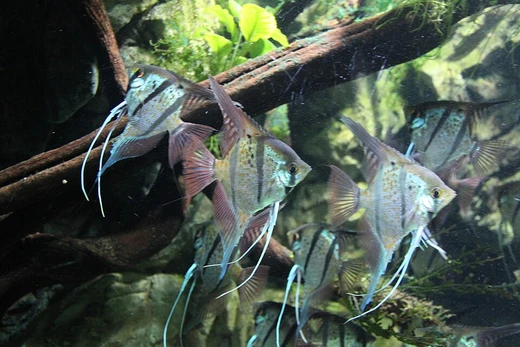
Pearlscale angelfish (Centropyge vrolikii)
Source-cited species reference: taxonomy from WoRMS, biology from FishBase, occurrence map from GBIF, conservation from IUCN Red List, description from Wikipedia.

Rickard Zerpe · CC BY 2.0
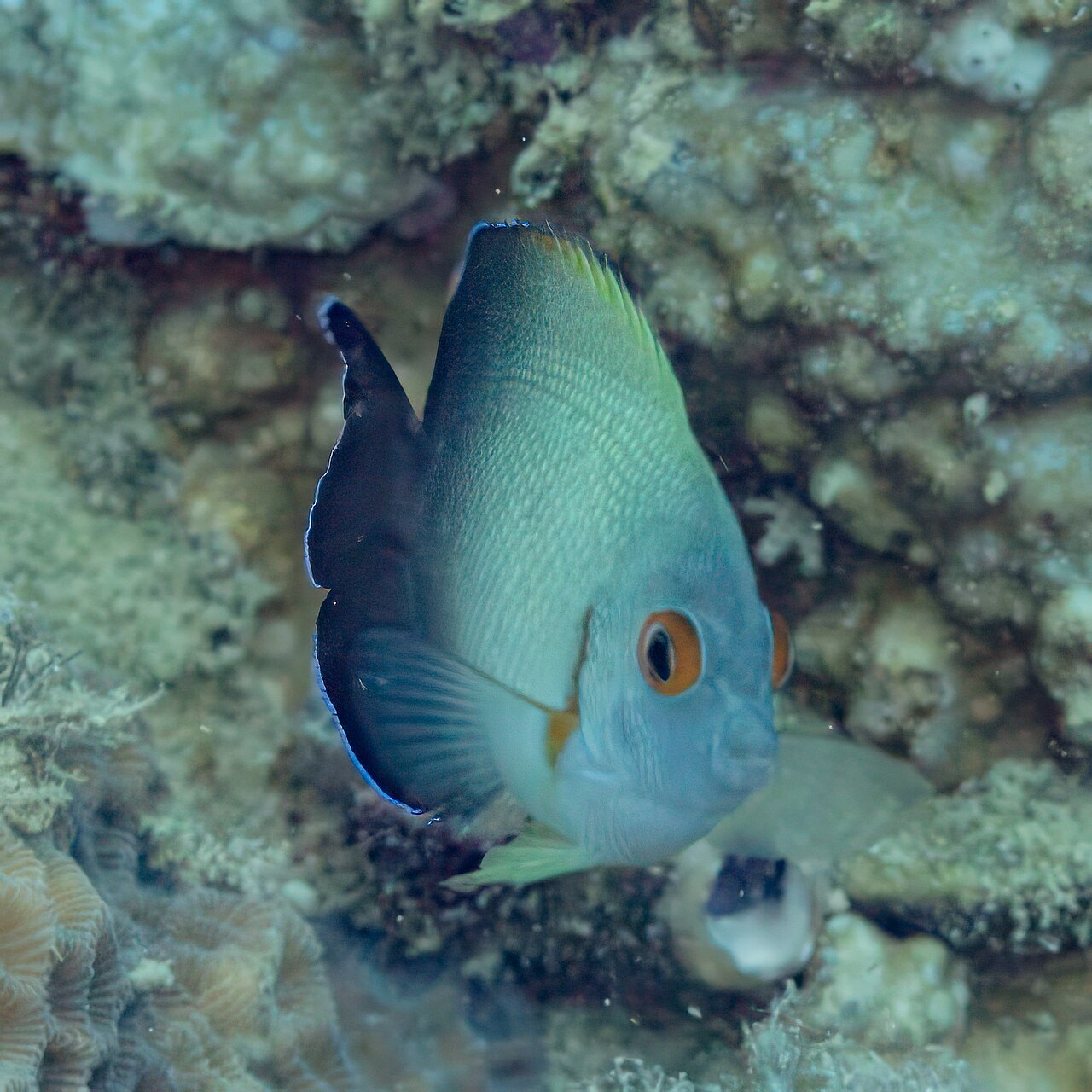
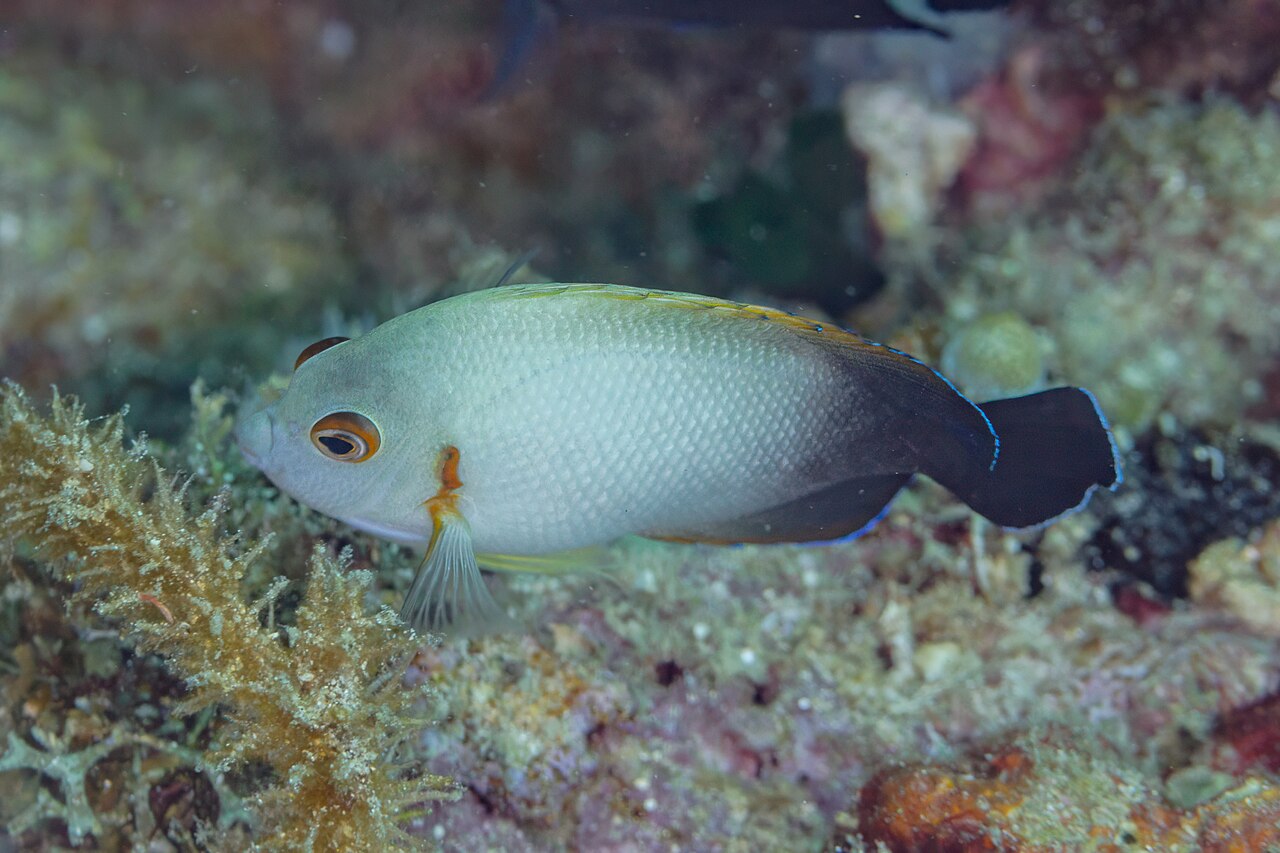
Centropyge vrolikii, known commonly as the pearlscale angelfish or half black angelfish, is a species of marine ray-finned fish, a marine angelfish belonging to the family Pomacanthidae. It is found in the Indo-Pacific.
- Scientific name
- Centropyge vrolikii
- Authority
- (Bleeker, 1853)
- Family
- Pomacanthidae
- Order
- Acanthuriformes
- Maximum length
- 12 cm
- Depth range
- 0–30 m
- Habitat zone
- reef-associated
- Iucn red list
- Least Concern
- Gbif occurrence records
- 2,332
Classification (WoRMS)
Full classification as recorded by WoRMS: Kingdom: Animalia · Phylum: Chordata · Class: Teleostei · Order: Acanthuriformes · Family: Pomacanthidae · Genus: Centropyge.
Accepted name: Centropyge vrolikii · Authority: (Bleeker, 1853) · Taxonomic status: accepted · AphiaID: 278853.
Synonyms and superseded combinations recorded for this taxon: Centropyge vrolicki (Bleeker, 1853); Centropyge vroliki (Bleeker, 1853); Holacanthus vrolikii Bleeker, 1853.
Source: World Register of Marine Species (WoRMS) — https://www.marinespecies.org/aphia.php?p=taxdetails&id=278853 (CC BY 4.0). Accessed 2026-09-23.
Biology and life history (FishBase)
Measured values published by FishBase for Centropyge vrolikii. Only fields the database actually holds for this species are shown; these are database values, not aquarium guidance.
Maximum length: 12 cm · Depth range: 0–30 m · Habitat zone: reef-associated · Body shape: short and / or deep · Vulnerability index: 10 of 100 · Fishery importance: subsistence fisheries · Aquarium trade: commercial.
FishBase notes: Inhabits lagoons and seaward reefs, mainly in coral rich areas (Ref. 1602). Feeds on algae. Oviparous (Ref. 240), monogamous (Ref. 52884). Frequently exported through the aquarium trade. Form hybrids with Centropyge eibli and C. flavissima at areas of sympatry. Mimicked by juveniles of the acanthurid Acanthurus pyroferus (Ref. 48391).
Source: FishBase species summary (SpecCode 5447) — https://www.fishbase.se/summary/Centropyge-vrolikii.html (CC BY-NC 3.0 — non-commercial use only). Accessed 2026-09-23.
Distribution and occurrence records (GBIF)
2,332 georeferenced occurrence records for Centropyge vrolikii are published through GBIF from 22 countries or marine areas. The map above plots 316 distinct locations from a sample of 2,332 records, omitting 44 inland records that carry an institution's coordinates rather than a collection site; it shows where the species has been observed and reported, not a modelled range.
Most records by country or area: Australia (1,141); Philippines (283); Indonesia (259); Palau (132); Solomon Islands (110).
The full country table, WoRMS marine regions and the sampling notes are on this species' Distribution page.
Source: GBIF Occurrence Search (taxonKey 2396509) — https://www.gbif.org/occurrence/search?taxon_key=2396509&has_coordinate=true (records CC0 / CC BY); WoRMS distribution records (MarineRegions) — https://www.marinespecies.org/aphia.php?p=taxdetails&id=278853 (CC BY 4.0); Natural Earth 110m basemap — https://www.naturalearthdata.com/ (public domain). Accessed 2026-09-23.
Conservation status (IUCN Red List)
The IUCN Red List assesses Centropyge vrolikii (Bleeker, 1853) as Least Concern (code LC). No trend, population estimate or threat analysis is given here, because none is available from this source without the Red List API; follow the source link for the full assessment, including its date.
Source: IUCN Red List of Threatened Species (taxon 165860) — https://www.iucnredlist.org/species/165860/0; GBIF IUCN Red List category endpoint (taxonKey 2396509) — https://api.gbif.org/v1/species/2396509/iucnRedListCategory. Accessed 2026-09-23.
Description and natural history (Wikipedia)
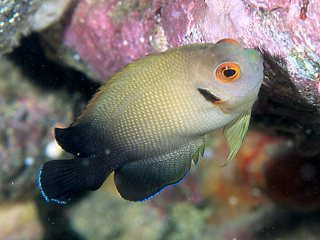
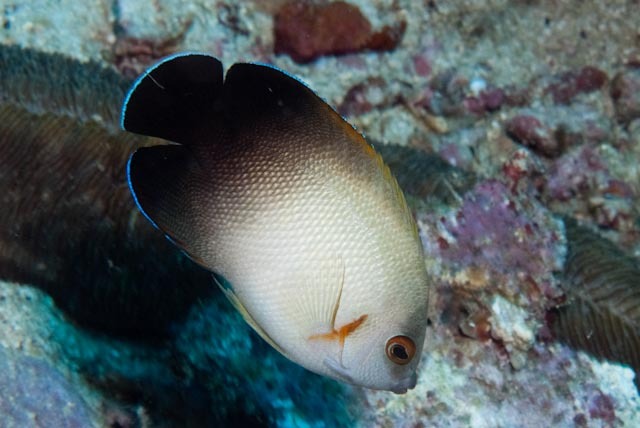
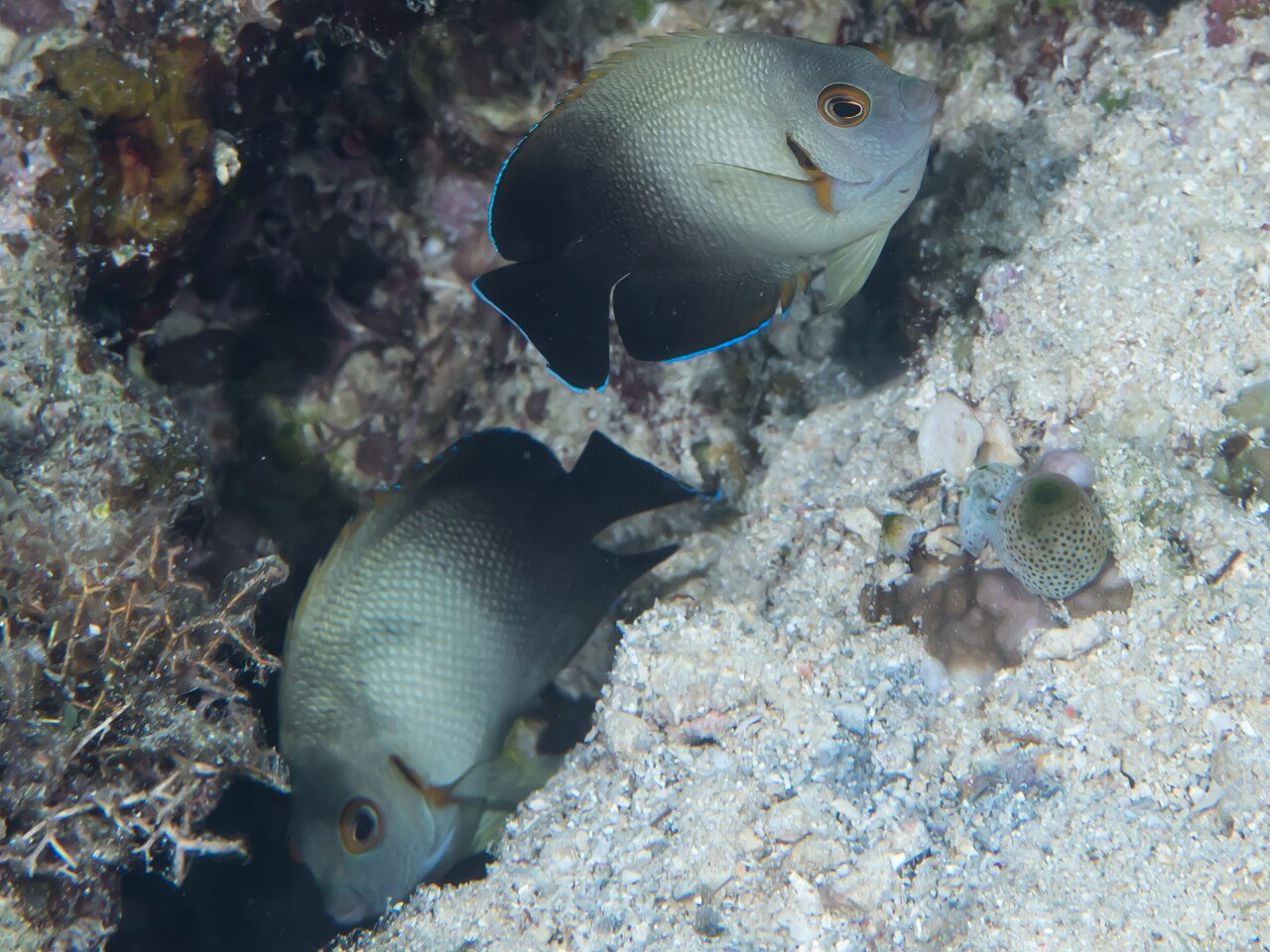
Centropyge vrolikii has a pale greyish to brownish body marked with whitish scale centres that darken to black towards the tail. The gill slit and base of the pectoral fin are orange. The caudal fin and posterior part of the dorsal and anal fins have a blue margin. The dorsal fin contains 14 spines and 15–16 soft rays while the anal fin has 3 spines and 16–17 soft rays. This species attains a maximum total length of 12 cm.
Centropyge vrolikii is found in the Indo-Pacific region. Its range extends from Christmas Island in the west to Vanuatu and the Marshall Islands in the east, north to Taiwan and south to Lord Howe Island. In continental Australia it also occurs off north-western Western Australia and on the northern parts of the Great Barrier Reef of Queensland, as far south central coast of New South Wales.
Centropyge vrolikii is found at depths between 1 and 25 m. This species is found in lagoons and seaward reefs, most frequently in areas of dense coral growth. They are common where there is a rock or rubble substrate, particularly where there is rich and varied algal and sponge growth. It is a largely herbivorous species which feeds on filamentous algae, but also on sponges. This species is able to change sex from female to male: when there is no male in a harem, one of the females changes sex. The juveniles of the mimic surgeonfish (Acanthurus pyroferus) mimic this angelfish.
Centropyge vrolikii was first formally described as Holocanthus vrolikii in 1853 by the Dutch physician, herpetologist and ichthyologist Pieter Bleeker (1819–1874) with the type locality given as Ambon Island. The specific name honours the Dutch anatomist and pathologist Willem Vrolik (1801–1863). Some authorities place this species in the subgenus Centropyge; where they are sympatric this species will hybridise with C. eibli and C. flavissima.
Centropyge vrolikii is common in the aquarium trade, but does not tolerate Ionic copper medications very well.
Source: Wikipedia: Centropyge vrolikii — https://en.wikipedia.org/wiki/Centropyge_vrolikii (CC BY-SA 4.0). Accessed 2026-09-23.
Gallery
Related in Pearlscale angelfish
Links follow this subject's own source article.
Elsewhere in Pearlscale angelfish
Spotted an error? Know more?
Reader corrections go straight into our review queue. Suggest an edit · How this site is sourced