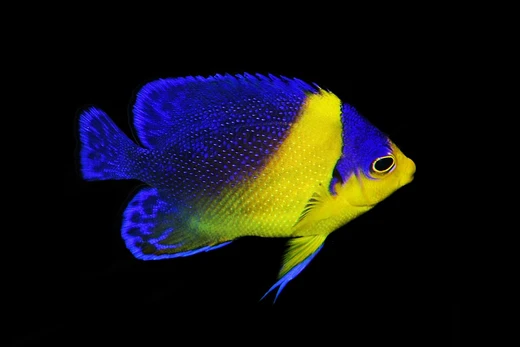
Purplemask angelfish (Centropyge venusta)
Source-cited species reference: taxonomy from WoRMS, biology from FishBase, occurrence map from GBIF, conservation from IUCN Red List, description from Wikipedia.

Centropyge venusta, the purplemask angelfish is a species of marine ray-finned fish, a marine angelfish belonging to the family Pomacanthidae, It is found in the Western Pacific and is occasionally found the aquarium trade.
- Scientific name
- Centropyge venusta
- Authority
- (Yasuda & Tominaga, 1969)
- Family
- Pomacanthidae
- Order
- Acanthuriformes
- Maximum length
- 12 cm
- Depth range
- 10–40 m
- Habitat zone
- reef-associated
- Iucn red list
- Least Concern
- Gbif occurrence records
- 39
Appearance & Physical Characteristics
The purplemask angelfish presents a striking contrast of blue and yellow across its body, though the exact arrangement shifts from one individual to another. Yellow takes command of the lower front portion of the fish and wraps around the snout region, while a distinct wedge of blue sits on the nape, acting as a divider between the yellow patches. Starting near the leading edge of the dorsal fin, a broad sweep of blue extends backward to blanket the rear section of the body and the caudal fin. The anal and pelvic fins carry a yellow base trimmed with blue edges. In terms of fin structure, the dorsal fin bears fourteen spines paired with sixteen soft rays, while the anal fin carries three spines alongside fifteen soft rays. Despite this bold coloration, the species remains modest in size, reaching a maximum total length of just twelve centimetres, roughly four and a half inches.
Distribution & Habitat
The purplemask angelfish is a creature of the western Pacific, with its known range spanning the Ryukyu Islands and the Izu Islands off southern Japan, the waters around Taiwan, and the northern reaches of Luzon in the Philippines. It inhabits depths ranging from ten to forty metres, placing it well below the surface in the dimmer, calmer zones of the reef. Behaviourally, this species is notably shy and difficult to approach. Observers typically find it tucked into caves or beneath rocky overhangs, most often as a solitary individual hanging upside down on the ceiling of its shelter. That said, it is not strictly alone for life; pairs and small groups do form. What remains a mystery is its natural diet in the wild, a gap in knowledge that persists despite the species being known to science for over five decades. In captivity, however, the requirement is clear: it must be fed live food to thrive.
Taxonomy & Discovery
The purplemask angelfish entered formal scientific record in 1969 when two Japanese ichthyologists, Fujio Yasuda and Yoshiaki Tominaga, described the species under the name Holocanthus venustus. They designated Izu Ōshima, located in Sagami Bay, as the type locality. The specific epithet venusta is Latin for "beautiful," a fitting tribute to the fish's vivid blue-and-yellow livery. Since its original description, taxonomic placement has shifted somewhat. The species now sits within the genus Centropyge, part of the angelfish family Pomacanthidae, a group of marine ray-finned fishes. Some authorities, however, prefer to slot it into the subgenus Paracentropyge, a grouping that is occasionally elevated to full genus status in the literature. This taxonomic fluidity reflects the ongoing refinement of how we classify the diverse members of the angelfish family. Despite these shifts in nomenclature, the core identity of the species—its appearance, its western Pacific range, and its cave-dwelling habits—has remained consistent since Yasuda and Tominaga first pinned it to the map of known marine life.
Aquarium Trade & Captivity
In the world of the marine aquarium, the purplemask angelfish occupies a rare and expensive niche. It is not a species one encounters on a regular basis; when specimens do surface in the trade, they command notably high prices, a clear reflection of their scarcity. On the positive side, captive breeding of Centropyge venusta has been achieved, and the species has been successfully reared in artificial settings. This is a meaningful milestone, particularly for a species whose natural diet in the wild remains entirely undocumented. In captivity, the dietary requirement is clear and non-negotiable: the fish must be provided with live food. This dependence on live prey, combined with its reclusive temperament and its characteristic upside-down orientation on cave ceilings, makes the purplemask a demanding subject for aquarists. Those who succeed in keeping it are rewarded with a small, vividly coloured fish that brings an unusual and elegant presence to the reef tank.
Frequently Asked Questions
What is the Purplemask angelfish (Centropyge venusta)?
It is a small marine angelfish in the family Pomacanthidae, originally described by Yasuda and Tominaga in 1969. The species belongs to the order Acanthuriformes and is native to the Western Pacific Ocean.
Where does the Purplemask angelfish live in the wild?
This angelfish is restricted to the Western Pacific and typically occupies reef habitats at depths ranging from about 10 to 40 meters. It is not known to occur outside that region.
How big does a Purplemask angelfish get?
Adults top out at roughly 12 centimeters in total length, placing it among the smaller members of the Pomacanthidae family.
Can I keep a Purplemask angelfish in a home aquarium?
The species does show up in the aquarium trade on occasion, though it is far from a common or widely stocked choice. Because it is a wild-caught reef fish, prospective keepers should research its specific water and dietary requirements before purchasing.
What is the full taxonomic classification of Centropyge venusta?
The Purplemask angelfish is a ray-finned fish in the family Pomacanthidae, order Acanthuriformes, with the species authority credited to Yasuda and Tominaga (1969).
Spotted an error? Know more?
Reader corrections go straight into our review queue. Suggest an edit · How this site is sourced