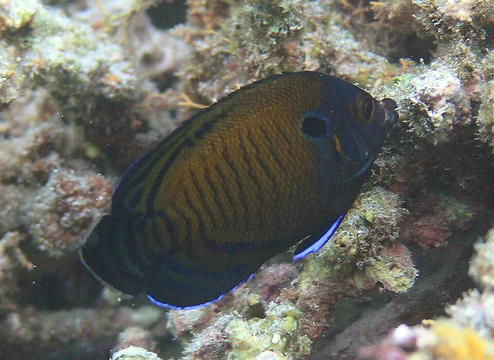
Dusky angelfish (Centropyge multispinis)
Source-cited species reference: taxonomy from WoRMS, biology from FishBase, occurrence map from GBIF, conservation from IUCN Red List, description from Wikipedia.

Centropyge multispinis, known by the common names bluefin dwarf, brown pygmy angelfish, dusky angelfish, dusky cherub, many-spined angelfish, and multispined angelfish, is a species of marine ray finned fish, a marine angelfish belonging to the family Pomacanthidae. It is found in tropical waters of the Indo-Pacific area.
- Scientific name
- Centropyge multispinis
- Authority
- (Playfair, 1867)
- Family
- Pomacanthidae
- Order
- Acanthuriformes
- Maximum length
- 14 cm
- Depth range
- 1–30 m
- Habitat zone
- reef-associated
- Iucn red list
- Least Concern
- Gbif occurrence records
- 715
Appearance and Morphology
The dusky angelfish presents a striking yet understated visual profile among its reef-dwelling relatives. Its body carries a muted, dusky base tone broken up by bold black vertical bars running along the flanks, giving the fish a striped, almost camouflaged appearance against reef rubble. The most eye-catching feature, however, is the vivid blue edging that traces the trailing edges of the dorsal and anal fins, providing a sharp chromatic contrast to the otherwise subdued palette. Structurally, the dorsal fin is armed with fourteen spines followed by fifteen to seventeen soft rays, while the anal fin carries three spines and sixteen to seventeen soft rays. The species tops out at roughly fourteen centimetres in total length, placing it firmly in the dwarf or pygmy angelfish category. This modest size, combined with its many common names—bluefin dwarf, brown pygmy angelfish, dusky cherub, many-spined angelfish, and multispined angelfish—reflects how widely it is recognised across both hobbyist and scientific communities.
Geographic Range and Habitat
The dusky angelfish is a creature of the northern and western Indian Ocean, with a distribution that stretches along the eastern African coastline, through the Red Sea, and eastward across the Indian Ocean to the waters around Thailand and Sumatra. Its presence off Madagascar remains unconfirmed, and a single record from Darwin in Australia's Northern Territory is widely regarded as a probable misidentification rather than a genuine occurrence. Within its core range, the species inhabits depths from just one metre down to thirty metres, favouring areas of broken coral rubble in the immediate vicinity of living reefs. It is not strictly confined to one microhabitat, however, and can also be encountered on lagoon reefs and along outer reef slopes. Notably, within the Indian Ocean this species ranks among the most commonly encountered members of the angelfish family, a testament to its adaptability across the varied structural niches that fringing and barrier reefs provide.
Feeding and Reproductive Biology
In terms of daily sustenance, the dusky angelfish is a relatively unspecialised forager, drawing its nutrition from a mix of algae and detritus scavenged from the reef substrate. This broad dietary flexibility likely contributes to its status as one of the most frequently seen angelfish species throughout the Indian Ocean. The species' reproductive strategy is perhaps its most biologically remarkable trait: it is a protogynous hermaphrodite, meaning every individual begins life as a female and retains the capacity to transition into a male. In practice, this sex change is triggered by social context rather than age alone. When the resident male of a group dies or is removed, one of the remaining females will undergo the transformation to assume the male role, ensuring that the breeding unit remains functional. This mechanism underscores the social cohesion of the species and highlights how reproductive plasticity can stabilise small, territory-holding reef populations.
Taxonomic History and Human Encounters
The formal scientific description of Centropyge multispinis dates to 1867, when the Scottish naturalist Lambert Playfair, who lived from 1828 to 1899, published the species with Zanzibar designated as the type locality. The specific epithet multispinis is a direct reference to the two to four small spines found on the interoperculum, a subtle anatomical detail that distinguishes this species from close relatives. Taxonomically, the species sits within the family Pomacanthidae as a marine ray-finned fish, and while it is generally placed directly in the genus Centropyge, some authorities have chosen to assign it to a subgenus bearing the same name. Despite its widespread occurrence across the Indian Ocean and its distinctive blue-finned appearance, the dusky angelfish remains an uncommon sight in the commercial aquarium trade, appearing only infrequently among the species offered to hobbyists. This relative scarcity in the pet market contrasts sharply with its abundance in the wild and may reflect both collection difficulties and the species' modest size.
Frequently Asked Questions
What is a Dusky angelfish (Centropyge multispinis)?
It is a small marine angelfish in the family Pomacanthidae, commonly encountered in the tropical reefs of the Indo-Pacific. The species was first described by Playfair back in 1867 and sits within the order Acanthuriformes.
Where can I find Dusky angelfish in the wild?
They inhabit tropical Indo-Pacific waters, typically ranging from just below the surface down to about 30 metres along reef slopes and rocky outcrops. Their 1–30 m depth range places them in the shallow, well-lit zone where most reef fish forage.
How big does a Dusky angelfish grow?
Adults top out at roughly 14 cm (about 5.5 inches) in total length, which puts them firmly in the dwarf-angelfish category. That modest size is one reason they are popular with hobbyists who want a colorful Pomacanthid without the space demands of larger angelfish.
What other common names does Centropyge multispinis go by?
Depending on the region or trade, you will see it called bluefin dwarf, brown pygmy angelfish, dusky cherub, many-spined angelfish, or multispined angelfish. All of those names refer to the same single species within the genus Centropyge.
Is the Dusky angelfish considered rare or threatened?
Its broad Indo-Pacific distribution and common presence on healthy reefs mean it is not currently flagged as a conservation concern by the IUCN Red List. FishBase and GBIF occurrence records both show it as a widespread, locally abundant reef species rather than a scarce one.
Spotted an error? Know more?
Reader corrections go straight into our review queue. Suggest an edit · How this site is sourced