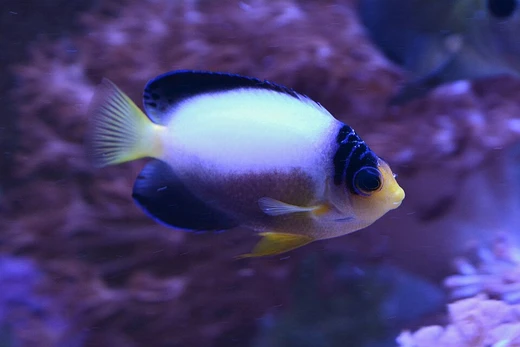
Multicolor angelfish (Centropyge multicolor)
Source-cited species reference: taxonomy from WoRMS, biology from FishBase, occurrence map from GBIF, conservation from IUCN Red List, description from Wikipedia.

Centropyge multicolor, the multicolor angelfish or pearlback angelfish, is a species of marine ray-finned fish, a marine angelfish belonging to the family Pomacanthidae. It is from the Pacific Ocean that sometimes makes its way into the aquarium trade. It grows to a size of 9 cm in length.
- Scientific name
- Centropyge multicolor
- Authority
- Randall & Wass, 1974
- Family
- Pomacanthidae
- Order
- Acanthuriformes
- Maximum length
- 9 cm
- Depth range
- 20–115 m
- Habitat zone
- reef-associated
- Iucn red list
- Least Concern
- Gbif occurrence records
- 54
A Study in Contrasting Hues
The multicolor angelfish earns its common name through a striking palette that shifts dramatically across its body. The base coloration runs from pale peach to warm orange, providing a soft canvas against which bolder accents pop. Behind the eyes, a patch of blue is scattered with small black spots, giving the head a distinctive, almost jewel-like quality. The dorsal and anal fins blaze in an intense blue, while the tail fin shifts to a vivid yellow, creating a bold color transition at the rear. Along the upper mid-flank, a silvery-white patch stretches toward the caudal fin, adding a metallic sheen that catches light in the water column. Structurally, the dorsal fin carries fourteen spines followed by sixteen or seventeen soft rays, and the anal fin bears three spines with seventeen soft rays. Despite this vivid display, the fish remains modest in size, reaching a maximum total length of just nine centimeters, or roughly three and a half inches. As a member of the family Pomacanthidae, it belongs to the broader group of marine angelfishes among the ray-finned fishes.
A Scattered Pacific Presence
The multicolor angelfish occupies a broad but fragmented range across the western and central Pacific Ocean. Its core distribution spans numerous island groups, including Palau, the Caroline Islands (recorded in both the Federated States of Micronesia and Palau), Guam, the Republic of the Marshall Islands, the Gilbert Islands of Kiribati, Fiji, Tonga, the Cook Islands, and the Society Islands in French Polynesia. Beyond this core range, the species has turned up as a vagrant in the Hawaiian Islands and at Johnston Atoll, suggesting occasional dispersal events into more distant waters. Ecologically, this is a benthopelagic species that inhabits depths between twenty and ninety meters. It favors the outer reef slopes, specifically areas where patches of rubble sit between zones of dense coral growth. This particular microhabitat likely provides both the algae it grazes and the structural complexity it needs to remain concealed, consistent with its notably shy disposition.
Harems and Shifting Sexes
In the wild, the multicolor angelfish is a notably reclusive creature, rarely putting on a bold display despite its colorful appearance. It typically moves through its environment in small social groups known as harems, consisting of three to seven individuals. Its diet is predominantly herbivorous, centered on grazing algae from the reef substrate, though it likely supplements this with small quantities of benthic animals it encounters along the way. The most remarkable aspect of its biology lies in its reproductive strategy. This species is a protogynous hermaphrodite, meaning every individual begins life as a female and retains the capacity to transition into a male later. In a harem where the dominant male is absent, one of the remaining females will undergo this sex change to assume the male role, ensuring the group's reproductive continuity. This flexible system allows the species to maintain functional breeding groups even in the absence of a permanent male, a trait well suited to the isolated reef habitats scattered across its Pacific range.
From Enewetak to the Aquarium
The scientific record of the multicolor angelfish traces back to 1974, when John E. Randall and Richard C. Wass formally described the species. The type locality they designated was an ocean reef off Rigili Islet in the Enewetak Atoll, part of the Marshall Islands. Randall, who lived from 1924 to 2020, was a prominent figure in fish taxonomy, and his collaboration with Wass on this description anchored the species firmly in the scientific literature. Taxonomically, some authorities have chosen to place this fish within the subgenus Centropyge, reflecting the ongoing refinements in how the broader angelfish family is organized. In terms of human interaction, the multicolor angelfish has entered the aquarium trade, where it is sometimes collected from the wild for hobbyist display. A particularly notable development is that the species has been successfully bred in captivity. This captive breeding capability has made the fish more readily available to enthusiasts, offering an alternative to wild collection and broadening access to this small, colorful reef dweller for the marine aquarium hobby.
Spotted an error? Know more?
Reader corrections go straight into our review queue. Suggest an edit · How this site is sourced