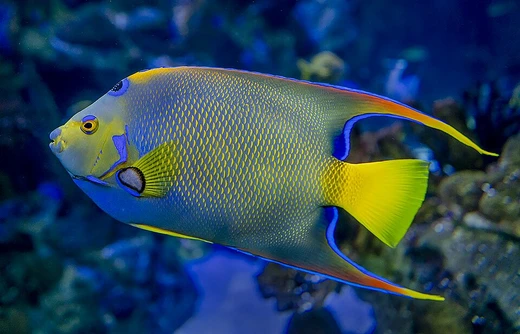
Yellow angelfish (Centropyge heraldi)
Source-cited species reference: taxonomy from WoRMS, biology from FishBase, occurrence map from GBIF, conservation from IUCN Red List, description from Wikipedia.

Centropyge heraldi, the yellow angelfish or Herald's angelfish is a species of marine ray-finned fish, a marine angelfish belonging to the family Pomacanthidae. It comes from the Pacific Ocean and sometimes makes its way into the aquarium trade.
- Scientific name
- Centropyge heraldi
- Authority
- Woods & Schultz, 1953
- Family
- Pomacanthidae
- Order
- Acanthuriformes
- Maximum length
- 12 cm
- Depth range
- 5–90 m
- Habitat zone
- reef-associated
- Iucn red list
- Least Concern
- Gbif occurrence records
- 1,471
Taxonomic Identity and the Puzzle of Classification
Centropyge heraldi, the yellow angelfish, is a ray-finned marine species placed within the family Pomacanthidae and the genus Centropyge, a group of small angelfish that do not grow beyond fifteen centimetres in length. The genus spans the Atlantic, Indian, and Pacific Oceans and currently encompasses thirty-five recognized species. Yet the taxonomic picture is far from settled. Centropyge is widely regarded as paraphyletic, meaning that other genera—Genicanthus and the polyphyletic Apolemichthys—are actually nested inside its lineage rather than standing apart from it. Within the genus, three subgenera are recognized: Xiphypops, which groups the C. acanthops species complex; Paracentropyge, home to C. boylei, C. multifasciata, and C. venusta; and the large, non-monophyletic nominate subgenus Centropyge, into which C. heraldi falls. Researchers continue to debate how to delineate species complexes within this group, and the two monophyletic subgenera have been proposed for elevation to full genus rank, a move that would further reshape the family tree.
Haremic Life and the Reversibility of Sex
Like all members of its genus, the yellow angelfish lives in a haremic social arrangement: a single dominant male presides over a group of multiple females on the reef. The sex of an individual is not fixed at birth. Centropyge species are protogynous hermaphrodites, meaning every adult begins life as a female. Should the dominant male be removed from the group, the most dominant remaining female can transform into a male in a matter of days, a remarkably rapid physiological shift. The reverse process—reverting from male back to female—is biologically possible but demands considerably more time to complete. In at least one close relative, C. ferrugata, males have been observed successfully reversing their sex change, a trait that appears unique among protogynous reef fish. Externally, the two sexes can be hard to tell apart, though females tend to be slightly shorter and display more rounded fin shapes. For C. heraldi, this fluid social and reproductive system means that the identity of the 'male' in any given group is always provisional, contingent on the hierarchy that surrounds it.
A Small Reef Dweller with a Broad Oceanic Range
Standing no taller than fifteen centimetres, Centropyge heraldi is a compact marine angelfish whose relatives occupy reef habitats across all three major tropical oceans—the Atlantic, the Indian, and the Pacific. This wide distribution underscores the genus's ecological versatility, yet each species tends to be tied to specific reef structures and depth zones. In the wild, members of Centropyge are primarily benthic feeders, grazing on algae, sponges, and small invertebrates that cling to the substrate. Their small size and specialized diet place them in a distinct ecological niche among reef fish, one that does not overlap heavily with larger angelfish or predatory species. The genus's thirty-five recognized species represent a remarkable radiation of form and colour within a constrained body size, suggesting that niche partitioning and local adaptation have driven diversification more than changes in overall scale. For C. heraldi specifically, its yellow coloration and modest stature mark it as a familiar yet understudied component of the reef community it inhabits.
Behind Glass: Keeping a Shy Reef Specialist
For the hobbyist aquarist, the yellow angelfish presents both a reward and a challenge. Centropyge species thrive best in matured reef tanks, where stable, high-quality water and abundant well-cured live rock recreate the conditions of their natural habitat. That live rock is not merely decorative; it provides a crucial supplementary food source of micro-organisms that mirrors the algae, sponges, and tiny benthic invertebrates these fish consume in the wild. Neglecting this dietary component can lead to behavioural problems, as underfed individuals may begin nipping at corals and sessile invertebrates. Behaviourally, newly introduced dwarf angels are characteristically shy, retreating into corals, caves, and crevices until they feel secure. Given an appropriately sized tank and compatible tank mates, however, they gradually establish a territory and emerge as more active, outgoing residents. Patience and a well-established system are the keys to seeing a Centropyge heraldi display its full personality behind glass.
Frequently Asked Questions
What is the Yellow angelfish (Centropyge heraldi)?
The Yellow angelfish, also called Herald's angelfish, is a small marine angelfish in the family Pomacanthidae. It belongs to the order Acanthuriformes and is a ray-finned species native to the Pacific Ocean.
Where does the Yellow angelfish live and at what depths?
Centropyge heraldi is found throughout the Pacific Ocean, inhabiting waters that range from about 5 meters down to roughly 90 meters deep. This wide depth span lets it occupy both shallow reef zones and deeper offshore habitats.
How large does the Yellow angelfish (Centropyge heraldi) get?
Adults of this species reach a maximum total length of approximately 12 centimeters, making it one of the smaller members of the angelfish family. Its compact size is one reason it occasionally appears in the marine aquarium trade.
Can I keep a Yellow angelfish in a home reef tank?
Because Centropyge heraldi sometimes enters the aquarium trade, experienced saltwater hobbyists do keep it, though it is not as commonly stocked as other Centropyge species. Prospective keepers should research its specific water parameters and temperament, as it originates from a broad Pacific depth range of 5 to 90 meters.
Who first described the Yellow angelfish and when was it named?
The species was formally described in 1953 by Woods and Schultz, who gave it the binomial name Centropyge heraldi. It has remained in the same family, Pomacanthidae, in all subsequent taxonomic revisions.
Related in Yellow angelfish
Links follow this subject's own source article.
Elsewhere in Yellow angelfish
Spotted an error? Know more?
Reader corrections go straight into our review queue. Suggest an edit · How this site is sourced